Category: Mountains & Nature

Guides to Theth, the Albanian Alps, lakes, hiking routes and nature-focused travel across Albania.

  • Permet Travel Guide: Benja Thermal Baths, Vjosa River and Southern Albania at a Slower Pace

    Permet Travel Guide: Benja Thermal Baths, Vjosa River and Southern Albania at a Slower Pace

    Përmet is one of the places I recommend when an Albania itinerary starts feeling too fast. The town sits in the Vjosa valley, surrounded by mountains, and the whole region encourages a different rhythm: thermal springs in the morning, a long lunch, a riverside walk, local sweets, rafting or a drive through the valley instead of another crowded checklist of monuments.

    It combines naturally with Gjirokastër on a southern road trip, but I would not treat it as a two-hour detour. Spend at least two nights if you want Bënja, Langarica and the town itself without feeling rushed.

    Why visit Permet?

    Përmet is known for nature, food and hospitality more than for a single blockbuster attraction. The Vjosa valley creates the setting, while thermal springs and canyons add outdoor experiences. The town itself is small and easy to walk, which makes it a good recovery stop between longer driving days.

    The official tourism page for Përmet describes the town as the “City of Roses” and highlights Bënja, Langarica Canyon, the Vjosa and regional culinary traditions. This is one destination where the surroundings are at least as important as the urban centre.

    Benja Thermal Baths

    Bënja is the best-known natural attraction near Përmet. The official tourism information for Bënja Baths places the springs along the Lengarica River at the entrance to the canyon and notes naturally warm mineral water. The historic stone bridge and mountain setting are as much a part of the experience as the pools themselves.

    Stream Hot Sulfuric Water Thermal Baths Permet Albania Langarica Canyon Kadiut Bridge 3

    Do not imagine a polished spa complex. The appeal is the open landscape and natural setting. Facilities and conditions can be simple, so bring water, sun protection, footwear that can get wet and a towel. In busy periods, arriving early makes a big difference.

    Thermal-bath etiquette and safety

    • Enter natural pools carefully because rocks can be slippery.
    • Do not treat mineral water as a substitute for medical care or repeat unverified health claims.
    • Keep soap and cosmetics out of natural water.
    • Take rubbish away with you.
    • Check river and weather conditions before exploring deeper into the canyon.

    Langarica Canyon

    The canyon begins close to the thermal area and can look deceptively easy from the entrance. Water depth, current and weather can change conditions, so I do not recommend wandering deep into a canyon after heavy rain or when storms are possible. If you want a more technical exploration, go with a reputable local guide.

    Even without a full canyon walk, the landscape around the entrance is worth the journey. The combination of stone bridge, river, cliffs and thermal pools gives you one of the most recognisable scenes in the Përmet region.

    The Vjosa River

    The Vjosa is central to the identity of the region. It remains free-flowing through long stretches and supports a complex river landscape of channels, gravel bars, forests and tributaries. In 2023 Albania declared the Vjosa a wild-river national park, and in 2025 the Vjosa Valley joined UNESCO’s network of biosphere reserves.

    For travellers, the river means rafting, viewpoints, picnics and scenery, but the protected status should also influence behaviour. Choose operators that take safety and environmental impact seriously, and avoid leaving waste or driving onto sensitive riverbanks simply because a track exists.

    Rafting and outdoor activities

    Rafting is one of the signature activities around Përmet, with conditions varying by season and water levels. I would book with an experienced local operator, ask what safety equipment is provided and disclose any medical or swimming concerns. A “family-friendly” description is not enough information if you are travelling with children; ask about the exact section of river and minimum age.

    Walk around Permet town

    Përmet itself is compact, and that is part of the charm. The riverside, small centre and City Stone can be explored without a car. I like using the town as a base where the vehicle stays parked for part of the day. After busy coastal towns, the slower pace is noticeable.

    What to eat in Permet

    Përmet is famous in Albania for food traditions, especially gliko—fruit or nuts preserved in syrup—along with regional cheeses, pies, meat dishes and locally produced drinks. Ask guesthouses and family restaurants what is made in-house. This is a place where buying a jar of local preserve can feel more meaningful than buying a generic souvenir.

    If you drink alcohol, you may encounter raki and regional wine. Treat homemade spirits with respect: strength can vary considerably, and driving after tasting is an obvious mistake.

    Where to stay in Permet

    The centre works well if you want to walk to restaurants in the evening. Rural guesthouses are better if the point of the trip is quiet, farms and mountain views. I would choose based on your morning plan: staying outside town is lovely, but it can add driving every time you want dinner or coffee.

    You can compare guesthouses and hotels in Permet on Booking.com. This is a sponsored link. I pay particular attention to road access, parking, breakfast and whether a rural property accepts card payments.

    How to reach Permet

    A rental car is the simplest way to combine Përmet with Gjirokastër, Tepelenë, Korçë or other southern destinations. Public transport exists, but a road trip gives you much more freedom to stop along the Vjosa and reach natural attractions. Driving times can be longer than the distance suggests because the route is mountainous.

    If you are building a multi-stop trip, compare the route with my Albania transport guide. I would avoid scheduling Përmet, Bënja and a long onward drive to the coast all in one day.

    Best time to visit Permet

    Spring is especially beautiful when the valley is green and river landscapes feel full of life, but higher water can also change outdoor conditions. Summer is good for warm weather and swimming, although the middle of the day can be hot. Early autumn is excellent for road trips, food and walking. Winter is quieter and requires more weather flexibility.

    A 2-day Permet itinerary

    Day 1: town and Vjosa valley

    1. Arrive before lunch and settle into your accommodation.
    2. Walk around central Përmet and the riverside.
    3. Have a regional lunch and try local products.
    4. Choose a gentle riverside outing or viewpoint in the afternoon.
    5. Enjoy dinner without another long drive.

    Day 2: Benja and Langarica

    1. Leave early for Bënja Thermal Baths.
    2. Spend time around the stone bridge and pools.
    3. Explore only a safe section of Langarica Canyon for the conditions.
    4. Return for a late lunch or add a booked rafting activity on a separate half-day.
    5. Sleep in Përmet again or continue only if the next stop is close.

    Permet or the Riviera?

    If you have a week and this is your first Albania trip, the Riviera may be the higher priority because it delivers the coastal scenery most visitors expect. If you have ten to fourteen days, adding Përmet dramatically improves the balance of the trip. It gives you river and mountain Albania rather than another night beside the sea.

    Common mistakes

    • Treating Bënja as a managed spa and arriving without practical footwear.
    • Entering canyons without considering rain and water conditions.
    • Driving too much on the same day as rafting or a long outdoor activity.
    • Skipping the town and using Përmet only as a road name on the way elsewhere.
    • Assuming every rural guesthouse accepts cards.

    Përmet is where I slow an Albania itinerary down on purpose. The reward is not one famous monument; it is the combination of river, thermal water, food and space.

    Continue west toward Gjirokastër, head east toward Korçë, or compare southern route options in my Albania itinerary guide.

    Final planning checklist

    Before publishing a final itinerary around Permet travel guide, I recheck three things: the weather, the transport for the next day and the exact location of my accommodation. These small checks prevent most avoidable problems in Albania, especially in summer when traffic is heavier and in mountain regions where conditions can change quickly.

    • Save accommodation addresses and phone numbers offline.
    • Carry some Albanian lek for small businesses and transport.
    • Confirm parking before driving into historic centres or beach resorts.
    • Download offline maps before mountain or rural days.
    • Leave margin between a long transfer and any fixed tour or ferry.

    I also avoid planning every meal, beach and café in advance. Albania is still a destination where local advice can improve the trip significantly. Guesthouse owners often know the current road condition, the best departure time or whether a supposedly quiet beach has become crowded that week.

    Is this destination suitable for a first trip to Albania?

    Yes if it fits the wider route and your interests. The mistake is not choosing the “wrong” destination; it is combining too many good destinations into too few days. Two or three well-planned bases usually create a better first trip than six rushed overnight stops.

    Do I need to book everything in advance?

    In July and August I book accommodation in popular coastal areas and any essential transport connection. Outside peak season I keep more flexibility, while still reserving special guesthouses or small properties that I would be disappointed to miss. Activities that depend on sea or mountain weather are often better confirmed closer to the day when cancellation terms allow it.

    Cash or card?

    Carry both. Cards are increasingly common in larger hotels, supermarkets and restaurants, but cash remains useful for buses, rural guesthouses, parking and small family businesses. Having a backup payment method is more important than trying to make the entire trip cashless.

    For the bigger picture, return to the Albania travel guide and use the travel-cost guide to check how this stop fits your time and budget.

    \n

    Related guide: For Benja and other bathing areas, see our guide to Albania’s thermal springs.

    Related guide: Go beyond the thermal pools with our Langarica Canyon and Benja guide.

    Related guide: For a slower mountain-road stop toward Korce, read our Leskovik guide.

    Related guide: For a cultural mountain excursion from Përmet, see our guide to Frashër village and the Frashëri Brothers museum.

    Related guide: For a forest and mountain day beyond the Vjosa valley, see our Hotova–Dangëlli National Park guide.

    \n\n

    Related guide: Kelcyra Gorge Guide: Vjosa Landscapes, Cliffs and a Southern Albania Road Stop adds a focused stop to this destination and helps build a more detailed Albania itinerary.

    \n

    Explore beyond the city: Best Day Trips from Permet: Benja, Langarica, Hotova, Frasher and the Vjosa Valley compares the most useful excursions, transport options and realistic timing.

    Local food: Permet Food Guide: Gliko, Local Dairy, Mountain Dishes and Vjosa Flavours explains regional dishes, food shopping, what to order and how to plan a food-focused day.

    Where to stay: Where to Stay in Permet: Town Center, Vjosa River, Benja and Rural Guesthouses compares the most practical areas, parking, no-car options and the best base for different types of trip.

    Only one day? 1 Day in Permet: Benja Thermal Baths, Langarica Canyon and the Vjosa Valley gives you a selective, realistic route with timing, transport and what to skip if you start late.

    Stream Hot Sulfuric Water Thermal Baths Permet Albania Langarica Canyon Kadiut Bridge

    Have three days? 3 Days in Permet: Benja Thermal Baths, Langarica Canyon and the Vjosa gives you a slower city plan plus the most logical regional excursion.

    48-hour itinerary: 2 Days in Përmet: Bënja Thermal Baths, Langarica Canyon and the Vjosa Valley.

    Driving and parking: Driving and Parking in Përmet: Town Center, Bënja Baths and Vjosa Valley explains access, parking strategy, hotel logistics and when the car is actually useful.

    Hiking: Best Hikes Near Përmet: Langarica Canyon, Hotova-Dangëlli, Leusë and Nëmërçka compares the best local walks and mountain routes by difficulty, access, season and transport.

    How long should you stay? How Many Days in Përmet? 1, 2 or 3 Days for Bënja, Langarica and the Vjosa compares one, two and three days and explains when an extra night is actually useful.

    Family travel: Permet with Kids: Benja Baths, Langarica Canyon and Family Nature Trips.

    When to go: Best Time to Visit Përmet: Bënja Baths, Vjosa, Hiking and the Best Months compares the destination month by month, including weather-sensitive activities, crowds and seasonality.

    Villages nearby: Best Villages and Small Towns Near Përmet: Leusë, Frashër, Bënjë, Leskovik and More compares the best rural and small-town escapes from this base.

    \n

    More local Albania guides

    \n\n

    More local Albania guides

    \n\n

    Arriving and leaving by bus

    \n

    For current departure points, tickets, luggage and onward connections, see the Përmet Bus Station Guide.

    Responsible travel: Sustainable Travel in Përmet: Vjosa National Park, Bënja Baths, Local Food and Responsible Nature Trips covers transport, waste, water, local spending and lower-impact choices for this destination.

    Scenic drive: Vjosa Valley Scenic Drive adds a road-trip route with viewpoints, stops and practical driving advice.

    \n

    Rural experience: Agrotourism in Përmet and the Vjosa Valley: Farm Stays, Gliko, Dairy and Slow Travel adds farm stays, local food and practical countryside planning.

  • Theth with Kids: Realistic Family Hikes, Guesthouses and Mountain Travel Tips

    Theth with Kids: Realistic Family Hikes, Guesthouses and Mountain Travel Tips

    Theth with kids can be one of the most memorable parts of Albania, but it should not be planned as a smaller version of an adult trekking trip. The village works best for families who are comfortable with mountain roads, uneven paths and changeable weather, and who are willing to make the guesthouse, valley and short walks the experience rather than measuring success by a famous hike.

    Use the main Theth and Albanian Alps guide for the full destination. This article is deliberately more conservative: it explains what families can realistically do, which classic activities need more caution, and why two relaxed nights may be better than one packed day.

    Red Bridge Along River Valbona Valley Theth National Park Albanian Alps Albania

    Is Theth suitable for children?

    Yes for many families, but not automatically for every age or itinerary. School-age children who already enjoy walking can have a fantastic time. Toddlers may enjoy the village, animals, streams and guesthouse life while being too young for longer trails. Babies can travel to Theth, but parents need to think about car seats, feeding, temperature changes and the fact that a mountain village does not offer the same immediate services as Tirana or Shkodër.

    The official Albanian tourism portal describes Theth as an alpine village in the Shala area, reached through the Tërthore Pass, with attractions including Grunas Waterfall, canyon, springs and mountain scenery. It also notes the growing network of traditional guesthouses. See the official Theth tourism page for destination background.

    The road to Theth is part of the family decision

    Modern road improvements have changed access compared with older travel reports, but families should still treat the drive as a mountain journey rather than a routine transfer. Children prone to motion sickness may find the curves difficult. Check current road and weather conditions locally, avoid driving tired and give yourself daylight for the final approach.

    If you are not comfortable driving in mountain terrain, a transfer from Shkodër may be worth the cost. The best transport choice is the one that leaves the adults calm enough to supervise children and enjoy the arrival.

    Choose a guesthouse for location, meals and family logistics

    Theth’s guesthouse experience is one of the reasons to stay overnight. Compare guesthouses in Theth and check the exact location, road access, meal options, private bathroom arrangements, heating outside summer and whether the property can prepare an early or simple meal for children.

    A beautiful guesthouse far from the village center can be perfect for adults who want quiet, but it may add extra walking every time a child needs to rest. Families should ask how long it actually takes to reach the church area, trailheads or road, not just rely on map distance.

    Theth Church and village walks: excellent low-effort activities

    The Theth Church and surrounding valley are ideal for a first afternoon. You can let children explore the landscape, photograph the peaks and get used to the terrain without committing to a major hike. The nearby Lock-in Tower can introduce older children to local history, although the theme of blood feuds requires age-appropriate explanation.

    Theth Church And Albanian Alps Albania

    This type of slow arrival matters. After several hours in a vehicle, children often need unstructured movement more than another “must-see” attraction. Save the longer walk for the following morning when everyone is rested.

    Grunas Waterfall: assess the trail on the day

    The Grunas Waterfall is one of Theth’s classic outings. The official tourism portal describes the waterfall as a protected natural monument about a 30-minute walk from the village, but that simple distance should not be treated as a guarantee that the route is easy for every child. Terrain, heat, rain and the exact starting point matter. See the official Grunas Waterfall page.

    Ask the guesthouse about current path conditions. Children should wear proper shoes, and adults should be ready to turn around if the trail is slippery or the child is tired. Reaching the waterfall is optional; a safe partial walk can still be a successful morning.

    Blue Eye of Theth: not the same as an easy village stroll

    The Blue Eye of Theth is frequently included on northern itineraries, but families should read the route carefully. It usually involves travel toward Nderlysa and walking on natural terrain. Do not assume that because the destination is called a “Blue Eye” it is equivalent to the road-accessible southern spring near Saranda.

    For strong walkers, it can be a rewarding outing. For a family with a toddler, it may mean carrying a child for significant sections. Decide based on the weakest walker and current conditions rather than on the itinerary you created months earlier.

    What about the Theth–Valbona hike?

    The Theth to Valbona hike is a proper mountain route, not a mandatory family activity. Some experienced hiking families with fit older children may complete it, but the decision should depend on mountain experience, weather, footwear, navigation and the child’s proven endurance. Do not use age alone as the safety test.

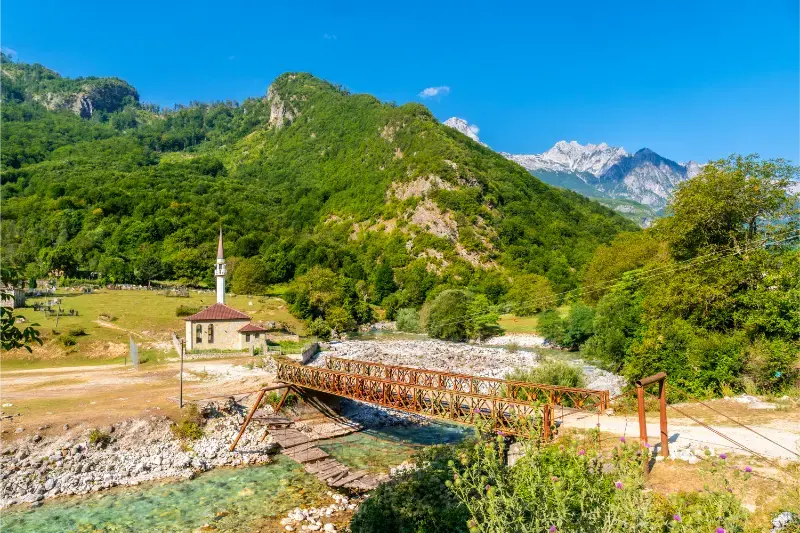
    Small Mosque Dragobi Valbona Valley Theth National Park Albanian Alps Albania

    Families who are unsure lose nothing by skipping the pass. Theth is still worthwhile for the valley, guesthouse atmosphere, short walks and waterfalls. A holiday does not become less authentic because you did not complete the most famous trail.

    Weather and clothing

    Mountain weather can differ sharply from the coast, even on the same trip. Bring layers, rain protection and shoes that can handle wet ground. In hot weather, sun exposure on open paths still matters. In shoulder seasons, cold evenings may surprise families arriving from Tirana or the Riviera.

    Check the broader Albania packing list and reduce it to the items that matter in the mountains. Carry a small first-aid kit, but do not pack so much that every walk becomes difficult.

    Food with children

    Many guesthouses serve set or semi-set meals based on local products. This can be part of the experience, but parents of selective eaters should communicate before arrival rather than expecting a custom menu at the table. Bread, cheese, yogurt, potatoes, eggs and simple meat dishes can be useful fallback foods, but availability varies by property.

    If a child has an allergy or medical dietary restriction, explain it clearly in advance and bring essential backup food. Mountain hospitality is generous, but a remote kitchen cannot always replace a specialist product at short notice.

    A gentle two-night family plan

    DayPlan
    ArrivalDrive or transfer from Shkodër, check in, church and easy village walk
    Full dayChoose Grunas Waterfall or another short route; long lunch/rest; sunset in the valley
    DepartureSlow breakfast, short walk, return toward Shkodër or continue only if the family is rested

    This plan leaves out the Blue Eye and Valbona Pass on purpose. Add one of them only if your children are strong walkers and conditions are appropriate. The mountains should feel spacious, not scheduled minute by minute.

    Strollers, carriers and young children

    A conventional stroller has limited value on rough village tracks and hiking paths. A sturdy child carrier is often more practical, but adults should already be comfortable using it on uneven terrain. Remember that carrying a child changes balance and increases fatigue; it does not turn a difficult trail into an easy one.

    Final safety mindset

    Theth rewards families who are willing to stop early. Turn around before a child is exhausted, ask locals about path conditions, avoid river edges after heavy rain and do not treat social-media viewpoints as instructions to approach exposed terrain. The best family memory may be a guesthouse dinner under the mountains, not the furthest point reached on a trail.

    Final advice

    If your children enjoy nature, give Theth time. Two nights let the journey, valley and one manageable outing become a coherent experience. If the family is already tired from a fast Albania itinerary, shorten the ambition rather than forcing the mountains into the schedule. Theth is impressive even when you do less.

    Choosing walks by effort, not by fame

    Before leaving the guesthouse, ask three questions: how long is the route in current conditions, how much climbing is involved and where can you turn around comfortably? A trail that is easy for a local adult may still be demanding for a six-year-old in heat. Families should choose the walk that fits the child’s normal activity level, not the one that appears most often on social media.

    Carry enough water and snacks to avoid a small delay becoming a problem, but keep backpacks light. Children can carry a tiny personal pack if they enjoy it, yet adults should hold essential water, clothing and first-aid items.

    River and stream safety

    Theth’s water is part of its beauty, but cold, fast mountain water deserves respect. Children should not enter streams simply because the water is clear or shallow near the edge. Flow changes after rain and stones can be slippery. Ask the guesthouse where local families consider safe for paddling and supervise at arm’s length with younger children.

    Avoid improvised crossings if water is high. Turning back is normal mountain judgment, not a failed excursion.

    What to do if the weather turns

    Mountain weather can close the gap between a pleasant walk and an uncomfortable one quickly. If rain or thunderstorms are forecast, shorten the outdoor plan and spend more time at the guesthouse or around the village. Do not begin a longer hike hoping the weather will improve.

    This is another reason to stay two nights: one poor-weather afternoon does not destroy the whole visit. Families can move the main walk to the clearer morning and still enjoy meals, conversation and valley views while conditions are less suitable.

    The value of doing nothing in Theth

    Children often enjoy the parts adults forget to put in an itinerary: watching animals, throwing stones beside a safe stream edge, helping choose dinner, drawing the mountains or simply having space to run near the guesthouse. Leave room for those moments.

    A mountain stay should feel different from city sightseeing. If every hour is assigned to a trail, viewpoint or attraction, the family may miss the very quality that makes Theth worth the journey.

  • Valbona Travel Guide: Hiking, Guesthouses and the Albanian Alps

    Valbona Travel Guide: Hiking, Guesthouses and the Albanian Alps

    Valbona Valley is the quieter counterpoint to some of Albania’s more publicized mountain stops. The valley stretches through the Albanian Alps around a cold, clear river, with guesthouses scattered beneath limestone peaks and walking routes leading toward Rragam, Dragobi and the famous pass to Theth. It is dramatic, but the best way to experience it is not to rush straight to the hardest hike.

    Red Bridge Along River Valbona Valley Theth National Park Albanian Alps Albania

    The official tourism portal describes Valbona as one of Albania’s major mountain destinations and highlights hiking, nature exploration, mountaineering and the villages of the valley. I use Valbona differently depending on the trip: as the end of the Lake Koman–Valbona route, as a two-night mountain retreat, or as one side of the classic trek to Theth.

    What makes Valbona special

    The landscape is immediately alpine: a broad stony riverbed, forested slopes and steep mountains closing the horizon. Yet the valley is inhabited and welcoming, with family-run guesthouses, restaurants and small farms. That combination matters. You can spend the morning on a serious walk, then return to a simple meal and a quiet garden rather than feeling that you are camping in complete wilderness.

    The official Valbona Valley page notes its protected status and importance for mountain tourism. Treat the protection seriously: stay on established routes, carry rubbish out, avoid disturbing wildlife and use local accommodation rather than seeing the valley only as a backdrop for a photograph.

    Getting to Valbona through Lake Koman

    The most memorable approach combines road transfers with the Lake Koman ferry to Fierza, followed by a transfer through Bajram Curri into the valley. It is not the fastest route, but it turns the journey into part of the experience. Timetables and operators can change seasonally, so book critical connections directly and confirm the pickup arrangement with your guesthouse.

    Allow buffer time. A ferry arrival followed immediately by a fixed hike is poor planning, especially if weather or traffic delays the transfer. I prefer to arrive, settle into the valley, walk locally and start a longer trail the next morning.

    Driving via Kosovo

    Some travelers reach Valbona by road through Kosovo because the route can be practical from Tirana or Pristina depending on the itinerary. If you are driving a rental car across an international border, confirm permission, insurance and documentation with the rental company in writing before departure. Do not assume every contract allows the same crossings.

    Our Albania border crossings guide and car rental guide cover the planning questions. Even when navigation apps show a quick route, mountain weather and roadworks can affect travel time.

    Easy walks before the big hikes

    You do not need to cross to Theth to enjoy Valbona. Walking along quieter roads and tracks toward Rragam, exploring sections near the river and visiting Dragobi can fill a rewarding day. Ask your host for current trail advice because water levels, landslides and seasonal conditions can change what is straightforward.

    Small Mosque Dragobi Valbona Valley Theth National Park Albanian Alps Albania

    For families or travelers who do not want a strenuous climb, the valley itself is the attraction. Plan shorter walks with generous stops, keep children away from fast water and exposed edges, and carry sun protection even when the air feels cool.

    The Valbona–Theth hike

    The pass between Valbona and Theth is one of Albania’s signature hikes, but popularity does not make it casual. It is a full mountain day with sustained climbing and descending, exposed weather and navigation decisions. Start early, carry enough water and food, and ask locally about conditions. If snow, storms or poor visibility are expected, change the plan.

    Our best hiking trails in Albania guide explains how to think about difficulty and equipment. A luggage transfer can make the crossing more comfortable, but it does not reduce the physical demands of the trail itself.

    Rragam, Dragobi and the wider valley

    Rragam is useful for getting deeper into the mountain setting and is associated with routes toward waterfalls and the pass. Dragobi has strong cultural identity and access to nearby natural features. Rather than treating these names as boxes to tick, ask your host which short routes are in good condition during your stay.

    Seasonal water makes a large difference. A waterfall that is powerful in spring may be reduced after a dry summer, while river crossings can become more difficult after heavy rain. Current local knowledge is more valuable than an old GPS track.

    Food and guesthouse culture

    A Valbona stay is as much about hospitality as hiking. Guesthouses often serve filling mountain food built around bread, dairy, vegetables, meat and regional dishes. If dinner is important, tell the host in advance because some kitchens plan portions around confirmed guests rather than operating like walk-in city restaurants.

    Carry some cash. Card acceptance is improving across Albania, but remote mountain businesses should not be treated as guaranteed card environments. Our {internal(“albania-money-atms-cards-guide”,”money and ATM guide”)} explains why a small cash reserve is useful outside major cities.

    Best season and how many nights

    Late spring to early autumn is the main period for hiking, but the exact mountain season changes with snow and weather. Summer has the most services and visitors; September can be beautiful with cooler walking temperatures. Winter is a different proposition and requires specific transport and weather planning.

    I recommend at least two nights if Valbona is more than a transport stop. Three nights are better for a relaxed hike, a valley day and flexibility for weather. One night can work after the ferry if you are crossing to Theth the next morning, but it gives you very little time to understand the place.

    Valbona planning questions

    Do you need a guide? Not for every valley walk, but a guide is valuable for unfamiliar, remote or technical routes and when conditions are uncertain. The Theth crossing is popular, yet weather and fitness still matter. A guide does not make bad conditions safe, but local knowledge can improve decisions.

    Can you visit without hiking? Absolutely. The drive, river, villages, guesthouses and short walks make Valbona worthwhile for travelers who prefer scenery to strenuous trekking. Just choose accommodation with a comfortable setting so the valley itself becomes part of the stay.

    Planning for different travel styles

    Valbona Valley can work for very different travelers, but the same plan will not suit everyone. Families usually benefit from shorter transfers, reliable meal stops and one clear activity at a time. Couples may prefer a later start and a longer lunch or sunset stop. Hikers and photographers often want early light and more time outside. Senior travelers or anyone with limited mobility should check gradients, surfaces, shade, toilets and parking before committing to the most scenic route.

    Budget travelers can keep costs controlled by using a larger nearby town as a base and making Valbona Valley a day trip, while travelers who value quiet should consider sleeping closer to the destination. The trade-off is convenience: remote stays can be atmospheric but may have fewer restaurants, ATMs, pharmacies and transport options. Decide which inconvenience you are actually happy to accept rather than choosing accommodation only because the photos look isolated.

    Build a backup plan for weather and delays

    A useful Albania itinerary always has a second version. If weather makes Valbona Valley less enjoyable or unsafe, use the day for Bajram Curri, Lake Koman and the Albanian Alps instead of forcing the original plan. Save indoor museums, long lunches, city walks and flexible drives as backup ideas. This is especially valuable on the coast, where wind can cancel boats, and in the mountains, where rain, snow or low cloud can transform an easy-looking route.

    Do not judge the entire trip by one forecast icon. Check the specific location, elevation and time of day, then ask accommodation or local operators what conditions are actually like. A destination can be clear while a pass above it is in cloud, or a city can be dry while the coast is too windy for a boat. The best decision is the one based on current local conditions rather than the plan you made weeks earlier.

    How this stop fits into a longer Albania trip

    I would connect Valbona Valley to the route rather than make a long out-and-back journey only because it appears on a must-see list. Look at where you are sleeping before and after, then group nearby places logically. Albania is compact, but mountain roads, summer traffic and city parking make repeated backtracking tiring. A one-way sequence usually gives you more real travel time than returning to the same base every night.

    Finally, protect at least one unscheduled block in every three or four travel days. Use it for laundry, a beach, a café, an extra walk or a place someone recommends locally. That empty space is not wasted. It is what lets the itinerary absorb a delayed bus, a changed boat departure or a mountain shower without turning the rest of the holiday into a chain of missed reservations.

    How to keep the plan realistic

    Valbona Valley works best when you leave margin for the parts of Albania that are hard to predict from a map: traffic, road surfaces, parking, weather and seasonal services. I prefer to build the day around one major experience, then add smaller stops only if time and conditions cooperate. That approach is especially useful when combining Bajram Curri, Lake Koman and the Albanian Alps, because the distance may look short while the real travel time is shaped by mountain roads or coastal traffic.

    For transport, arrange the mountain transfer before a tight itinerary and confirm whether your guesthouse offers pickup, especially if you arrive through the Koman–Fierza route. Save offline directions before leaving a city, carry some cash for small local expenses and avoid making a non-refundable activity the same day as a tight flight or ferry connection. In late spring, summer and early autumn, recheck conditions shortly before departure because access, boat departures, trail conditions or opening patterns can change.

    Where to stay

    The best base depends on whether this is your main destination or a side trip. Staying nearby gives you the quietest mornings and evenings, while sleeping in a larger hub creates more restaurant and transport options. Compare recent reviews, exact map location, parking or transfer details and cancellation terms rather than choosing on headline price alone. Check current accommodation on Booking.com.

    A final note before you go

    Albania is changing quickly as a travel destination, so I treat schedules and access details as information to verify rather than permanent facts. Check the latest local weather, transport and protected-area guidance close to your visit. Keep confirmations offline, tell your accommodation about late arrivals, and let current local advice override an old screenshot or social-media post.

    Most importantly, give Valbona Valley enough time to feel like a place rather than a photo stop. A slower plan creates room for a coffee, a local meal, an unexpected viewpoint or a short walk that never appears on a checklist. That is usually where the most memorable part of an Albania trip happens.

    Related cultural guide: K’cimi Dance of Tropoje Guide: Albania’s UNESCO Mountain Dance Tradition.

    Where to stay: Where to Stay in Valbona: Central Valley, Rragam, Dragobi and Mountain Guesthouses compares the most practical areas, parking, no-car options and the best base for different types of trip.

    Getting here: Shkoder to Valbona: Koman Ferry, Shuttle, Car and the Classic Alps Route compares public transport, driving and private-transfer options with arrival advice.

    48-hour itinerary: 2 Days in Valbona: Valley Walks, Mountain Views and a Relaxed Alps Stay.

    Comparing bases? Theth vs Valbona: Which Destination Should You Choose in Albania? explains the differences in atmosphere, sightseeing, transport, budget and ideal length of stay.

    Driving and parking: Driving and Parking in Valbona: Valley Road, Guesthouses and Theth Hike Logistics explains access, parking strategy, hotel logistics and when the car is actually useful.

    Tourist Walking Road Valbona Valley Enjoying Freedom Theth National Park Albanian Alps Valbona Albania

    Route planning: Tirana to Valbona: Koman Ferry Route, Direct Road, Shuttle and Car Options explains bus/shuttle, car, transfer, luggage and seasonal logistics.

    Easy excursions: Best Day Trips from Valbona: Rragam, Kukaj, Cerem, Bajram Curri and Alpine Excursions compares the most useful day trips, transport and when an overnight is better.

    Hiking: Best Hikes in Valbona: Rragam, Kukaj, Xhema Lake and the Valbona Pass compares the best local walks and mountain routes by difficulty, access, season and transport.

    Backpacking: Backpacking Theth and Valbona: Guesthouses, Hiking, Koman Ferry and Luggage Logistics covers budget stays, buses, luggage, social travel and onward route planning for independent travelers.

    Only have one day? 1 Day in Valbona: Valley Walks, River Views and a Realistic Albanian Alps Itinerary gives you a realistic morning-to-evening plan without overloading the schedule.

    Explore more of Albania beyond the main route

    More local Albania guides

    \n

    More local Albania guides

    \n\n

    More local Albania guides

    \n
  • Pogradec Boat & Kayak Guide: Lake Ohrid, Drilon, Tushemisht and Lin

    Pogradec Boat & Kayak Guide: Lake Ohrid, Drilon, Tushemisht and Lin

    Pogradec offers one of Albania’s calmest water-based travel experiences: a UNESCO-listed lake where boating, paddling and shoreline villages make sense as slow activities rather than high-speed excursions.

    The lake is ancient, biologically exceptional and shared with North Macedonia. That means I would plan water activities with more restraint than on a resort coastline. Use the Pogradec travel guide and Lake Ohrid Albania guide to understand the shoreline before deciding whether a short boat, kayak or village day fits best.

    UNESCO says the Albanian part of Lake Ohrid was added to the World Heritage property in 2019 and emphasizes the lake’s extraordinary endemic biodiversity. Albania’s official tourism site lists swimming, boating and fishing among lake activities and highlights Pogradec, Lin, Drilon and Tushemisht. See the UNESCO Lake Ohrid World Heritage page and official Albania tourism Lake Ohrid page.

    Pogradec & Lake Ohrid boat trips at a glance

    QuestionPractical answer
    Best for first-time visitorsA short local boat or calm-water kayak outing
    Best for swimmingNear Pogradec/Tushemisht on a calm day
    Best for sceneryThe broad lake panorama and mountain reflections
    Most important booking checkWind, route limits and respect for the protected lake environment
    Best seasonLate spring to early autumn; mornings are best for paddling
    Main limitationOpen-lake distance is deceptive and cross-border rules matter

    Best boat-trip options from Pogradec & Lake Ohrid

    Pogradec waterfront short boat ride

    A short outing from Pogradec is enough to appreciate the scale of Lake Ohrid and see the city from the water. It works well for families and travelers who do not want a full-day excursion.

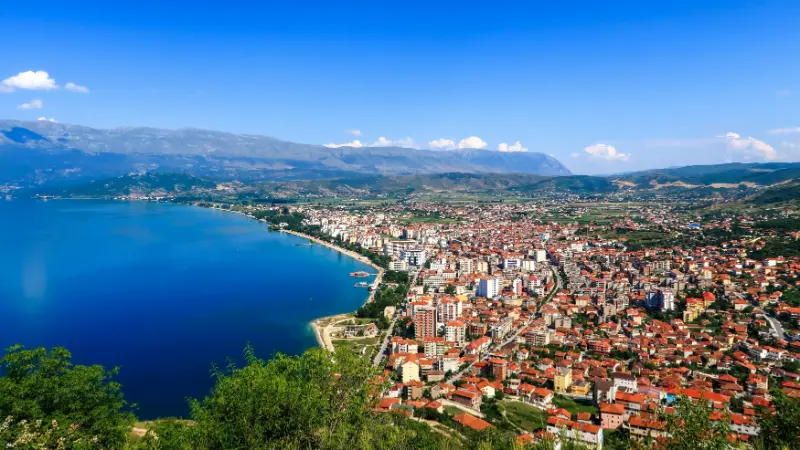
    Lake Ohrid View from Pogradec Albania

    I would choose a slow sightseeing route rather than trying to cover long distances. The lake’s character comes from water clarity, mountain views and the relationship between settlements and shore.

    Kayaking near the Albanian shore

    Calm-water paddling is one of the most fitting ways to experience Lake Ohrid. Stay close to the Albanian shoreline unless a qualified operator explicitly handles longer or cross-border routes.

    The lake can develop wind and waves, and its apparent calm from the promenade is not a guarantee. Wear a buoyancy aid and set a conservative turnaround time.

    Tushemisht and Drilon water day

    Tushemisht and Drilon combine lake access with spring-fed channels, greenery and a slower village day. The Tushemisht travel guide and Drilon Park guide help you decide which parts are better on foot and which can be enjoyed from small local boats where available.

    Do not expect a continuous boat corridor from every attraction. Think of it as a water-themed day with short boat or paddle experiences separated by walking, meals and village time.

    Lin perspective from the water

    Lin’s peninsula is part of the World Heritage landscape and has important archaeology. The Lin village guide is essential because the cultural sites themselves are on land.

    A boat view can add context to the peninsula, but I would not replace the walk to the early Christian basilica and viewpoints. Water and archaeology work best as complementary experiences.

    Where boats leave from and how to plan the departure

    Pogradec’s waterfront is the easiest place to ask about short local boat options, but schedules and availability can be informal or seasonal. Confirm the route, duration and return before paying.

    For kayaking, a lakeside hotel or rental provider may be more useful than searching for a formal excursion desk. Ask where they recommend launching based on the day’s wind.

    Do not assume you can freely cross the international lake border in a rented kayak or small boat. Albania and North Macedonia are separate jurisdictions; use authorized services for any cross-border movement.

    Shared tour or private boat?

    Large group cruises are not necessary for the Albanian side of Lake Ohrid. Small boats fit the local shoreline better.

    A kayak is ideal for active travelers who want silence and independence, but only when wind and ability match the route.

    A private small boat can work for families, photographers or travelers wanting to view Lin or the shoreline without a fixed group schedule.

    Weather, sea or lake conditions and the best time to go

    Lake Ohrid is deep and large, so wind matters. Morning is generally the best planning window for paddling because conditions can become more unsettled later.

    Lake Ohrid and Lin Village Albania

    Summer gives the warmest water and longest days, but spring and early autumn can be excellent for sightseeing and shoreline paddling. Water may feel cool even when the air is warm.

    Because the lake is a protected transboundary ecosystem, I would avoid any operator that treats high speed, close wildlife approach or careless waste as part of the entertainment.

    Swimming, snorkeling and time in the water

    Swimming is popular around Pogradec and Tushemisht, but choose recognized local swimming areas and follow current advice. The lake is deep and can remain cool.

    For kayaking, carry a waterproof phone and stay within a distance you can comfortably paddle back if the wind turns against you.

    Fishing is culturally important but regulated and ecologically sensitive. Travelers should not assume casual fishing is allowed everywhere; use local licensed guidance and avoid targeting protected or sensitive species.

    Families, older travelers and accessibility

    A short local boat is easier than a long kayak with small children. Confirm life-jacket sizes and sun shade.

    Older travelers can enjoy the water with minimal physical effort if boarding is from a stable quay. Ask about steps and whether the boat has back support.

    For reduced mobility, the Pogradec promenade and some lakeside areas are easier than steep heritage sites, but the boat boarding point should still be checked in advance.

    What I would ask before paying

    • How far from shore does the route go?
    • Are life jackets or buoyancy aids provided?
    • What wind conditions cause cancellation?
    • Is the boat operating only in Albanian waters?
    • Can the route include Lin, and how much shore time is provided?
    • Is swimming part of the trip?
    • Are children accepted, and what equipment is available?
    • How is the lake environment protected during the activity?

    A good operator should be able to answer these questions clearly before departure. I would be cautious about a booking where the meeting point, maximum group size, life-jacket policy or cancellation rules remain vague after payment. Sea and lake trips are not the place to trade basic clarity for a slightly lower headline price.

    What to bring

    • Light wind layer
    • Sun protection
    • Dry bag
    • Drinking water
    • Water shoes for shoreline stops
    • Binoculars or camera
    • Personal flotation device if renting independently and not supplied

    Even on a warm day, I keep a dry layer in the bag. The combination of deep water, breeze and wet clothing can make a return ride cooler than expected.

    Responsible travel and protected areas

    Lake Ohrid’s UNESCO status is not just a label. UNESCO describes a lake with more than 200 endemic plant and animal species and notes ongoing pressure from tourism, development and water quality. Read the UNESCO property page and treat low-impact behavior as part of the visit.

    Avoid litter, soap or sunscreen discharge directly into the lake, and do not remove shells, plants or other natural material. Stay clear of sensitive shoreline habitats and follow local restrictions.

    Where to stay for an easier boat day

    Pogradec is the best all-round base because it has the widest accommodation, promenade and dining choice. Tushemisht is quieter and works well if your priority is Drilon, swimming and a village atmosphere.

    Lin is ideal for a slow heritage stay but is less practical if you expect a large menu of rentals or daily boat departures.

    For current room availability, cancellation terms and locations, compare accommodation in Pogradec, Albania. I prefer a property that lets me walk to the departure area or reach it with one short taxi ride, especially when check-in for a boat excursion is early in the morning.

    A realistic boat-day plan

    I would paddle or take a short boat early, return for lunch in Pogradec or Tushemisht, then use the afternoon for Drilon or Lin. This creates a full lake day without spending six hours on the water.

    Pogradec And Lake Ohrid Albania

    If Lin is the priority, drive there and explore the peninsula on foot, then add a water view only if a legitimate local option fits the schedule. The archaeological landscape deserves time on land.

    Tours and activities

    When I compare guided trips, I look at the exact route, boat type, time actually spent at each stop, whether food or drinks are included, and the most recent reviews about organization and safety. The widget below is useful for checking current activities for the travel dates rather than relying on old schedules.

    Related Wonderful Albania guides

    Frequently asked questions

    Can I kayak on Lake Ohrid?

    Yes on suitable days, especially close to the Albanian shore. Wear a buoyancy aid and avoid long open-water crossings without expert guidance.

    Can I kayak to North Macedonia?

    Do not assume a recreational rental permits international crossing. Use authorized transport and border procedures for cross-border travel.

    Is the lake warm enough to swim?

    Summer swimming is popular, but the deep lake can feel cool. Use established local swimming areas and judge conditions on the day.

    Is Lin best visited by boat?

    No. A boat view is an addition; the village, peninsula walk and early Christian basilica are land experiences.

    Why does UNESCO status matter for boat trips?

    It reflects exceptional natural and cultural value, including endemic biodiversity. Low-impact boating and responsible shoreline behavior help protect the qualities people come to see.

    Pogradec is the place to slow down on the water. A short boat ride or careful kayak outing is enough to understand Lake Ohrid’s scale; the rest of the day should leave room for villages, archaeology and the quiet shoreline that make this UNESCO landscape distinctive.

    Safety checklist: Before booking, read the Boat Trip Safety in Albania guide for life jackets, weather, swimming, children and operator checks.

  • Zvernec and Narta Lagoon Guide: Monastery, Birdlife and a Quiet Vlore Escape

    Zvernec and Narta Lagoon Guide: Monastery, Birdlife and a Quiet Vlore Escape

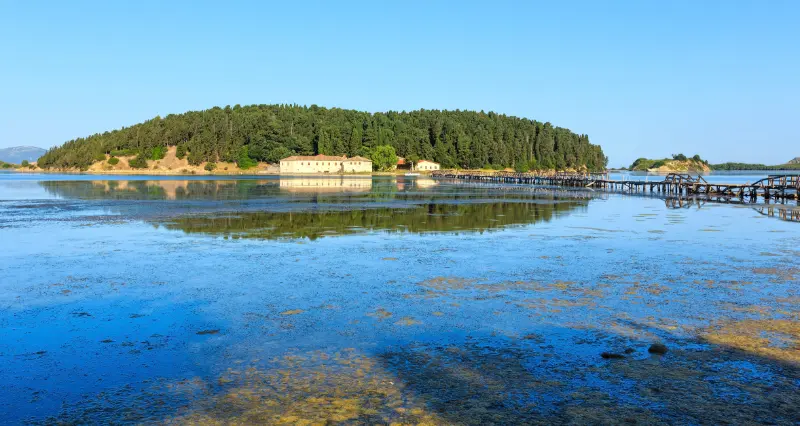
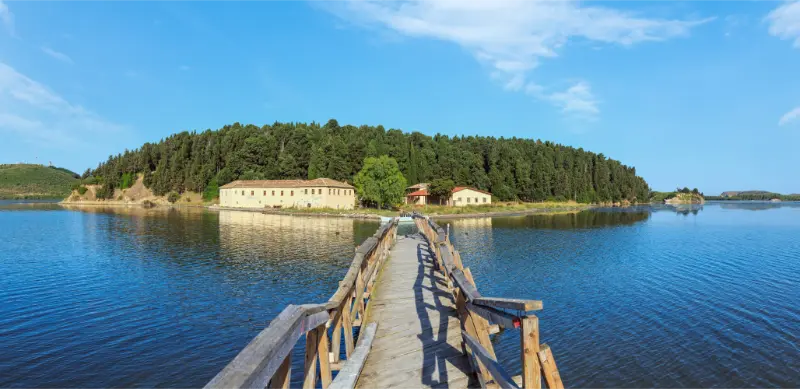
    Zvërnec and Narta Lagoon show a completely different side of the Vlorë region from the busy seafront and the Ionian road south. Here the landscape is flatter, quieter and shaped by shallow lagoon water, birdlife, pine trees and the small island that holds the Monastery of Saint Mary. It is one of the easiest places to add nature and cultural heritage to a stay in Vlorë without committing to a long excursion.

    Wooden Ruined Bridge Isolated Monastery Saint Mary Zvernec Island Narta Lagoon Vlore Albania

    The official Albanian tourism portal describes Narta as a protected natural area of ecological importance, with shallow waters and habitats for water birds; it also identifies Zvërnec Island and its Byzantine monastery as a major cultural feature inside the lagoon landscape.

    Why Zvërnec and Narta Lagoon deserves a place in an Albania itinerary

    The appeal is the combination of landscape and heritage. You can walk through a peaceful lagoon environment, cross the wooden bridge toward the wooded island, visit a historic Orthodox monastery and then continue toward the coast. It is close enough to Vlorë for an easy half-day, yet it feels removed from the city’s traffic and apartment-lined beaches.

    This is the kind of stop that works best when you understand its context. Pair it naturally with our Vlorë travel guide or the nature-focused photography guide to Albania. I would not visit only to collect a photograph and leave. Give yourself enough time to notice the landscape, local rhythm and the practical details that connect the attraction to the wider region.

    What to see and what not to rush

    The wooden bridge to Zvërnec Island is part of the experience rather than just an access route. Once on the island, the monastery gives the visit a spiritual and historical focus. Dress respectfully, keep voices low around religious spaces and remember that this is not only a tourist attraction.

    Around the lagoon, the main reward is the wider environment: reeds, salt-tolerant vegetation, open water, birds and long horizontal views. A nearby beach can complete the outing, but treat swimming conditions and beach services as seasonal rather than guaranteed.

    The most rewarding visits in Albania often happen between the headline sights: a view from a quiet road, a conversation over coffee, a village lane, a local bakery or a few minutes watching the landscape change. Leave space for those moments instead of turning the day into a race between pins on a map.

    How much time to allow

    Allow three to five hours for a relaxed visit from Vlorë, longer if you want birdwatching, photography or beach time. Early morning and later afternoon are especially pleasant because the light is softer and the open lagoon landscape is less exposed to midday heat.

    If you are driving, count parking, short detours and slower rural roads as part of the day. Distances in Albania can look small on a map while still requiring patience. I prefer one well-planned regional day to three attractions connected by constant driving.

    Getting there and moving around

    A car or taxi is the simplest option from Vlorë. Public transport is not as straightforward as on major intercity routes, so confirm any local bus information near your travel date. Roads are generally manageable, but the final approach can feel more rural than the city.

    For a wider overview, use our getting around Albania guide and, if you are driving, our car-rental and driving guide. Download offline maps, keep some Albanian lek, and save the name of your accommodation or destination in Albanian spelling as well as English.

    Best time to visit

    Spring and autumn are excellent for walking and birdlife, while summer works well if you combine the lagoon with the coast and start before the strongest heat. Winter can be atmospheric for nature lovers, although tourism services are much lighter.

    Weather matters differently depending on the setting. Archaeological sites and castles can feel exposed in summer, mountain roads can change quickly after storms, and beach destinations are much busier in July and August. Recheck current conditions near departure rather than assuming last year’s timetable or access arrangement is still valid.

    Where to stay

    Stay in Vlorë for the widest choice of accommodation, restaurants and onward transport. Zvërnec itself suits travelers who deliberately want a quieter local atmosphere rather than a full-service resort base.

    Zvernec Monastery Island Albania

    Check current accommodation on Booking.com. Check the exact map location before booking because Albanian properties sometimes use the name of the nearest famous beach, lake or town even when they sit several kilometres away. Recent reviews are especially useful for parking, road access, noise and seasonal facilities.

    Food and local atmosphere

    Vlorë is the easiest place for a broad choice of seafood and Albanian dishes. Around the lagoon and village, opening times can be more seasonal, so do not depend on finding a specific restaurant at an exact hour.

    I usually avoid building a rural day around one supposedly “must-visit” restaurant. Instead, I look for a place that is busy with local diners, read the menu and ask what is fresh. A slower lunch often adds more to the memory of a trip than squeezing in one extra viewpoint.

    Families, accessibility and comfort

    Families can enjoy the bridge, island and nature walk, but young children need supervision near water and on uneven surfaces. Bring shade and water in summer because the lagoon landscape offers less continuous cover than a city park.

    Travelers with reduced mobility should confirm the exact surface, steps, parking distance and toilet access directly with the attraction or accommodation. “Accessible by car” does not necessarily mean a historic ruin, castle, beach path or village street is step-free once you arrive.

    Safety and responsible travel

    Respect protected habitats and do not disturb nesting or feeding birds for photographs. Keep to established access, avoid entering fragile wetland areas and follow any local restrictions around the monastery and protected landscape.

    Carry water, sun protection and a small first-aid kit. Do not climb unstable walls, remove stones, carve names into ruins or leave rubbish in natural areas. Where infrastructure is light, visitors have an even greater responsibility to protect the place rather than expecting the place to absorb every kind of visitor behavior.

    What to combine with this stop

    Combine the lagoon with central Vlorë, the Independence area or a slow evening on the seafront. On another day continue toward Karaburun or the Albanian Riviera.

    The best combinations are regional. Avoid pairing two places just because each looks attractive online if the transfer between them consumes half the day. A coherent route reduces driving, gives you more time outside the car and usually produces a more enjoyable trip.

    A simple way to plan the day

    Leave Vlorë in the morning, walk to the island and monastery before the strongest heat, spend time around the lagoon, have a relaxed lunch and decide afterward whether conditions suit a nearby beach stop or a return to the city.

    Aerial View of Vlore City and Mosque Albania

    Keep the final hour flexible. If the place is quieter than expected, stay longer. If access is busy, the weather changes or a road is slower than planned, use that margin for a café, a nearby village or an early dinner. Flexibility is one of the most useful travel skills in Albania.

    Is Zvërnec and Narta Lagoon worth visiting?

    Yes, especially if you want a quieter counterpoint to the Riviera. It is not a high-adrenaline attraction; its strength is the mixture of nature, religious heritage and the calm of a lagoon landscape only a short distance from a major coastal city.

    I would include it for the experience it adds to the route, not because every traveler needs to see the same checklist. Albania rewards matching places to your interests: archaeology for history lovers, quiet villages for slow travelers, mountain landscapes for hikers, and beaches for people who want time by the water. That is the approach used throughout WonderfulAlbania.com.

    Practical details that make the visit easier

    A few small preparations make a disproportionate difference. Save an offline map before leaving your hotel, screenshot the exact parking or meeting point, and carry cash in smaller denominations. Mobile data coverage is generally useful in Albania, but valleys, rural roads and crowded summer areas are exactly where you do not want navigation to depend on a perfect signal.

    I also keep one flexible hour in the schedule. That margin absorbs traffic, roadworks, a longer lunch, a slower museum visit or a spontaneous viewpoint. Albania is compact enough to tempt travelers into overplanning, but the most enjoyable itineraries are usually the ones that leave room for the country to surprise you.

    Costs and booking strategy

    Prices vary sharply by season and by how close you are to a famous beach or attraction. Check current rates rather than copying an old budget from a forum. For accommodation, flexible cancellation can be worth paying slightly more during road trips because weather, transport and route changes are easier to manage when one reservation does not control the entire itinerary.

    For taxis, boat trips or private transfers, confirm what the quoted price includes and whether it is per person, per vehicle or for a round trip. A clear message before departure avoids most misunderstandings. Keep receipts or screenshots for important bookings and use official or well-reviewed providers for services where safety matters.

    More local Albania guides

    \n

    Birdwatching: Flamingos in Albania explains responsible viewing around Narta and other Albanian wetlands.

    Motorcycle route: Vlorë Motorcycle Day Ride: Narta Lagoon, Zvërnec, Orikum and Bay of Vlorë.

  • Theth to Valbona Hike Guide: Valbona Pass, Route Planning and Safety

    Theth to Valbona Hike Guide: Valbona Pass, Route Planning and Safety

    The hike between Theth and Valbona is the classic point-to-point walk of the Albanian Alps. It is popular for good reason: one day links two famous valleys through a high pass, with changing views, guesthouse culture and a satisfying sense of traveling through the mountains rather than driving around them.

    The official Albanian tourism portal describes the Valbona Valley as a major Albanian Alps destination and notes its natural connection with Theth through the Valbona Pass.

    Panoramic Aerial Drone View Valbona Valley Theth National Park Albanian Alps Albania 2

    Why visit the Theth to Valbona hike?

    The route turns two destinations into one coherent journey. Instead of visiting Theth and Valbona separately, you cross the mountain barrier that defines their geography and understand why the valleys feel so close on a map yet so different by road.

    Read this with our Theth guide, Valbona guide and Lake Koman ferry guide.

    What to see and do

    The Valbona Pass is the emotional high point, but the full route matters: forest, open slopes, valley views and changing mountain scale make the ascent and descent feel distinct.

    Guesthouse logistics are part of the experience. Most hikers sleep in one valley, cross with a day pack, and continue from the other side rather than returning the same way.

    Luggage transfer services can make the hike much more comfortable for travelers on a longer trip. Confirm where bags are collected and delivered, what is excluded and how delays are handled.

    How much time to allow

    Treat it as a full hiking day. Start early enough for breaks, lunch, photography and an unhurried descent. Do not build the plan around catching a tight onward transfer the same afternoon.

    I would rather plan one strong experience here than race through several stops. Albania often looks compact on a map, but mountain roads, parking, weather and photo stops can stretch travel times. Leaving a buffer usually produces a better day than trying to follow a minute-by-minute schedule.

    How to get there

    The wider route usually involves Shkodër, Theth, Valbona and often the Lake Koman ferry. Because transport chains are seasonal, confirm each leg before you begin the mountain section.

    Aerial Drone View Small Beach Turquoise River Valbona Valley Theth National Park Albanian Alps

    For the broader logistics, see our getting around Albania guide and driving and car-rental guide. Save the route offline before leaving a major town and carry some cash for small services, parking or cafés.

    Best time to go

    The safest non-winter window depends on snow conditions, not a fixed calendar date. Late spring can still hold snow on the pass, while autumn brings shorter daylight and colder weather.

    The practical rule is to check the forecast again shortly before departure. Heavy rain can change canyon and waterfall conditions, summer heat can make exposed trails unpleasant, and snow can turn an otherwise straightforward mountain route into a technical winter outing.

    Walking and outdoor conditions

    This is a real mountain hike with significant ascent and descent. Fitness, footwear, water, sun protection and navigation matter. In snow, storm or poor visibility, difficulty increases sharply.

    Use shoes with reliable grip, carry enough water, and turn around if the route becomes unclear or weather deteriorates. In remote areas, offline maps, a charged phone, a power bank and a simple message to your host about the day plan are sensible precautions.

    Where to stay

    Book guesthouses in both valleys before a busy-season hike. A good night’s sleep, breakfast and the ability to order food for the trail make a meaningful difference.

    Check current accommodation on Booking.com. Check the exact map position rather than relying only on the property name, especially in mountain and rural areas where a guesthouse can be many kilometres from the attraction that appears in its description.

    Food and local atmosphere

    Carry enough food for the day even if seasonal cafés or huts are sometimes available. Mountain businesses should be treated as a bonus unless you have confirmed they are open.

    I like to ask what is seasonal instead of arriving with a rigid list of dishes. Mountain areas are often strongest for dairy products, pies, meat, beans, potatoes, honey and herbal teas, while river and coastal regions add fish and lighter Mediterranean-style meals.

    Families and accessibility

    Strong teenagers with hiking experience may enjoy the crossing, but it is not a casual family stroll. Younger children or inexperienced walkers are better served by shorter valley hikes.

    Travelers with limited mobility should confirm the final surface, steps, slope, toilet access and distance from parking directly with the attraction or accommodation. Being reachable by road does not automatically make a castle, viewpoint, canyon or hiking trail step-free.

    Safety and responsible travel

    Do not follow a crowd blindly if weather or snow conditions look wrong. Ask your guesthouse about the pass, carry offline navigation and turn around if the route becomes unsafe.

    Respect protected-area signs, private land, archaeological remains and local residents. Do not enter unstable ruins or exposed terrain because another traveler posted a photograph from there. Take all rubbish away and avoid damaging plants, rocks or historic fabric for a photo.

    What to combine with it

    The classic sequence links Shkoder, Theth, the hike, Valbona and the Koman ferry.

    Panoramic Aerial Drone View Valbona Valley Theth National Park Albanian Alps Albania

    Regional combinations usually work best. Two nearby places connected by a short transfer create a more enjoyable day than three famous attractions separated by hours of driving. This also makes it easier to adjust if weather or access changes.

    A practical one-day plan

    Eat an early breakfast, start in cool conditions, climb steadily without racing, take a proper break at or near the pass if weather allows, then descend carefully and arrive at the next guesthouse with daylight in reserve.

    Keep at least one flexible hour. That buffer absorbs a slower road, a longer lunch, a busy trailhead or an unexpected viewpoint and prevents the whole day from feeling rushed.

    Costs and booking strategy

    The hike itself does not need to be expensive, but accommodation, transfers and optional luggage transport add up. Compare the entire route cost rather than looking only at one ticket.

    For guides, transfers or boat services, ask what is included, whether the price is per person or per group, the cancellation policy and what happens if weather conditions are unsuitable. Written confirmation is more useful than assuming a service described online operates every day of the year.

    Photography tips

    The pass delivers big landscapes, but stop fully before taking photographs on narrow or loose sections. Morning side-light and changing cloud can be more dramatic than clear midday sky.

    If you use a drone, check current national and local rules before flying. Protected areas, archaeological sites, wildlife, military infrastructure and crowded beaches can involve restrictions or legitimate privacy concerns.

    Is the Theth to Valbona hike worth adding to your Albania trip?

    Yes for reasonably fit travelers who enjoy mountain walking. It is one of the strongest single-day experiences in Albania when conditions are suitable.

    The best answer depends on the route you are already taking. A lesser-known stop can be more rewarding than another famous sight if it fits naturally between two bases and matches the way you like to travel.

    Frequently asked questions

    Which direction is better, Theth to Valbona or Valbona to Theth?

    Both are valid. Your wider transport plan, accommodation and personal preference for ascent versus descent should decide.

    How difficult is the hike?

    It is a strenuous full-day mountain walk for many visitors, with substantial elevation gain and loss. Weather and snow can increase difficulty.

    Can I send my luggage around by road?

    Seasonal luggage-transfer services are common, but confirm the provider, collection point and delivery details directly before relying on them.

    What I would check the evening before

    I recheck weather, road access and any operator message the evening before departure, then save the destination and accommodation offline. In rural Albania, the difference between an easy day and a frustrating one is often a small piece of current local information rather than more ambitious planning.

    I also make sure I have enough Albanian lek for a meal, small parking fee or guesthouse expense. Card acceptance is improving, but nature areas and villages are exactly where I would not build the day around the assumption that every terminal or ATM will work.

    What to pack for the day

    My basic day bag contains water, sun protection, a light waterproof, a warm layer, power bank and a few snacks. For mountain or canyon routes I add offline navigation and a compact first-aid kit. The exact balance changes with season, but self-sufficiency is useful whenever services are sparse.

    Good footwear is more important than technical-looking gear. Wet limestone, old castle stone, loose mountain paths and muddy forest tracks can all become slippery. Shoes with grip make the day safer and more comfortable.

    How to keep the itinerary realistic

    I plan one primary experience and treat secondary stops as optional. This is particularly useful in Albania because scenic roads invite pauses and rural access can be slower than expected. A flexible hour gives room for a coffee, a photo stop or a longer lunch without turning the schedule into a problem.

    If weather removes the main objective, I switch to a lower walk, village meal or cultural stop rather than forcing the original plan. Flexibility is one of the easiest ways to travel more safely and enjoyably in mountain and canyon regions.

  • Best Hikes Near Himarë: Gjipe Canyon, Old Himara, Llogara and Riviera Walks

    Best Hikes Near Himarë: Gjipe Canyon, Old Himara, Llogara and Riviera Walks

    Himarë is a beach base with a mountain landscape immediately behind it. That makes walking unusually rewarding: you can hike through a canyon to the sea, climb to an old hill village, or drive into Llogara for forest and ridge trails. Heat is the main practical limitation in summer, so the best Riviera hike often starts much earlier than the best beach day.

    Porto Palermo Beach Himare Albanian Riviera Panoramic 2

    This guide uses “hike” broadly enough to include easier nature walks and tougher mountain days, but it does not pretend those activities carry the same risk. Distances, weather, trail markings and access roads can change. For remote or high routes, confirm conditions locally before leaving and carry a navigation method that works offline.

    Quick comparison

    RouteDifficultyBest forAccess
    Gjipe Canyon and beach approachModerateBest signature Riviera hikeCar/taxi + walking or boat one way
    Old Himara and castle hillModerateBest short cultural hikeOn foot/taxi-assisted
    Vuno village and surrounding pathsEasy to moderateBest stone-village walkCar/bus/taxi + walking
    Llogara National Park trailsEasy to strenuous depending on routeBest mountain escape from coastal heatCar required
    Qeparo Old Village walkModerateBest quiet Riviera village climbCar/bus/taxi + walking
    Livadhi–Jalë area coastal explorationEasy to moderateBest flexible half-dayTaxi/car + short walks

    Which hike should you choose?

    If this is your first outdoor day in the area, choose the route with the simplest access and an obvious turnaround point. Save the highest or most remote objective for a day when the forecast, transport and your energy all line up. I would rather complete a shorter route comfortably than turn a holiday into a rescue problem by chasing a summit because it was on the original itinerary.

    Gjipe Canyon and beach approach

    Best signature Riviera hike. Difficulty: Moderate. Access: Car/taxi + walking or boat one way. Gjipe is the classic active day from Himarë. The canyon and beach are the attraction together, not just the final swim. Read the Gjipe Canyon and Beach guide for access. Start early, carry water and avoid entering narrow canyon sections when heavy rain or storms are a concern.

    Himare Beach Sunny Albanian Riviera Coastline

    Old Himara and castle hill

    Best short cultural hike. Difficulty: Moderate. Access: On foot/taxi-assisted. The climb from the modern coast toward Old Himara gives you village lanes, churches and sea views. Himara Castle is the natural objective. In July/August, use a taxi uphill and walk down if you want to reduce heat exposure.

    Vuno village and surrounding paths

    Best stone-village walk. Difficulty: Easy to moderate. Access: Car/bus/taxi + walking. Vuno is a strong walking stop between Himarë and Dhërmi. The Vuno Village guide helps you combine architecture with viewpoints and, for stronger hikers, access toward the Gjipe side.

    Llogara National Park trails

    Best mountain escape from coastal heat. Difficulty: Easy to strenuous depending on route. Access: Car required. Llogara gives you forest and high mountain air above the coast. Use the Llogara National Park guide and choose the trail according to current weather and ability. A coastal heatwave does not mean the ridge is wind-free.

    Qeparo Old Village walk

    Best quiet Riviera village climb. Difficulty: Moderate. Access: Car/bus/taxi + walking. Old Qeparo is a rewarding uphill cultural walk south of Himarë. The Qeparo guide explains the difference between the beach settlement and the historic village. It is best in morning or late afternoon.

    Himare Beach Sunny Albanian Riviera Coastline 2

    Livadhi–Jalë area coastal exploration

    Best flexible half-day. Difficulty: Easy to moderate. Access: Taxi/car + short walks. The bays north of Himarë invite short walking sections between viewpoints and beaches. Do not assume every coastline has a continuous public footpath; use roads and known accesses rather than crossing private property.

    Do you need a guide?

    For an obvious low-elevation walk with clear local directions, most experienced travelers can usually walk independently. A guide becomes much more valuable when the route is high, remote, poorly signed, seasonally snow-covered, canyon-based or dependent on a vehicle pickup at a different endpoint. A guide can also turn a simple walk into a better cultural/nature experience because local place names and private-land boundaries are not always obvious on online maps.

    Never use “there are reviews online” as a substitute for current conditions. A route can be straightforward in July and inappropriate after an October storm or during late spring snowmelt.

    Getting to the trailheads

    A car or taxi is useful for Gjipe, Vuno, Llogara and Qeparo. You can walk Old Himara from town, but the climb is substantial in heat.

    Best hikes for families

    Old Himara, Vuno and shorter Llogara walks are easiest with children. Gjipe works for active older children if heat and access are handled well. Avoid long exposed coastal walking at midday.

    Best time of year

    May–June and September–October are the best hiking periods. July/August can still work with dawn starts and a swim afterward. Winter/early spring are excellent for village walking, while high Llogara routes need weather checks.

    Heat, storms and mountain safety

    Start early in warm weather and carry more water than you expect to need. On exposed ridges, thunder is a reason to turn around, not an invitation to wait under the tallest tree. In canyons and near waterfalls, heavy rain upstream can change conditions even if the sky above you looks better. In the Alps and other high ranges, snow, fog and wind can make a familiar summer route a completely different undertaking.

    Tell someone where you are going when the route is remote, keep your phone charged, download offline mapping and do not count on mobile coverage. If the trail is beyond your navigation or scrambling experience, choose a local guide rather than learning those skills in a place you do not know.

    What to pack

    • Shoes with reliable grip rather than smooth city sneakers.
    • At least one extra layer, even on a warm valley day if the route gains altitude.
    • Sun protection: hat, sunscreen and sunglasses.
    • Enough water plus a small snack; do not assume every spring is safe to drink.
    • Offline map, charged phone and small power bank on longer routes.
    • Compact rain/wind shell.
    • Basic first-aid items and any personal medication.
    • Cash for rural cafés, taxis or guesthouse transfers where cards may not be practical.

    Where to stay for hiking

    Compare current accommodation in Himare on Booking.com.

    For area-by-area accommodation advice, read the local Where to Stay guide. For hiking trips I care more about early breakfast, vehicle access, luggage storage and the host’s current trail knowledge than about a small difference in room decoration.

    Guided hikes and outdoor tours

    Guided options are most useful when transport and hiking are bundled together, especially from a city base or on routes where the start and finish are different. Compare the current activity description carefully rather than assuming every tour includes the same trail or difficulty.

    How to plan a two-hike stay

    I use the first outdoor day for the easier route. That gives me a real sense of local heat, trail surfaces, driving and my own energy after travel. I put the harder objective on the second day with a backup plan. If the weather is poor, I swap the order rather than forcing the mountain day. This simple strategy is especially useful in Theth, Valbona, Tomorr, Nëmërçka and the higher Korçë/Pogradec ranges.

    Common hiking mistakes

    • Starting too late because the route looks short on a map.
    • Using road-driving time as if it were guaranteed trailhead access.
    • Following an old GPX track without checking closures, private land or changed paths.
    • Carrying too little water on exposed summer routes.
    • Treating a canyon, waterfall or river crossing as safe after heavy rain.
    • Assuming a famous high pass is snow-free because the valley is warm.
    • Wearing sandals on loose rock because the hike ends at a beach or thermal spring.
    • Booking an onward bus or flight too tightly after a mountain day.

    Official and related planning resources

    For the destination overview, see the official Albania tourism page. The national trail overview Best Hiking Trails in Albania is useful for comparing this area with the rest of the country.

    Frequently asked questions

    Can I hike here without a car?

    At least one of the routes in this guide can usually be done without owning a car, but the answer depends on your accommodation and the exact trail. City-adjacent walks are easiest; remote national-park and high-mountain trailheads often require a taxi, driver, shuttle or rental car.

    Do I need hiking boots?

    For easy dry paths, good trail shoes can be enough. For loose rock, wet canyon terrain, snow or a major mountain route, more supportive footwear is a better choice. Grip matters more than brand.

    Can I hike in July and August?

    Yes, but start early, carry substantial water and reduce exposed midday walking. Higher mountain routes may be cooler, while low canyon and coastal paths can become extremely hot.

    Is hiking safe after rain?

    It depends on the route. Rain can make stone, clay and roots slippery, and canyon or river conditions can change rapidly. Choose a lower-risk route or wait when conditions are uncertain.

    Should I download an offline map?

    Yes for anything beyond an obvious short walk. Mobile signal is not a reliable navigation strategy in mountain and canyon terrain.

    Final recommendation

    Build the hiking day around conditions rather than ambition. Choose one route that matches your transport, fitness and the forecast, start earlier than you think you need to, and keep a lower-risk alternative ready. Albania’s best outdoor experiences are not improved by rushing them.

  • Theth and the Albanian Alps Travel Guide: Hiking, Waterfalls and Mountain Villages

    Theth and the Albanian Alps Travel Guide: Hiking, Waterfalls and Mountain Villages

    Theth is the place in Albania where I most strongly feel that the journey is part of the destination. After city streets and coastal roads, the valley opens into a landscape of steep limestone mountains, scattered guesthouses, old homes and walking trails. It is also the part of a first trip where planning matters most: weather, footwear, transport and realistic hiking ability are much more important than a perfect restaurant list.

    I would give Theth at least two nights. One night barely covers the arrival and departure logistics. Two nights let you walk around the valley and choose a meaningful hike; three nights give you the flexibility that mountain weather deserves. If your broader route is still undecided, see the Albania travel guide first.

    When to visit Theth

    Late spring through early autumn is the main hiking period, but exact conditions vary by year and elevation. Snow can remain on high routes after the valley itself feels warm, and autumn weather can change quickly. I never use a generic “best month” as proof that a particular trail is safe on a particular day.

    July and August bring the most reliable summer tourism infrastructure but also more visitors and stronger midday heat on exposed trails. June and September can be excellent, with the important caveat that mountain conditions need checking locally.

    Getting to Theth

    Most first-time visitors approach from Shkodër. Road improvements have made access much easier than it once was, but the journey still deserves respect. Mountain roads can involve curves, weather and seasonal traffic. If I am not comfortable driving in those conditions, I use a local transfer or minibus rather than renting a car purely for the adventure of reaching the valley.

    The current transport options and the role of Shkodër are explained more broadly in my getting-around Albania guide. Ask your guesthouse to confirm the most reliable current transfer; mountain hosts usually know the route better than an old online timetable.

    Should you stay in Shkodër first?

    Yes, in many itineraries it makes sense. Shkodër is not only a transport hub but a city worth a night of its own. Arriving the day before a mountain transfer removes pressure if your flight or bus is delayed. It also gives you time to leave unnecessary luggage at your accommodation before heading into the Alps.

    Where to stay in Theth

    Guesthouses are part of the experience. I look for a place that clearly explains dinner, breakfast, parking or transfer arrangements and the distance to the village centre or trailheads. Theth is spread out enough that “in Theth” does not always mean the same walking convenience.

    Half-board can be practical because evening restaurant choices are more limited than in a city. A guesthouse dinner also gives you a chance to try mountain dishes and ask about current trail conditions.

    You can compare guesthouses in Theth on Booking.com. This is a sponsored link. I would prioritise recent reviews about access, meals and host communication.

    Theth village and church

    The village itself is worth walking slowly before you chase a major hike. The small church, traditional homes, river and surrounding peaks create the landscape that made Theth famous. Morning and late-afternoon light are especially beautiful, and those hours are also more comfortable for gentle walking in summer.

    Grunas Waterfall

    The waterfall is one of the classic shorter objectives from Theth. The exact route and conditions can change after rain or seasonal work, so ask locally for the best path. Even on a “short” mountain outing I take water, sun protection and footwear with proper grip.

    Blue Eye of Theth

    The Blue Eye is another popular day-hike objective in the wider valley. Depending on where you start and how much road transport you use, the effort can vary. I plan it as a real excursion, not as a quick add-on after another long hike.

    Cold water, slippery rocks and changing river conditions deserve caution. The beauty of the pool does not remove the normal risks of a mountain environment.

    The Theth–Valbona hike

    The crossing between Theth and Valbona is one of the most famous hikes in Albania, but it should not be treated as a compulsory rite of passage. Distance, ascent, heat, snow, water availability, navigation and transport logistics all matter. I would only do it with current local information and a plan that matches my fitness.

    If carrying your full travel luggage makes the route unpleasant, look into luggage-transfer options or leave unnecessary items in Shkodër. Travelling light changes the experience dramatically.

    Which direction is better?

    Both directions are used. The practical choice depends on your wider transport plan, where you sleep, and whether you are including the Lake Koman ferry and Valbona. I would design the loop from Shkodër outward, not choose the direction based only on a claim that one side is “easier.”

    Lake Koman and Valbona

    For travellers with more time, a classic northern loop can combine Shkodër, the Lake Koman ferry, Valbona, the mountain crossing and Theth. It is one of Albania’s great routes, but it requires more coordination than a simple two-night Theth stay. Boat and transfer schedules are seasonal, so lock down the key connections before booking non-refundable rooms.

    What to pack for Theth

    • Proper walking shoes: not smooth beach sandals.
    • Light layers: mountain mornings and evenings can feel very different from the coast.
    • Rain protection: even if the forecast looks good.
    • Sun protection: hat, sunscreen and sunglasses for exposed sections.
    • Water: carry enough for your route and ask locally about refill points.
    • Offline map: useful as a backup, not a substitute for current trail advice.
    • Small first-aid kit: especially for longer hikes.
    • Cash: do not assume every guesthouse or small service takes cards.

    Hiking safety

    I check the weather again on the morning of a hike and ask the guesthouse about recent conditions. A trail that was clear last week may be affected by rain, snow, rockfall or maintenance. I also tell someone where I am going and when I expect to return.

    If a route exceeds my experience, I use a local guide. Mountain travel is not the place to protect an itinerary at the expense of safety. Turning around is always a valid decision.

    Theth with children

    Families can enjoy Theth, but the trip should be built around the child rather than around adult hiking goals. Short valley walks, the village and easy scenic stops may be more enjoyable than a long exposed route. Check drop-offs, river crossings, heat and the return distance before starting.

    Food and evenings in the valley

    Evenings are one of my favourite parts of a Theth stay because the pace drops dramatically after day visitors leave. Guesthouse meals often focus on simple mountain food: bread, cheese, vegetables, meat, soups and dishes based on what is available locally. Do not expect city-level menu choice; the setting is the point.

    A 2-night Theth plan

    Day 1: Shkodër to Theth

    Travel in the morning, check in, have lunch and use the afternoon for the village, church, river and a short walk. Ask about the next day’s conditions before dinner.

    Day 2: one main hike

    Choose either a waterfall/Blue Eye outing or another hike suited to your ability. Start early, avoid stacking multiple major routes, and leave time to enjoy the guesthouse in the evening.

    Day 3: slow morning and departure

    Have breakfast, take a final short walk, then return to Shkodër or continue the northern loop. I do not schedule a tight same-day flight from Tirana after leaving Theth; too many variables can affect mountain transport.

    How Theth fits into a first Albania trip

    Theth is easiest to combine with Tirana and Shkodër. Trying to add it to a seven-day route that already includes the full Riviera creates too much transit. In my 7-day itinerary, I present alternatives so you can choose north or south rather than attempting both at full speed.

    Phones, connectivity and payments

    Mobile coverage in and around mountain valleys can be less predictable than in Tirana or the coast. I download booking details, maps and transfer contacts before leaving Shkodër. I also carry enough cash for the guesthouse, meals and small transport because card acceptance should not be assumed in every mountain business.

    A power bank is useful on long hiking days, especially if your phone is serving as camera, map and emergency contact. I keep battery use conservative and never rely on a single device as my only navigation plan.

    What to do if the weather ruins your hiking plan

    A wet or cloudy day in Theth is not automatically a wasted day. Short village walks, long meals, reading at the guesthouse and conversations with hosts can be part of the mountain experience. If conditions are unsafe for the hike you planned, do not replace it with another exposed route just to “save” the day.

    This is another reason I prefer three nights when mountains are the centrepiece of a trip. One flexible day can turn bad weather from a crisis into a simple change of plan.

    My Theth takeaway

    The best mountain itinerary is not the one with the longest hike. It is the one that leaves enough time and energy to notice where you are.

    For the rest of the country, return to the best things to do in Albania or use the transport guide to connect Shkodër and Tirana with your next stop.

    Related guide: For more routes beyond Theth, see our Albania hiking guide.

    Related guide: For a quieter alpine stop on the road toward Theth, read our Boge guide.

    Related guide: For the popular spring hike via Ndërlysaj, see our dedicated Blue Eye of Theth guide.

    Related guide: Theth Church Guide adds a focused layer to this destination, with historical context and practical visiting advice.

    Related guide: Lock-in Tower Theth Guide adds a focused layer to this destination, with historical context and practical visiting advice.

    \n\n

    Related guide: Albanian Alps Without Hiking: Scenic Villages, Drives, Ferries and Easy Views expands this topic with a broader route and practical planning advice.

    \n

    Family planning: Theth with Kids: Realistic Family Hikes, Guesthouses and Mountain Travel Tips.

    Choosing your base: Where to Stay in Theth: Village Center, Gjelaj, Nderlysa and Mountain Guesthouses compares the most practical areas, access, parking and accommodation styles for this destination.

    Aerial Drone View Rustic Homes Hotels Theth National Park Albania Albanian Alps

    Suggested itinerary: 3 Days in Theth: Waterfalls, Blue Eye, Village Life and a Realistic Hiking Plan gives you a realistic day-by-day plan with pacing, transport and optional stops.

    Getting here: Shkoder to Theth: Shuttle, Car, Private Transfer and Mountain Road Guide compares public transport, driving and private-transfer options with arrival advice.

    When to go: Best Time to Visit Theth: Hiking Season, Snow, Crowds and Trail Conditions compares every season, crowds, weather-sensitive activities and the best months for different travel styles.

    Traveling as a couple? Theth for Couples: Guesthouses, Hikes, Waterfalls and a Romantic Alps Escape covers where to stay, relaxed experiences, food, sunsets and a two-day plan.

    48-hour itinerary: 2 Days in Theth: Grunas Waterfall, Blue Eye and an Easy Albanian Alps Itinerary.

    Aerial Drone View Rustic Homes Hotels Theth National Park Albania Albanian Alps 2

    Comparing bases? Theth vs Valbona: Which Destination Should You Choose in Albania? explains the differences in atmosphere, sightseeing, transport, budget and ideal length of stay.

    Driving and parking: Driving and Parking in Theth: Mountain Road, Guesthouses and Hiking Logistics explains access, parking strategy, hotel logistics and when the car is actually useful.

    Route planning: Tirana to Theth: Shuttle, Car, Shkodër Connection and Mountain Travel Tips explains bus/shuttle, car, transfer, luggage and seasonal logistics.

    Easy excursions: Best Day Trips from Theth: Blue Eye, Nderlysa, Grunas and Mountain Excursions compares the most useful day trips, transport and when an overnight is better.

    Hiking: Best Hikes in Theth: Grunas Waterfall, Blue Eye, Valbona Pass and Easy Valley Walks compares the best local walks and mountain routes by difficulty, access, season and transport.

    Backpacking: Backpacking Theth and Valbona: Guesthouses, Hiking, Koman Ferry and Luggage Logistics covers budget stays, buses, luggage, social travel and onward route planning for independent travelers.

    Only have one day? 1 Day in Theth: A Realistic Itinerary for the Village, Grunas Waterfall and Alpine Views gives you a realistic morning-to-evening plan without overloading the schedule.

    \n

    Geology deep dive: For karst, glacial valleys and alpine-lake context, see Geology of the Albanian Alps.

    Night-sky guide: Stargazing in the Albanian Alps: Theth, Valbona and Vermosh Night-Sky Guide

    Tourist Walking Road Valbona Valley Enjoying Freedom Theth National Park Albanian Alps Valbona Albania
  • Lukovë Coastal Lakes Guide: Natural Monument, Birdlife and a Quiet Riviera Stop

    Lukovë Coastal Lakes Guide: Natural Monument, Birdlife and a Quiet Riviera Stop

    The coastal Lukovë lakes are two small natural lakes in the southern Riviera landscape, close to Lukovë and the road between Himarë and Sarandë. The official tourism portal highlights their Mediterranean setting, with low hills, olive and pine vegetation, aquatic life and seasonal use by migratory waterfowl. They should not be confused with the high-altitude Lukovë glacial lakes reached from Bishnicë near Pogradec.

    • Best for: travelers who enjoy quiet water landscapes, countryside walks and nature photography.
    • Best base: Lukovë for accommodation, food and easier transport.
    • Time needed: about 1–3 hours for a focused stop; half a day when combined with nearby villages or attractions.
    • Transport: a car, taxi or private driver gives the most flexibility outside the main towns.
    • Planning rule: treat water level, track condition, access and local restrictions as changeable details rather than permanent facts.

    Why visit Lukovë Coastal Lakes?

    These lakes are useful precisely because they are not a major attraction. They offer a quiet ecological stop between beaches and villages, showing a softer side of the Riviera where freshwater, low hills and the sea sit close together. They make most sense for slow travelers, birdwatchers, photographers and anyone already staying in Lukovë or Bunec.

    I would not build an entire Albania itinerary around this one place. The better strategy is to use it as a high-quality supporting stop inside a regional day: one strong landscape, one cultural or village visit and enough time for an unhurried meal. That is usually more satisfying than collecting five small map pins and spending most of the day in the car.

    What to expect on the ground

    Expect a real Albanian landscape rather than a polished attraction with a ticket office, marked parking bays and fixed opening hours. Signage can be limited, facilities may be absent and the best viewpoint can depend on the season, vegetation and water level. That lack of infrastructure is part of the appeal, but it also means visitors need to be self-sufficient and conservative about access.

    A common mistake is to judge small natural places from one dramatic photograph. Water can look very different after rain, during drought or under harsh midday light. I plan these stops for the overall setting and the route, not for a promise that one exact social-media angle will look the same on the day.

    How to get to Lukovë Coastal Lakes

    Use Lukovë village or the main Riviera road as your orientation point. A car is the easiest option because the final approach may involve local roads or short walks rather than a formal visitor entrance. Save the location offline and ask locally if the best access has changed; do not drive onto rough tracks merely because a map line appears to reach the shore.

    Download the destination and surrounding roads before leaving reliable mobile coverage. I also save the name in Albanian and take a screenshot of the wider map because it is easier to ask a local person for help when you can point to the correct village or road. If two navigation apps disagree, I choose the safer obvious road rather than the shortest line.

    Road, parking and navigation

    Do not assume that a line on a digital map is suitable for a rental car. Minor Albanian roads can change quickly from asphalt to gravel, narrow farm lane or rough track. Check your rental agreement before driving off paved roads, avoid deep ruts after rain and turn around early if the surface is worse than expected. A ten-minute walk from a safe parking place is better than damaging a vehicle.

    Park only where you can leave space for residents, tractors and emergency access. I avoid gateways, irrigation channels and soft verges. In small villages, a brief polite question about where to leave the car can solve the problem faster than circling with the hazard lights on.

    Best time to visit

    Spring is excellent for green vegetation and mild walking weather. Autumn and the colder months can be more interesting for birdlife. In midsummer, visit early or late to avoid heat and combine the stop with a beach day. After prolonged dry periods the visual character of small coastal water bodies can change, so expect seasonal variation.

    For most small nature stops, morning and late afternoon are easier than the hottest part of the day. The light is softer, roads are quieter and you have more margin if the approach takes longer than expected. In shoulder season I carry a light waterproof layer because a short shower can change an exposed track or riverbank surprisingly fast.

    What to do

    Keep the visit simple: walk where access is obvious, watch birds from a respectful distance, photograph the contrast between lake, olive groves and coast, then continue to Lukovë, Bunec or another nearby beach. This is not a destination for loud water sports or a long activity checklist.

    Albania Riviera Beach Coast Ionian Sea Lukove Greece Island Corfu Borsh Beach

    I prefer a simple visit with a clear purpose: one short walk, a few photographs, time to observe the landscape and then a nearby lunch or village stop. That pace leaves room to notice birds, farming, geology and local architecture instead of treating the place as a background for a quick photo.

    A practical half-day itinerary

    Start from Lukovë after breakfast and travel to the site while temperatures and traffic are still manageable. Spend enough time to explore the obvious public-access area without rushing, then continue to one of the related destinations listed later in this guide. If the road or weather is poor, reverse the order and use the small nature stop only if conditions improve.

    Keep the second half of the day flexible. Albania’s smaller attractions often work best when you can stop for a village café, roadside produce or an unexpected viewpoint without worrying about a timed reservation. I only book a fixed lunch or tour when it is the main reason for the day.

    Walking and footwear

    Even a short visit can involve loose gravel, mud, grass, uneven stone or an unprotected bank. Closed shoes with reasonable grip are more useful than sandals away from developed beaches. I carry a small daypack with water, sunscreen, a basic first-aid kit and an extra layer. Hiking poles are optional but can be useful after rain or on steep rural paths.

    If the route becomes exposed, overgrown or difficult to follow, turning back is the correct decision. A small destination is not worth pushing into unsafe terrain. Offline tracks are helpful references, but they are not proof that a path is public, maintained or currently passable.

    Photography tips

    Wide-angle compositions work well when they include the surrounding hills and Mediterranean vegetation rather than isolating the water. A polarizing filter can help with reflections, but do not trample shoreline plants to reach a cleaner foreground. Birds are best photographed with distance rather than by approaching nests or feeding areas.

    A useful approach is to take one wide establishing image, one medium landscape and several details such as reeds, rock, reflections, old walls or agricultural textures. That tells a more complete story than repeating the same panorama. I keep tripods and bags out of roads and never ask other visitors to move through unsafe ground for a picture.

    Visiting with children

    Families can treat the lakes as a short nature break rather than a full excursion. There may be limited shade, toilets or barriers, so supervision matters around water and uneven ground. Pair the visit with Lukovë village or Bunec Beach where food and a more predictable stop are easier to arrange.

    Albania Riviera Beach Coast Ionian Sea Lukove Greece Island Corfu Borsh Beach 2

    For a family day, I would combine this stop with one predictable attraction or town where you know there are toilets, shade and food. Children usually enjoy a short nature break more when it is not the third remote location of the day. A change of shoes and dry clothes in the car can be useful after muddy ground or unexpected splashes.

    Food, water and practical services

    Do not count on finding a café, public toilet or shop beside a small natural site. Carry drinking water and a snack, then spend money in the nearest village or town. If you see a local restaurant, farm shop or producer that fits the route, that is often a better way to support the area than arriving with everything purchased in a large city.

    Cash is still useful in rural Albania. I keep small-denomination lek for cafés, produce, parking where a local arrangement exists and family-run businesses. Card acceptance is improving, but a remote day should not depend on it.

    Safety around water

    Clear water is not automatically safe water. Depth, current, cold temperature, algae, submerged objects and sudden changes after rain can all create risk. I never recommend swimming simply because other people are doing it. If swimming is locally accepted, assess conditions on the day and keep children and weak swimmers especially conservative.

    After thunderstorms or prolonged rain, river and reservoir margins deserve extra caution. Fast current, soft banks and hidden debris can appear where the same place looked calm a week earlier. In hot weather, the opposite problem is dehydration and sun exposure, so carry more drinking water than the short distance might suggest.

    Responsible travel

    Small wetlands are easy to damage. Stay off fragile shore vegetation, keep dogs controlled around birds, take all litter away and avoid drones when wildlife is present. The value of the site is ecological quiet; behave as though you are visiting habitat rather than a recreational park.

    Natural places with little formal management can be damaged by only a small increase in visitors. I keep to durable ground, avoid picking plants, do not feed wildlife and leave stones or archaeological fragments where they are. If there is no bin, rubbish goes back in the car. If access is clearly private, I do not argue that a map app shows a route.

    Where to stay

    For the widest choice of accommodation and services, I would normally use Lukovë as the base for this visit. Compare current accommodation on Booking.com. On a road trip, map location matters more than a slightly lower headline price if an early start or easy parking will save time.

    For rural guesthouses, check recent reviews for road access, parking, heating or air-conditioning, breakfast times and whether the host can provide current local directions. A good local host is often the best source for last-minute information about a track, water level or temporary closure.

    Nearby places to combine with the visit

    Choose one or two of these links rather than trying to fit all of them into the same day. Driving times in Albania can be misleading when traffic, mountain roads, village stops and parking are involved. The best itinerary usually has fewer stops and more time at each one.

    Tours and local guides

    A dedicated tour to a small lake or river may not exist every day, but private regional tours can sometimes be adapted. Before booking, ask for the exact route, pickup point, walking level, vehicle type and what happens if weather or access changes. A knowledgeable local guide is most valuable when the destination has limited signage or environmental sensitivity.

    Official information and last-minute checks

    For the destination-specific facts used in this guide, see Albanian National Tourism Agency – Lukovë Lakes, Vlorë County. Official tourism pages are a useful starting point, but rural access, water levels, path condition and local restrictions can change. Recheck time-sensitive details close to departure.

    Frequently asked questions

    Is Lukovë Coastal Lakes worth visiting?

    Yes if you are already exploring the surrounding region and enjoy quiet nature, landscape photography or rural Albania. I would treat it as a complementary stop rather than a headline attraction for a very short first-time itinerary.

    Do I need a car?

    A car, taxi or prearranged driver is usually the easiest option. Public transport may reach the wider town or village, but small natural sites rarely have a convenient stop at the exact access point. If you rent a car, stay within the road-use rules of your contract.

    How long should I allow?

    For the site itself, one to three hours is normally enough. Allow half a day when you include the drive, route-finding, photographs and a nearby meal. Remote mountain locations may need more time because access is slower than the map distance suggests.

    Can I swim?

    Do not assume so. Conditions and permissions vary by place, season and water use. Reservoirs, working rivers and protected wetlands can have hazards that are not obvious from the bank. Follow current local guidance and choose safety over an unofficial online recommendation.

    Are there toilets and cafés?

    Often not at the immediate site. Use the nearest town or village for food, fuel and toilets, and carry drinking water. This is one reason I prefer combining small natural attractions with a larger nearby destination.

    Final perspective

    Lukovë Coastal Lakes is valuable because it adds detail to an Albania itinerary rather than because it competes with the country’s famous sights. Visit with realistic expectations, respect the landscape and local access, and combine it with the surrounding region. Small places are often where a road trip starts to feel personal instead of simply efficient.

    Albania Riviera Beach Coast Ionian Sea Lukove Greece Island Corfu Borsh Beach 3
  • Permet with Kids: Benja Baths, Langarica Canyon and Family Nature Trips

    Permet with Kids: Benja Baths, Langarica Canyon and Family Nature Trips

    Përmet is one of Albania’s best family bases when you want nature without turning every day into a hard hike. The town is small, food is a major part of the experience, and the Bënja Baths–Kadiu Bridge–Langarica area lets families combine water, scenery and a short outdoor adventure in one focused excursion.

    It works best for families who are comfortable with a rental car or transfer and who enjoy rivers, easy nature walks and local food. The thermal area is not a supervised swimming pool, so parents need to treat it as a natural site rather than a controlled family facility.

    Is this a good family destination?

    QuestionFamily answer
    Best forFamilies who want a manageable base with a mix of easy activities and one or two stronger excursions
    Car needed?Not always; see the transport section below
    Stroller?Useful in flatter built-up areas, but a carrier is important for historic/natural terrain
    Ideal stayUsually 2–4 nights depending on whether this is a beach/nature base or a short cultural stop
    Best family paceOne main activity in the morning, a real midday break, then one easy late-afternoon block

    Best things to do with kids

    Bënja Baths

    Best natural family highlight. The thermal springs sit beside the Langarica River and are one of the region’s signature attractions. The Bënja Thermal Baths Guide explains the site. Water depth, temperature and current can vary, so parents should assess conditions on arrival and keep young children within arm’s reach.

    Kadiu Bridge

    Best quick history-and-photo stop. The old stone bridge beside the baths gives children a clear visual landmark and breaks up the nature day. Surfaces can be uneven and slippery near water, so it is not a place for running or climbing unsupervised.

    Lower Langarica Canyon

    Best for older children who like exploration. The canyon begins near the baths and can be explored to a degree according to water and weather. The Langarica Canyon Guide is important reading. Do not turn a family outing into a canyoning challenge without appropriate conditions and expertise.

    Përmet town and the City Stone

    Best easy half-day. The town is compact enough for a slow family walk, local sweets and a relaxed meal. The City Stone is a recognizable landmark, but the climb is not necessary for every family; enjoy it from below if steps and exposure do not suit your children.

    Vjosa Valley viewpoints and riverside time

    Best for a low-pressure nature day. The Vjosa landscape is one of the reasons to stay longer than one night. Choose safe, established access points rather than pulling off randomly beside fast roads or entering river sections you have not assessed.

    Local food and gliko

    Best cultural activity that does not feel like sightseeing. Përmet is known for food traditions, including gliko preserves and regional cooking. A slow lunch, bakery stop or tasting can be one of the most successful family activities after a morning outdoors.

    Getting around as a family

    A car is strongly useful because Bënja, villages and nature areas sit outside the compact town. If you do not want to drive, arrange a taxi/driver for the key excursion instead of assuming you can improvise transport after arrival.

    With children, I calculate the whole movement rather than only the driving distance: loading the car, finding parking, walking from the parking area and returning for naps can turn a “10-minute trip” into an hour of effort. Whenever possible, cluster activities by area.

    Stroller or carrier?

    Përmet town can work with a stroller, but Bënja, the riverbank, bridge approaches and canyon terrain are carrier territory for toddlers. Bring footwear that can get wet and grip on natural surfaces.

    Stream Hot Sulfuric Water Thermal Baths Permet Albania Langarica Canyon Kadiut Bridge 3

    A lightweight stroller is still useful for airports, promenades and flatter streets. A carrier is better for cobbles, castle paths, steps, beach stones and natural terrain. Families with babies often get the most flexibility by bringing both.

    Where to stay with children

    For family trips, location matters more than a small difference in room price. I prioritize a short walk to the main daily activity, reliable air-conditioning or heating, a fridge, quiet sleeping conditions, and parking if I have a car. Read the local Where to Stay guide before booking.

    Compare family accommodation in Permet on Booking.com.

    Food, snacks and meal timing

    Albanian restaurants are generally easy to use as a family, but long summer dinners can be tiring for small children. I keep breakfast simple, carry water and a small snack, plan one proper sit-down lunch or dinner, and avoid scheduling a museum or long drive exactly when children normally eat or sleep.

    Ask about portions rather than automatically ordering a full main course for every child. Grilled meat, potatoes, rice, soups, yogurt, bread, fruit and simple pasta-style dishes are often easy choices, while regional specialties can be introduced as shared plates.

    Best time to visit with kids

    Late spring, early summer and September are excellent. Midsummer can be hot, while spring water levels and heavy rain can change canyon conditions. Winter is possible for town/food travel but outdoor family plans need more flexibility.

    What to do if it rains

    Avoid canyon exploration during or immediately after dangerous weather. Use the town, food, museum/cultural stops and a slower day instead. Natural gorges should never be treated as rainy-day attractions.

    Traveling with babies, school-age kids and teenagers

    Babies/toddlers can enjoy the town and a carefully managed Bënja visit. School-age children get more from the bridge, river and short nature walks. Teenagers can add longer hikes or guided rafting when age, operator rules and river conditions fit.

    Family safety: the practical issues

    • Keep children close around castle walls, cliff edges, rivers and unsupervised natural swimming areas.
    • Never assume a beach or river has a lifeguard just because it is popular.
    • Use appropriate child restraints in rental cars and arrange seats before arrival.
    • Protect the midday period from extreme summer heat; shade and hydration are part of the itinerary.
    • On pebbly beaches, water shoes can make entry easier and reduce slipping.
    • Do not turn a mountain, canyon or boat activity into a family outing without checking weather and age suitability.

    A realistic 2-day family plan

    • Day 1: explore Përmet town, local food and easy Vjosa viewpoints, keeping the afternoon relaxed.
    • Day 2: go early to Bënja Baths, see Kadiu Bridge and explore only the safe lower canyon section appropriate for your family.

    If you only have one day

    Use the 1 Day in Permet itinerary as the base, then remove one stop rather than adding more. Family travel improves when the schedule has space for snacks, toilets, naps and an unplanned break.

    Stream Hot Sulfuric Water Thermal Baths Permet Albania Langarica Canyon Kadiut Bridge

    Best family day trips

    For a wider regional plan, see the best day trips from Permet. With younger children, I usually choose the closest high-value excursion rather than the most famous one on the map.

    What to pack for this destination

    • Sun hats, high-SPF sunscreen and refillable water bottles in warm months.
    • A lightweight rain layer in shoulder season.
    • Comfortable shoes with grip for old towns, castles and nature areas.
    • Water shoes for pebble/stone beaches or natural bathing areas where useful.
    • A compact stroller plus carrier if traveling with a baby or toddler.
    • Basic medication, plasters and any child-specific items you do not want to search for late at night.

    Book family activities selectively

    Tours can be useful when they replace difficult transport or give a child-friendly structure to a complex site. I would not book every day in advance; leave free time for weather, tiredness and beach conditions.

    Useful related guides

    Official tourism information

    For current destination descriptions and official attraction information, see the Albania National Tourism Agency. For opening hours, tickets, beach management and seasonal transport, verify the current information again close to your travel date.

    Common family mistakes

    • Changing accommodation every night instead of using two- or three-night bases.
    • Planning long sightseeing blocks during the hottest hours of summer.
    • Assuming a stroller works on cobbles, ruins, dunes or canyon paths.
    • Choosing accommodation by price without checking the actual walk to the beach or parking.
    • Treating natural water—sea, river, spring or canyon—as if it were a supervised pool.
    • Adding several day trips because the map distances look short.

    Frequently asked questions

    Is Permet good for children?

    Yes, especially for families who like nature, food and a slower small-town base.

    Are Benja Baths a normal swimming pool?

    No. They are natural thermal springs, so supervision and current conditions matter.

    Do we need a car?

    A car or pre-arranged driver makes family travel much easier.

    Can toddlers visit Langarica Canyon?

    They can visit the lower area with close supervision, but a canyon hike is not a toddler activity.

    How many nights?

    Two or three nights give families enough time without rushing the nature day.

    Final family advice

    The best family version of Permet is usually slower than an adults-only itinerary. Choose the right base, protect the midday rest, make one activity the priority of each half-day and keep a backup plan for weather. Children remember swimming, food, castles, animals and small discoveries more than the number of attractions you managed to tick off.