
Albania’s UNESCO World Heritage story is unusually varied for a small country. It includes an ancient archaeological city, two historic Ottoman-era urban centers grouped in one property, a transboundary lake landscape and components of a vast European beech-forest property. That mix means a UNESCO-focused trip is not only about monuments: it can move from stone houses and ruins to lakes and protected forest.
According to UNESCO’s official Albania page, Albania currently has four properties inscribed on the World Heritage List. Two are cultural, one is natural and one is mixed. UNESCO also lists four Albanian sites on the Tentative List, which means they are being considered for possible future nomination but are not currently World Heritage properties.
Butrint
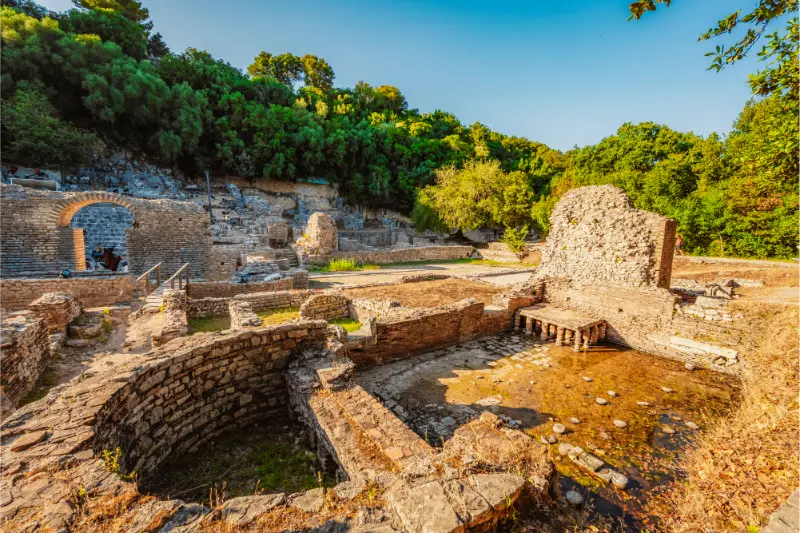
Butrint is Albania’s best-known archaeological World Heritage site and one of the easiest places to combine culture with a coastal holiday. Layers of Greek, Roman, Byzantine and later history occupy a green peninsula near Ksamil. The theater, baptistery, city walls and surrounding wetland landscape make the site much richer than a collection of isolated ruins.

Use our Butrint guide for practical visiting advice. I would arrive early in summer, carry water and allow enough time to walk beyond the first monuments. Treat the site as archaeology in a natural setting rather than a quick photo stop on the way back from Ksamil.
Historic Centres of Berat and Gjirokastra
Berat and Gjirokastër share one UNESCO property but should not be treated as interchangeable towns. Berat climbs around the Osum River with Mangalem, Gorica and a still-inhabited castle quarter. Gjirokastër is steeper and more monumental, with slate-roofed houses, a powerful castle and an old bazaar spread across the hillside.
Read the dedicated Berat guide and Gjirokastër guide. If your schedule allows, sleep in both. Evening and early morning reveal residential details that disappear when you visit only at the busiest middle of the day.
Natural and Cultural Heritage of the Ohrid region
The Lake Ohrid property is shared with North Macedonia and includes Albania’s side of one of Europe’s oldest lakes together with cultural heritage. Pogradec is the practical Albanian base, while Lin gives the route a smaller-village character and archaeological interest. The landscape is especially appealing if you want a slower contrast to the Riviera.
Our Pogradec and Lake Ohrid guide and Lin guide help plan the Albanian side. Remember that a World Heritage boundary can cover a wider cultural and natural landscape than one ticketed attraction.
Ancient and Primeval Beech Forests
Albania also contributes components to the transnational UNESCO property protecting ancient and primeval beech forests across Europe. This is fundamentally a conservation property, not a conventional city sight. Visitors should approach forest areas with low-impact expectations: stay on appropriate routes, respect protected-area rules and avoid interpreting UNESCO status as permission for unrestricted access.
Albania’s Tentative List
UNESCO’s current Albania page also names the Lower Selca tombs, Durrës amphitheatre, the ancient city of Apollonia and Bashtova Castle on the Tentative List. “Tentative” does not mean second-rate, but it is important to use the terminology accurately. Apollonia and Durrës are already excellent visits even without inscription.
For more archaeology, see our best archaeological sites in Albania and Apollonia guide. These give useful context for how much ancient heritage exists beyond Butrint.
A realistic UNESCO itinerary
With one week, combine Tirana, Berat, Gjirokastër, Butrint and the Lake Ohrid area only if you are comfortable with significant driving. With ten to fourteen days, the route becomes far more enjoyable. A logical sequence is Tirana–Pogradec–Berat–Gjirokastër–Sarandë/Butrint, then continue along the Riviera or return north.
How long to spend around Albania’s UNESCO World Heritage sites
I would plan Albania’s UNESCO World Heritage sites as part of a coherent regional route rather than as an isolated pin. A UNESCO-focused journey deserves several nights across different regions; Berat, Gjirokastër and the Lake Ohrid area are all better experienced overnight. A rushed visit can show you the headline view, but a slower plan gives you time for weather changes, a proper meal and the small local details that make travel in Albania more memorable. If your wider route includes Berat, Gjirokaster, Butrint, Pogradec and Lin, keep transfer days realistic and avoid stacking several distant stops simply because the country looks compact on a map.
Road and boat travel in Albania often takes longer than a straight-line distance suggests. Parking, mountain bends, seasonal traffic, fuel stops and informal departure arrangements all add time. I leave at least one flexible block in the day rather than planning every hour. That extra margin is especially valuable when a destination depends on a boat, trail conditions or a narrow coastal road.
Getting there and moving around
A rental car or combination of intercity transport and local taxis makes the multi-site route easiest. Do not try to cover the UNESCO properties as one compressed day-trip circuit. Download offline maps before leaving a major town and save the accommodation or operator phone number. When a road becomes rough, do not assume a navigation app knows whether it is suitable for an ordinary rental car. When a trip depends on a boat, confirm the meeting point and return plan directly with the operator rather than relying on an old screenshot or social-media post.
If you rent a car, photograph the vehicle before departure, check fuel and tire condition, and drive conservatively around pedestrians, livestock and cyclists. Our car-rental guide covers insurance, road conditions and practical driving details, while the Albania transport guide is useful if you are combining buses, taxis and private transfers.
Where to stay
Albania is the most practical base for the plan described here. Always check the exact map position because a hotel can use the name of a beach, valley or town while sitting several kilometers away. Prioritize recent reviews, parking if you drive, realistic luggage access, and the facilities that matter for your season. Check current accommodation on Booking.com.
For one-night stops I value easy check-in and parking more than decorative extras. For two or more nights I look harder at breakfast, shade, outdoor space, noise and whether I can walk to dinner. Those details save time and reduce unnecessary driving, especially in summer when coastal parking can be the most tiring part of the day.
Best time to visit
Spring and autumn are excellent for archaeology and historic towns, summer works well when UNESCO visits are combined with the Riviera, and winter gives quieter cities but shorter daylight. Shoulder months often give the best compromise between weather, traffic and availability, but mountain and marine destinations can operate on very different seasonal rhythms. Recheck conditions shortly before departure instead of treating a yearly timetable as permanent.
Families, accessibility and comfort
Families can enjoy the castles, ruins and lake, but cobbles, stairs and summer heat can be tiring. Build each day around one major heritage visit and add breaks. Historic paths, pebble beaches, steep viewpoints and boat landings can be much less accessible than a city attraction. Travelers with reduced mobility should confirm the exact walking surface, number of steps and distance from parking directly with the property, boat operator or attraction.
Safety and responsible travel
World Heritage status is a conservation responsibility. Do not climb fragile ruins, scratch surfaces, remove stones or treat protected natural areas as unrestricted recreation zones. Carry water, sun protection and a small amount of Albanian lek. Keep rubbish with you when bins are absent, avoid loud music in natural areas and do not carve names into rocks, ruins or trees. Albania’s most attractive landscapes are often precisely the places where visitor infrastructure is light, so responsible behavior matters more.
What makes this stop worth it
The UNESCO properties reveal how Albania’s identity has been shaped by archaeology, Ottoman towns, lake culture and protected European ecosystems. I would rather spend an unhurried half-day here than force the destination into an overfilled checklist. A good Albania itinerary mixes famous places with pauses: coffee, a viewpoint, a swim, a village meal or simply time to watch the landscape change. That rhythm is what turns a technically efficient route into a trip that actually feels enjoyable.
How to visit UNESCO places responsibly
World Heritage sites are living places as well as attractions. In Berat and Gjirokastër, residents still use narrow lanes and historic houses; in Butrint, vegetation and archaeology share the same protected landscape; around Ohrid, water quality and shoreline development affect the heritage value. Spend locally, follow marked routes and avoid treating residential architecture as an open-air film set.

A guided visit can add depth, especially at Butrint and in historic houses, but choose interpretation that distinguishes documented history from legend. UNESCO status is a useful starting point, not a guarantee that every story repeated by a guide or social-media post is historically settled.
Small details that improve the trip
Before leaving your base, save the destination name in Albanian as well as English, take a screenshot of the route and carry enough water for delays. Ask your host about current road, trail or boat conditions because local information can be more useful than an old timetable. I also keep a light layer in the daypack even in summer: wind on a boat, a mountain viewpoint or an air-conditioned transfer can feel surprisingly cool after strong sun.
Related guide: For one of Albania’s Tentative List fortifications, see our Bashtova Castle and Spille guide.
Related guide: For the Rrajca ancient beech forest and wild eastern mountains, read our Shebenik-Jabllanice guide.
\n\n
Leave a Reply