Tirana’s famous sights are easy to find: Skanderbeg Square, Bunk’Art, the Pyramid and Blloku appear in almost every first-time itinerary. The city becomes much more interesting when you start looking at the places that explain what existed before the capital became modern, how religious traditions survived, and where locals go when they want space outside the center.
I use the phrase hidden gems carefully. None of these places is secret, and several are well known locally. What makes them useful is that they are still skipped by many short-stay visitors. They work best when you already have the main landmarks covered or when you prefer slower, less checklist-driven travel.
Hidden gems at a glance
| Place | Best for |
|---|---|
| Bektashi World Center | Best for spiritual history and architecture |
| Tirana Mosaic | Best for ancient Tirana beneath the modern city |
| Farka Lake | Best for a quiet lake walk without leaving greater Tirana |
| Peza and Fjolla Lake | Best for rural atmosphere close to the capital |
| Preza Castle | Best for a small fortress and airport-area detour |
| Pëllumbas Cave | Best for a half-day hike near Tirana |
| Cyclops Eye | Best for a lesser-known swim-and-hike escape |
| Shëngjergj Waterfall | Best for a green countryside day |
| Mother Teresa Square | Best for modern architecture after the headline center |
| The quieter edges of the Grand Park | Best for an everyday local Tirana experience |
How to use this guide
I would not try to visit every place below in one trip. Pick two or three that create a different experience from the headline attractions you are already seeing. A hidden-gem day works best when it adds contrast: city plus lake, castle plus village, archaeology plus food, or beach plus cultural heritage.
Some of these places are less visited because they require a taxi, car, uphill walk or more research. That does not make them automatically better. I include them because they add context and variety, not because obscurity is a quality by itself.
Bektashi World Center
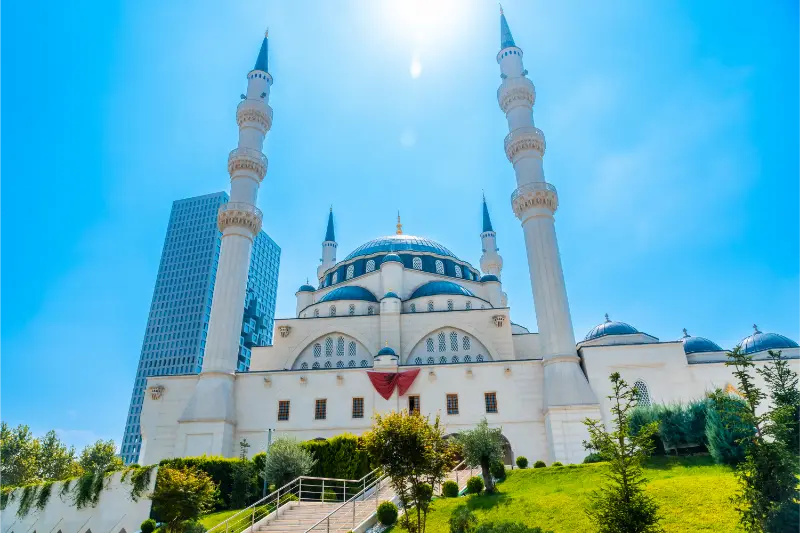
Best for spiritual history and architecture. The Bektashi World Center is one of Tirana’s most distinctive cultural stops, yet many visitors never leave the central sightseeing axis to see it. The complex includes the main tekke and a museum explaining the Bektashi tradition, which has an unusually important relationship with Albania. Go with the same etiquette you would use at any active religious site: dress respectfully, keep voices low and ask before photographing worshippers. I would pair it with another eastern-Tirana stop rather than crossing the city only for a quick photograph.
Tirana Mosaic
Best for ancient Tirana beneath the modern city. The Tirana Mosaic is valuable because it pushes Tirana’s story far beyond the twentieth century. The archaeological remains preserve evidence of a Roman villa and an early Christian basilica, making this one of the clearest places to see how much older the settlement history is than the capital’s modern image suggests. It is a compact stop, so I would combine it with a neighborhood walk rather than making it the entire morning.

Farka Lake
Best for a quiet lake walk without leaving greater Tirana. Farka Lake is a practical escape when the center feels busy. The lake is better for walking, cycling, views and a slower meal than for chasing a headline attraction. Go in the morning or late afternoon, especially in warm months, and treat it as open-air time rather than another sight to complete. A taxi is usually easier than trying to fit the visit into a dense public-transport itinerary.
Peza and Fjolla Lake
Best for rural atmosphere close to the capital. Peza and Fjolla Lake show a side of the Tirana region that disappears from city-break itineraries: villages, agricultural landscapes and a slower rhythm only a short drive from the capital. This is the kind of half-day I would choose after several museum-heavy days. It also works well with a countryside lunch, provided you confirm opening arrangements rather than assuming every rural venue operates continuously.
Preza Castle
Best for a small fortress and airport-area detour. Preza Castle is much smaller than Krujë, which is exactly why I like it as a hidden-gem stop. The hilltop position gives broad views over the plain and the castle can fit naturally before or after an airport transfer if luggage and timing are under control. Do not compare it with Albania’s major fortress complexes; its value is scale, quiet and location.
Pëllumbas Cave
Best for a half-day hike near Tirana. The Pëllumbas Cave route is for travelers who want a real outdoor excursion rather than a city viewpoint. The walk involves uneven terrain and the cave itself requires sensible footwear, lighting and caution. I would avoid treating it as a casual add-on after a long lunch. Start with enough daylight, carry water and turn around if weather or trail conditions make the route uncomfortable.
Cyclops Eye
Best for a lesser-known swim-and-hike escape. Cyclops Eye is a natural pool and hiking objective outside the urban center. It is more adventurous than Farka Lake and less straightforward than a normal park visit. Access conditions can change, so use the dedicated guide and current local information rather than copying a social-media pin. The payoff is a landscape that feels completely disconnected from the capital even though you have not traveled far.
Shëngjergj Waterfall
Best for a green countryside day. Shëngjergj Waterfall works best in a nature-focused day that includes the surrounding rural landscape rather than a rushed out-and-back photograph. Water flow is seasonal, which means the experience can vary dramatically through the year. I would favor spring or after wetter periods, while keeping road and trail conditions in mind.
Mother Teresa Square
Best for modern architecture after the headline center. Mother Teresa Square is not truly hidden, but it is often skipped by visitors who stop their walking route at Blloku. The broad square, nearby cultural buildings and approach toward the Grand Park reveal a more monumental southern axis of Tirana. It is especially useful if you like architecture and want to understand how the city extends beyond Skanderbeg Square.
The quieter edges of the Grand Park
Best for an everyday local Tirana experience. Most visitors who reach the Grand Park stay close to the busiest lakeside paths. Walk farther around the quieter edges and the park becomes less of an attraction and more of a local daily landscape: runners, families, cyclists and cafés rather than monuments. This is one of the easiest hidden-gem experiences because it requires no special transport, ticket or schedule.

Best hidden gems if you have only one extra half-day
If I only had half a day beyond the main sights, I would choose one place close to the city and one experience that changes the landscape. That usually means a small museum, neighborhood or religious monument first, followed by a lake, village, viewpoint or short nature outing. Avoid spending most of the half-day inside a car.
Do you need a car?
A car is useful for rural villages, archaeological parks and nature stops, but it is not automatically the best solution in historic centers. I park once when the destination is walkable and use taxis selectively for steep or outlying places. If you rent, read Renting a Car in Albania before building the route.
Best time of day
Early morning is best for residential lanes, photography and small archaeological sites exposed to the sun. Late afternoon works for hilltop viewpoints and village walks. Midday is when I place museums, lunch and shaded cultural stops. This simple rhythm matters more than trying to visit hidden gems in the exact order they appear on a map.
Hidden gems with children
With children, choose places that reduce logistical friction: short walks, open space and one clear activity. A small museum plus lake or village works better than three archaeological stops. For caves, canyons, ruins and mountain roads, assess current conditions and the child’s ability rather than assuming a family label makes every route easy.
Where to stay
Compare current accommodation in Tirana on Booking.com. A central base is usually best for the first visit; move to a rural or coastal guesthouse only when the slower setting is itself part of the trip.
Respectful slow travel
Many hidden-gem places are residential villages, active religious sites or fragile archaeological and natural areas. Stay on public paths, ask before photographing people, do not enter private courtyards or abandoned-looking buildings, and carry rubbish out of nature sites. A place does not become public property simply because it appears on a travel map.
Useful related guides
Common mistakes
- Calling every quiet place “undiscovered” even when it is well known locally.
- Driving to too many small stops and spending more time parking than exploring.
- Entering private property or fragile ruins for a photograph.
- Assuming a rural museum, church or monastery keeps big-city opening hours.
- Using an old road or trail report without checking current conditions.
- Choosing remote nature over the main destination before you have understood the basics.
Frequently asked questions
Are these places really hidden?
Not literally. They are established places that receive less attention than the destination’s headline sights. I prefer “less obvious” to pretending that local communities and historians have somehow never heard of them.
Can I visit the hidden gems without a car?
Several can be reached on foot or by taxi, while rural and nature stops are easier by car. Build the route around one transport method rather than changing plans constantly.
Are these good for a first trip?
Yes, but only after protecting the essential experience you came for. Add one or two hidden gems around the main sights rather than replacing every famous landmark for the sake of being different.
How many extra days should I add?
One extra night is enough to unlock many of these places. Two extra nights make sense when the surrounding region includes villages, archaeological parks, lakes or nature areas that deserve half-day trips.
How do I verify opening and access?
Ask your accommodation, check current official/local information and confirm small museums or religious sites shortly before visiting. Access rules, road works and seasonal services can change faster than the historic facts.
Final advice
The purpose of hidden-gem travel is not to avoid everything popular. It is to create a richer sequence around the famous places: one headline monument, one quiet neighborhood, one local meal and one landscape that most short-stay visitors skip. That combination usually produces a more memorable trip than a list made entirely of either famous sights or obscure detours.
Leave a Reply