
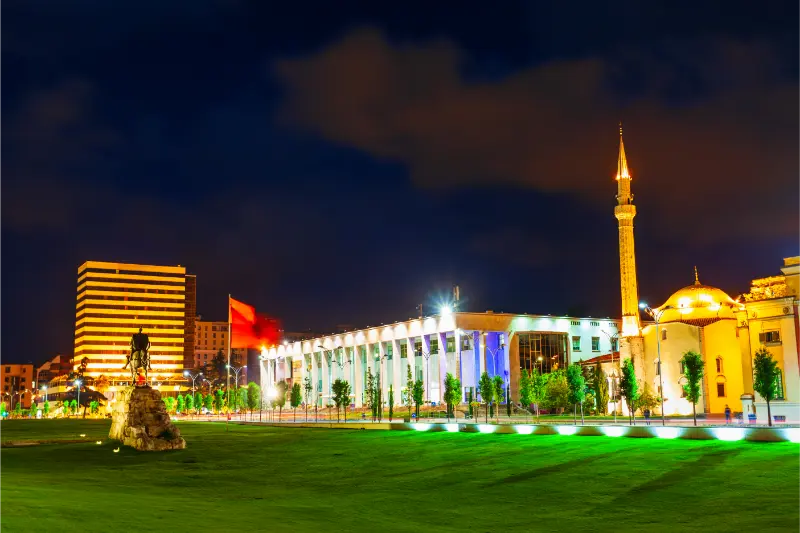
Mother Teresa Square is best understood not as a single attraction but as the southern architectural endpoint of central Tirana’s ceremonial boulevard. Its scale, open paving and institutional buildings make it a useful place to read the capital’s twentieth-century planning before continuing toward the Grand Park.
Albania’s official tourism portal is the principal reference used for the core historical and architectural facts in this guide. Opening hours, worship schedules, restoration work, entrance rules and commercial activity can change, so verify practical details shortly before your visit.
Why this place deserves its own guide
Mother Teresa Square Tirana is worth treating as more than a quick photo stop. It adds a specific layer to the story of Albania: urban life, religious coexistence, architecture, commerce or the way a neighborhood changed between Ottoman, communist and contemporary periods. A focused visit lets you notice those layers instead of moving through the city as a checklist of landmarks.
The most useful approach is to understand the setting first. Look at the street pattern, surrounding buildings, slope, river, square or neighboring monuments before concentrating on decorative details. Albanian heritage often makes sense only when you see how a church, mosque, bazaar, residential quarter or public square connects with everyday movement around it.
Historical context: the facts that matter
The square is one of Tirana’s principal public spaces and is dedicated to Mother Teresa.
The wider ensemble includes major institutional and cultural buildings and sits at the southern end of Bulevardi Dëshmorët e Kombit.
Official Tirana itineraries connect the square with the Polytechnic University, Palace of Congresses, presidency area, Air Albania Stadium and the route toward the Artificial Lake.

The square is public urban space rather than a ticketed attraction, so its value comes from architecture, city planning, events and its role within a longer walking route.
This background matters because Albania’s historic places rarely belong to one frozen moment. Buildings have been repaired, repurposed, damaged, secularized, restored and returned to religious or civic use. Neighborhoods have changed even more dramatically as families, businesses and tourism adapted to new political and economic conditions. Treat the visible place as the latest layer in a much longer story.
What to notice when you arrive
The monumental scale of the surrounding public buildings
Pause and look specifically at the monumental scale of the surrounding public buildings. Rather than taking one wide photograph and leaving, compare materials, scale, openings, decorative details and the relationship with adjacent streets or buildings. Small changes in stonework, plaster, timber, paving or rooflines often reveal which parts are older, restored or adapted to new uses.
The axis north along the central boulevard
Pause and look specifically at the axis north along the central boulevard. Rather than taking one wide photograph and leaving, compare materials, scale, openings, decorative details and the relationship with adjacent streets or buildings. Small changes in stonework, plaster, timber, paving or rooflines often reveal which parts are older, restored or adapted to new uses.
The transition south toward Grand Park and the lake
Pause and look specifically at the transition south toward Grand Park and the lake. Rather than taking one wide photograph and leaving, compare materials, scale, openings, decorative details and the relationship with adjacent streets or buildings. Small changes in stonework, plaster, timber, paving or rooflines often reveal which parts are older, restored or adapted to new uses.
How contemporary stadium and cultural uses sit beside older state architecture
Pause and look specifically at how contemporary stadium and cultural uses sit beside older state architecture. Rather than taking one wide photograph and leaving, compare materials, scale, openings, decorative details and the relationship with adjacent streets or buildings. Small changes in stonework, plaster, timber, paving or rooflines often reveal which parts are older, restored or adapted to new uses.
How to experience the area without rushing
Allow at least forty-five minutes for a single building and considerably longer for a neighborhood, market or public square. If the place is active rather than museum-like, the experience improves when you include time for a coffee, a short detour into side streets and a second pass after you understand the layout. In a bazaar or nightlife district, morning and evening can feel like two completely different destinations.
If you are visiting a functioning church or mosque, do not assume the entire interior is continuously available. Services, prayers, weddings, funerals and religious festivals take priority. Enter quietly, dress respectfully and avoid photographing people at worship without permission. In residential quarters, remember that many photogenic doors, balconies and courtyards belong to private homes.
Best time of day and season
Spring and autumn are usually the easiest seasons for urban exploration because walking temperatures are comfortable and streets are lively without the most intense summer heat. July and August can still be enjoyable, but exposed squares and steep historic neighborhoods are better early in the morning or in the late afternoon. Winter brings shorter daylight and rain, yet also quieter streets and a more local atmosphere.
Time of day matters as much as season. Religious buildings are often calm between services. Historic neighborhoods photograph beautifully when low light reaches façades from the opposite side of a valley or river. Markets are more interesting when shops are open, while nightlife areas make much more sense after late afternoon. Build the visit around the character of the place rather than forcing every attraction into the same 10:00–16:00 schedule.
Practical walking and accessibility advice
Historic Albania can be physically uneven. Cobbles, polished stone, steep slopes, high thresholds and narrow pavements are common. Comfortable shoes matter more than formal travel clothing. In summer carry water, and in wet weather expect stone paving to become slippery. Travelers with limited mobility should check current access directly because entrances, ramps and restoration zones can change.
Families can make the visit more engaging by focusing on visible details: domes, bells, old shop fronts, carved doors, stone arches, windows or viewpoints. Senior travelers may prefer one major heritage stop followed by a cafe break rather than several back-to-back attractions. The distances in these cities are often short on a map but can feel longer because of heat and gradients.
How to combine it with nearby places
Related guide: Tirana Grand Park. Combining two or three nearby places that explain different periods usually creates a stronger itinerary than crossing the city repeatedly for isolated sights.
Related guide: Pyramid of Tirana. Combining two or three nearby places that explain different periods usually creates a stronger itinerary than crossing the city repeatedly for isolated sights.
Related guide: Tirana travel guide. Combining two or three nearby places that explain different periods usually creates a stronger itinerary than crossing the city repeatedly for isolated sights.
A simple half-day plan
Start with the main site or neighborhood while your energy is high, then continue on foot to one complementary attraction. Take a real break for coffee or lunch and leave at least thirty minutes unplanned. That flexible time is often when you discover a side street, local bakery, small workshop or viewpoint that turns a competent itinerary into a memorable one.
For photographers, do not use the first viewpoint as your only composition. Walk past it, look back, change elevation and include ordinary street life where appropriate. For shoppers, compare several stores before buying and ask whether items are locally handmade. For food and nightlife districts, check recent reviews for individual businesses rather than assuming an old recommendation is still operating.
Respect, etiquette and responsible tourism
Do not treat lived-in historic quarters as film sets. Keep voices down in narrow residential lanes, avoid blocking doorways and do not photograph inside homes or private courtyards without permission. In markets, bargaining customs vary by shop and product; a polite conversation works better than treating every price as a confrontation. Buying directly from artisans can support skills that are part of the heritage you came to see.
At religious sites, modest clothing and quiet behavior are basic courtesy. At political-history locations, avoid turning difficult history into jokes or staged social-media content. Albania’s recent past remains personal for many families. A respectful visit can still be engaging and visually interesting without reducing the place to a backdrop.
Common mistakes to avoid
- Rushing through. Historic quarters and active civic spaces reward observation more than speed.
- Relying on old opening hours. Verify museums and interiors close to the date of travel.
- Ignoring context. The surrounding street, river, castle or boulevard often explains why the site exists where it does.
- Photographing worshippers without permission. Active religious practice always takes priority over tourism.
- Buying the first souvenir you see. Compare quality and ask about local production if craftsmanship matters to you.
- Overloading the day. Two or three meaningful stops are usually better than eight rushed landmarks.
Where to stay
For a short city stay, I prefer accommodation that lets you reach the historic core on foot but is still practical for luggage, taxis or parking. In hilly towns, a room that looks only a few hundred metres from the center may involve a steep climb. Check recent guest comments about access, noise, heating, air conditioning and parking rather than choosing by map distance alone.
Compare accommodation options in Albania on Booking.com. Use the map view to understand the relationship between the hotel and the historic area, especially in Berat, Gjirokastër, Krujë and Shkodër.
Frequently asked questions
Is this worth adding to a first trip to Albania?
Yes if it fits naturally into the city you are already visiting. It adds depth without requiring a long detour.
Do I need a guide?
Not always. A guide adds value when the history is complex, but official interpretation plus some preparation is enough for many independent visitors.
Can I visit with children?
Usually yes. Keep the visit shorter, focus on visible details and schedule a food or park break afterward.
Is photography allowed?
Outdoor photography is generally straightforward, but interiors, museums and active religious spaces may have specific restrictions. Follow signs and staff instructions.
How long should I allow?
Plan roughly one hour for a single landmark and two to three hours for a neighborhood or market combined with nearby sights.
Final thoughts
Mother Teresa Square Tirana earns a place in a thoughtful Albania itinerary because it turns a broad destination into a specific story. Slow down, notice how people use the place today, connect it with one nearby landmark and leave enough room for unplanned discoveries.

That approach is more useful than chasing a list of “must-sees.” Albania is most rewarding when architecture, daily life, landscape and history are allowed to overlap, and these focused guides are designed to help you see those connections rather than simply collect photographs.
Leave a Reply