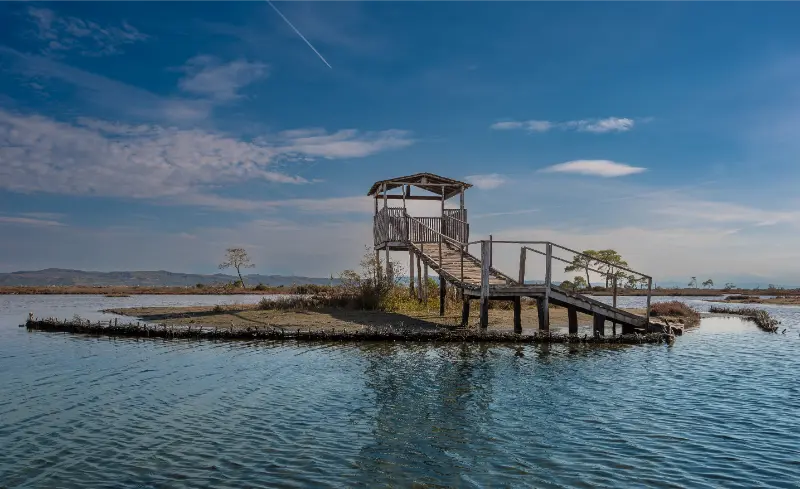
Divjake-Karavasta National Park is one of the easiest places in Albania to combine wetlands, forest and the Adriatic coast in a single day. The landscape is low and open rather than mountainous: lagoon water, reeds, pine woodland, salt-influenced habitats and a long sandy shoreline sit close together. It is a useful counterpoint to the more famous Riviera.

The official Albanian tourism portal describes Karavasta as the country’s largest lagoon and highlights more than 200 bird species, including the Dalmatian pelican. The area is also recognised under the Ramsar Convention. For travellers, this means the park is not simply a beach with some trees; it is an internationally important wetland that should be visited quietly and respectfully.
Why visit Divjake-Karavasta
The park is especially worthwhile for birdwatchers, families who want a gentle nature day and road trippers moving between Tirana, Durres, Berat or Vlore. You can walk in the pine forest, look across the lagoon, climb a panoramic tower where access is available and finish the day near the beach.
Because the terrain is flatter than Albania’s mountain parks, it can also suit travellers who do not want a strenuous hike.
The Karavasta Lagoon
The lagoon is the ecological heart of the park. Water levels, salinity and bird activity change through the year, so every visit is different. Do not expect wildlife to appear on demand at the closest viewpoint; binoculars reward patience.
Morning and late afternoon are generally more comfortable for observing birds and avoiding harsh summer light. Keep voices low and stay away from nesting or restricted areas.
Dalmatian pelicans and birdwatching
The Dalmatian pelican is the emblematic species of Karavasta, but the park’s value goes far beyond one bird. Herons, cormorants, flamingos and migratory species may be present depending on season and conditions.
Bring binoculars rather than trying to approach birds for phone photographs. A guided nature visit can be worthwhile for serious birdwatchers because local knowledge is far more useful than wandering randomly around a large wetland.
Pine forest and easy walks
The coastal pine forest creates shade and makes a pleasant break from the lagoon’s exposed viewpoints. In warm weather, alternate open areas with forest walks rather than staying in direct sun for hours.
Use marked or established paths and check for any seasonal access restrictions. Wetland and dune systems are easily damaged by vehicles and shortcuts.
Divjake Beach
Divjake’s beach is very different from Ksamil or the rocky Ionian coves. It is broad, sandy and backed by the park landscape. Families may appreciate the space, but sea conditions and facilities vary by area and season.
Treat the beach as one part of the nature day rather than the only reason to visit. If your priority is classic turquoise Riviera scenery, use my Albania beaches guide for comparison.
A good family day
Children often enjoy the combination of tower, forest, birds and beach because the day changes setting without requiring long drives between each activity. Bring snacks, water, hats and insect repellent during warmer months.
Do not promise children that they will definitely see pelicans close up. Wildlife viewing is better framed as exploration than as a guaranteed show.
How long to spend
A half day works for a forest walk, lagoon viewpoint and lunch. A full day allows birdwatching, beach time and a slower pace. Travellers interested in photography or ecology can stay overnight and use the cooler morning and evening periods.
The park is easy to underestimate on a map. Moving slowly is part of the point, so avoid combining it with two major cities on the same day.
Where to stay and eat
Divjake has local accommodation and restaurants, while travellers on a broader route may stay in Berat or Durres. Staying locally is better if sunrise birdwatching matters to you.
Local menus often reflect fish and produce from the surrounding agricultural and coastal area. Ask what is seasonal rather than searching only for one famous dish.
When to visit
Spring and autumn are excellent for bird activity and comfortable walking. Summer is useful if you want to combine nature with the beach, but shade, water and insect protection become more important. Winter can be rewarding for dedicated birdwatchers, though services may be quieter.
Check recent weather before driving onto minor access roads because heavy rain can affect wetland surroundings.
Photography without disturbing wildlife
A telephoto lens is more useful than getting physically close. Avoid playback calls, feeding or any behaviour that changes how birds move or feed. If a guide asks you to remain behind a boundary, treat that as part of the experience, not an obstacle to the photograph.
For landscapes, sunrise and sunset produce softer reflections across the lagoon than midday light.
Use the official park context
The official tourism page for Divjake-Karavasta describes the park’s wetland, pine forest and biodiversity. Use it as a current reference rather than relying entirely on old travel posts.
The best visit is one where you leave with a stronger sense of how coastal Albania functions as an ecosystem, not only a collection of beaches.
Final planning tips
Divjake-Karavasta fits naturally between Durres and Berat, or as a nature break on the way south.
Bring binoculars if you have them, avoid loud behaviour near the lagoon and leave enough time that wildlife observation does not become a rushed stop.
Extra practical advice
One final way to improve a trip focused on Divjake-Karavasta National Park is to leave deliberate margin in the day. Albania often looks compact on a map, but mountain roads, seasonal traffic, weather and informal stops can make travel times variable. I prefer to choose one important objective for the day and treat smaller viewpoints, cafés or short walks as optional. That prevents the itinerary from becoming a race and gives you room to follow useful local advice. Keep essential addresses, reservation numbers and route notes available offline. Confirm any service that would cause a major problem if it were unavailable, but avoid over-booking ordinary experiences. Carry water, some cash, a charged phone and a basic layer for changing weather. These small preparations are more valuable than trying to predict every detail weeks in advance. When conditions differ from what an old guide promised, trust current signs, local staff and official information. Protected areas, transport services and seasonal businesses evolve. A flexible traveller usually sees more because a changed plan becomes an alternative experience rather than a failed day.

Build extra time into transfers, check current conditions locally, and keep the day simple enough that weather or traffic does not force you to rush. Albania rewards travellers who combine planning with flexibility, especially outside major cities and on mountain or coastal roads.
Build extra time into transfers, check current conditions locally, and keep the day simple enough that weather or traffic does not force you to rush. Albania rewards travellers who combine planning with flexibility, especially outside major cities and on mountain or coastal roads.
Build extra time into transfers, check current conditions locally, and keep the day simple enough that weather or traffic does not force you to rush. Albania rewards travellers who combine planning with flexibility, especially outside major cities and on mountain or coastal roads.
Build extra time into transfers, check current conditions locally, and keep the day simple enough that weather or traffic does not force you to rush. Albania rewards travellers who combine planning with flexibility, especially outside major cities and on mountain or coastal roads.
Build extra time into transfers, check current conditions locally, and keep the day simple enough that weather or traffic does not force you to rush. Albania rewards travellers who combine planning with flexibility, especially outside major cities and on mountain or coastal roads.
Build extra time into transfers, check current conditions locally, and keep the day simple enough that weather or traffic does not force you to rush. Albania rewards travellers who combine planning with flexibility, especially outside major cities and on mountain or coastal roads.
Build extra time into transfers, check current conditions locally, and keep the day simple enough that weather or traffic does not force you to rush. Albania rewards travellers who combine planning with flexibility, especially outside major cities and on mountain or coastal roads.
Build extra time into transfers, check current conditions locally, and keep the day simple enough that weather or traffic does not force you to rush. Albania rewards travellers who combine planning with flexibility, especially outside major cities and on mountain or coastal roads.
Build extra time into transfers, check current conditions locally, and keep the day simple enough that weather or traffic does not force you to rush. Albania rewards travellers who combine planning with flexibility, especially outside major cities and on mountain or coastal roads.
Build extra time into transfers, check current conditions locally, and keep the day simple enough that weather or traffic does not force you to rush. Albania rewards travellers who combine planning with flexibility, especially outside major cities and on mountain or coastal roads.
Build extra time into transfers, check current conditions locally, and keep the day simple enough that weather or traffic does not force you to rush. Albania rewards travellers who combine planning with flexibility, especially outside major cities and on mountain or coastal roads.
\n\nRelated guide: Birdwatching in Albania: Karavasta, Narta, Prespa, Lake Shkodra and More expands this topic with a broader route and practical planning advice.
\nExplore more of Albania beyond the main route
\nWildlife deep dives: Dalmatian Pelicans in Albania and Flamingos in Albania add species-specific viewing and photography advice.
Leave a Reply