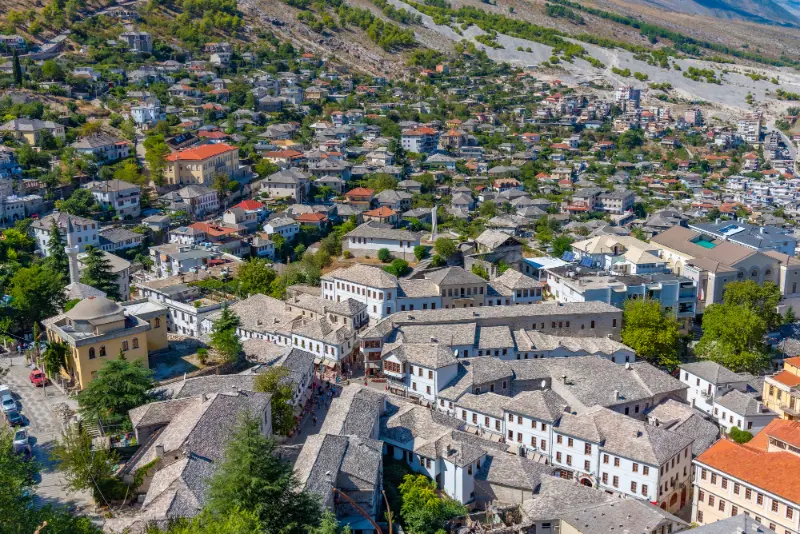
Is Gjirokastër safe for tourists? For most visitors, the useful answer is not a simple yes/no label. Gjirokastër’s most obvious safety issue is visible immediately: the old city is steep. For many travellers, slipping on stone, overheating on a climb or misjudging the distance from the lower-city bus stop is a more realistic concern than street crime. The best approach is to understand where ordinary travel problems actually happen, keep normal urban or outdoor precautions, and have a plan for transport and emergencies before you need one.
This guide focuses on practical risk management for an independent trip in 2026. It should be read alongside our Albania safety guide and the broader Gjirokastër travel guide. Safety conditions can change, so check official travel advice shortly before departure rather than treating any blog post as a permanent guarantee.
Quick answer: how safe does Gjirokastër feel?
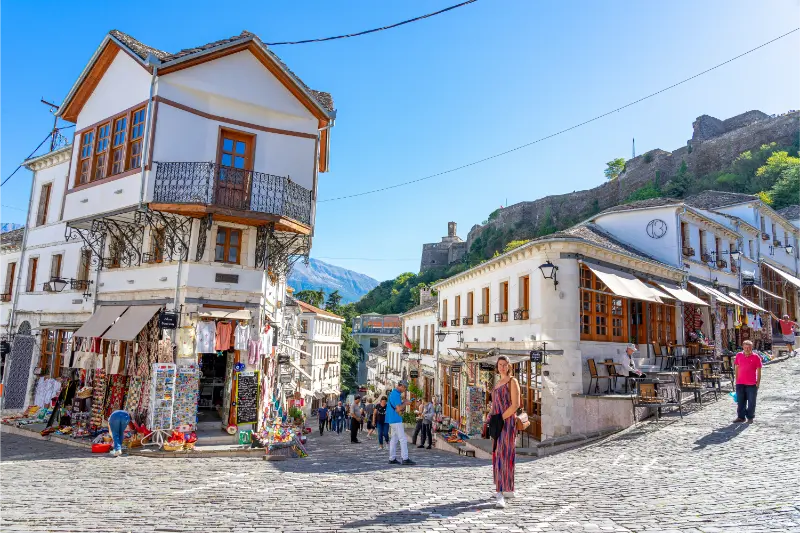
The Old Bazaar and castle zone are where most visitors spend their time. The intercity transport area is lower down, so a hotel pin that looks close in two dimensions may sit hundreds of metres higher on steep cobbles. In practice, a visitor who chooses a sensible base, keeps control of valuables, uses known transport and avoids obviously risky situations can remove most of the friction that gets described online as a “safety problem.”
It is also important not to confuse unfamiliarity with danger. Different driving habits, cash payments, informal bus stops or a street that looks rougher than a polished resort can feel uncertain without necessarily being threatening. At the same time, familiarity should not become complacency: crowded transport, nightlife, beaches and remote excursions all deserve specific precautions.
What the current official travel advice says
As of September 2026, the U.S. Department of State lists Albania at Level 2: Exercise Increased Caution because of crime. Its advisory notes that law-enforcement assistance can be more limited in some remote areas. The UK Foreign Office says crime and violence exist but reports of crime targeting foreigners are rare; it specifically recommends sensible precautions against street crime, pickpocketing and bag theft in tourist areas and transport hubs.
These are country-wide advisories, not a statement that every neighbourhood of every Albanian city has the same risk. Use them as context. Check the current U.S. travel advisory for Albania and the UK safety and security advice before travel, especially if your itinerary includes remote areas, demonstrations or severe weather.
Street crime, phones and bags
The easiest theft to prevent is the one created by distraction. Keep your phone away from the edge of a café table, close bags on buses and in crowds, and avoid carrying your passport, all bank cards and all cash in one wallet. A small amount of daily cash in an accessible pocket and backup cards/documents stored separately is a better system than constantly opening a large travel wallet in public.
At markets, bus stops, ferry queues and summer promenades, crowding can make accidental bumps and intentional distraction look similar. Do not become suspicious of everyone around you; simply reduce opportunity. Use a zipped cross-body bag or a front pocket, keep luggage physically connected to you during ticket questions and load/unload one bag at a time.
Common tourist “scams” versus normal negotiation
Not every disagreement over a taxi, restaurant bill or beach price is a scam. Albania still has many services where prices can be communicated verbally, and seasonal businesses may change rates. The practical defence is to ask the key question before accepting the service: total price, what is included, payment method and whether the price is per person, per vehicle, per hour or per item.
- Ask for the total taxi/transfer price or fare method before departure when a meter/app is not being used.
- At beaches, confirm whether the quoted amount covers one sunbed, two beds plus umbrella, or a full set for the day.
- For boat trips, confirm route, duration, return time, swimming stops and what happens if weather changes.
- At restaurants, check the menu price for market-price fish or seafood before ordering by weight.
- When exchanging money, compare the displayed buy/sell rate and count the cash before leaving the counter.
Pressure is the warning sign. If someone refuses to state a basic price, insists you decide immediately or prevents you from checking alternatives, walk away. A calm “no, thank you” is enough; there is no need to turn an ordinary sales pitch into a confrontation.
Night safety in Gjirokastër
The bazaar has evening activity, but upper residential lanes quieten fast. Use the same route you learned in daylight, keep a light/phone available and avoid shortcuts down unfamiliar stairways after drinking.
Alcohol changes the risk calculation more than the destination does. Keep your drink under your control, do not accept a lift from an unknown person because it is convenient, and make sure at least one person in the group knows the accommodation address. If you are travelling alone, send the hotel name or live location to someone you trust when returning very late.
Taxis, transfers and getting home safely
A taxi is especially useful on arrival with luggage. Confirm whether the driver can reach the guesthouse entrance; some historic lanes are too narrow or awkward, and the final section may still need to be walked.
For detailed transport planning, see the Gjirokastër taxi and transfer guide. Save the accommodation name and map pin offline because street names can be less useful than landmarks or exact pins. If a ride is pre-booked, keep the operator name and phone number in a screenshot in case mobile data fails.
Do not get into a vehicle merely because the driver says the name of your hotel; that information can be visible on luggage tags or overheard. Match the vehicle, driver or booking details whenever a transfer has been arranged in advance. For spontaneous taxis, use a clearly identifiable vehicle and agree on the payment method before the ride.
Driving and road safety
Driving into the historic centre requires patience. Streets can be narrow, gradients sharp and parking limited. If your accommodation does not provide precise instructions, park lower down or use a taxi rather than improvising turns on a steep lane.
If you rent a car, inspect and photograph the vehicle before departure, understand the insurance excess and never leave passports, laptops or camera bags visible inside. Use marked or managed parking when practical. Google Maps travel times can be optimistic on mountain or coastal roads, so add time rather than trying to “make up” delays with speed.
Night driving is less forgiving because road markings, pedestrians, animals and unlit vehicles are harder to see. If a route is already unfamiliar in daylight, a late return after dinner may be a good reason to use a driver instead. Never combine alcohol with driving, even for a short hotel transfer.
Pedestrian safety and the surfaces under your feet
Road crossings deserve active attention. Look in both directions even on one-way-looking streets, make eye contact when possible and do not follow another pedestrian into traffic just because they step off the kerb. Pavements may be interrupted by parked vehicles, café seating or construction, pushing pedestrians closer to traffic.
In Gjirokastër, footwear can matter as much as anti-theft precautions. Historic stone, wet tiles, beach steps, steep lanes or rough paths become slippery when rushed. A minor fall is more likely to disrupt a holiday than many of the dramatic risks travellers worry about before arriving.
Beaches, mountains and outdoor activities
For day trips toward Blue Eye, rural villages or mountain viewpoints, check the return plan before leaving. Heat and limited shade matter in summer; after rain, stone paths and natural areas become slippery.
For any outdoor activity, separate “can I physically do this?” from “are conditions good today?” Heat, wind, rain, wildfire restrictions, river levels and sea state can change the correct decision. Commercial operators should be willing to explain equipment, meeting points, age limits and cancellation rules. If answers are vague, choose another operator or another day.
Weather and natural hazards
Official UK advice highlights several country-wide natural hazards: earthquakes are possible, flooding and snow can disrupt winter travel, and wildfires are common in the hot dry period. None of these means a trip should be cancelled automatically; they mean you should keep alerts, weather and road conditions in the plan rather than treating every itinerary as fixed.
Gjirokastër rewards slow walking. Trying to fit the castle, museums, steep neighbourhoods and a day trip into one rushed day increases the risk of minor injury and transport mistakes far more than it improves the experience.
If authorities close a road, trail or beach access, respect the closure. Travel insurance may help with costs, but it does not make it sensible to cross a barrier or continue into smoke, floodwater or unstable terrain.
Solo travellers and solo women
Gjirokastër can work well for solo travel when accommodation is chosen for location and late-arrival logistics rather than price alone. Read recent reviews for the exact street, reception hours and noise. If you arrive after dark, message the property in advance and use a direct transfer when the alternative is navigating with luggage while tired.
Solo women should apply the same layered strategy they would use in another unfamiliar European destination: keep someone informed of the overnight location, avoid accepting rides from strangers, control alcohol intake, move away from persistent attention rather than arguing, and use a taxi if a route feels wrong. A destination does not have to be broadly dangerous for one situation to deserve a conservative decision.
Families and teenagers
For families, traffic, water and heat are usually more important than crime. Give children a simple rule for crowded places: if separated, stop and go to a staff member or agreed landmark rather than wandering. Put a parent phone number in a child’s bag or on a card. On beaches, designate one adult to supervise swimming instead of assuming the whole group is watching.
Teenagers often want more independence. Start with a short, clearly bounded area that the family has already explored together, set a return time and meeting point, and keep phones charged. Do not use an unfamiliar city as the first test of completely unrestricted independence.
Accommodation safety
Location often matters more than star rating. Compare accommodation in Gjirokastër on Booking.com, then read recent reviews for street access, reception, stairs, parking and late-night noise. A cheap room that requires an unlit 25-minute roadside walk can be poor value even if the property itself is perfectly secure.

On arrival, note the emergency exit and the exact property name/address. Use the room safe if available for backup documents, but do not place every essential item together. If you stay in an apartment, confirm how the building entrance works before returning late because host contact can be slower after normal check-in hours.
Cash, cards and document security
Carry enough lek for small payments without carrying the full trip budget. Use ATMs attached to or clearly associated with banks when possible, shield the PIN and reject any exchange-rate conversion you do not understand. Keep a second card separate from the main wallet and store a digital copy of your passport in secure cloud storage or encrypted offline storage.
Your passport does not need to spend every beach day inside the same bag as your phone and cash. Follow any legal or accommodation requirements for identification, but use a deliberate storage system and keep a copy available. Before a ferry or border journey, move the original document back into your travel-day bag before leaving the hotel.
What to do in an emergency
The UK government currently lists Albania’s emergency numbers as 112 for police/general emergency, 127 for ambulance and 128 for fire. Save these before travel. The national 112 number is the simplest one to remember when you are unsure which service is needed.
For current official details, see the Albania emergency-services information. If you need medical treatment, contact your travel insurer as soon as reasonably possible. For theft, make a police report when required by your insurer and keep copies of receipts, report numbers and replacement-document costs.
If your phone, wallet or passport goes missing
- Move to a calm public place before trying to solve everything at once.
- Use another device to lock or locate the missing phone and change critical passwords if necessary.
- Freeze affected bank cards immediately and use your backup card/cash.
- For suspected theft, contact the police and obtain documentation if your insurer requires it.
- For a lost passport, contact your embassy/consulate and do not book a complicated onward journey until you understand replacement-document rules.
- Tell the accommodation if keys or an access card were lost together with anything showing the property address.
Preparation makes this much easier: store emergency contacts and insurance numbers somewhere that is not dependent on your main phone. A paper note in the luggage can be surprisingly useful.
A practical safety routine for Gjirokastër
- Before leaving the hotel: charge the phone, download the day’s map, check weather and carry only the cash/cards you need.
- For transport: screenshot the pickup point, confirm the fare/booking, and keep luggage in sight.
- For sightseeing: use comfortable shoes, carry water and avoid rushing on uneven surfaces.
- For beaches or outdoor trips: check local conditions and decide who is watching valuables.
- Before evening: decide how you will get home, especially if the route is distant, steep or poorly lit.
- Before sleeping: put passport, backup card and next-day tickets in the same deliberate place so morning departures are not chaotic.
Common mistakes that create avoidable problems
- Treating a relaxed atmosphere as permission to leave a phone and wallet unattended.
- Booking accommodation without checking the exact location and then walking an unsuitable route late at night.
- Accepting a service before clarifying the price and later calling the disagreement a scam.
- Driving mountain/coastal roads according to optimistic map times.
- Starting hikes or boat trips without checking current weather and return logistics.
- Keeping passport, all cards, all cash and the only phone together.
- Assuming travel insurance covers an activity without checking adventure-sport exclusions.
- Following crowds across roads instead of independently checking traffic.
Useful links before you travel
- Is Albania Safe? national safety guide
- Gjirokastër travel guide
- UK Albania safety and security advice
- U.S. Albania Travel Advisory
FAQ
Is Gjirokastër safe at night?
Central, active areas are usually the easiest choice for evening walking, but the answer changes by exact street, season and distance from your accommodation. The bazaar has evening activity, but upper residential lanes quieten fast. Use the same route you learned in daylight, keep a light/phone available and avoid shortcuts down unfamiliar stairways after drinking. Use a taxi when the alternative is a long unfamiliar route after drinking or when the street environment makes you uncomfortable.
Are tourists targeted by crime in Gjirokastër?
Official UK advice says reports of crime targeting foreigners in Albania are rare, but pickpocketing and bag theft remain possible in tourist areas and transport hubs. The practical response is normal control of valuables rather than fear of ordinary interactions.
Should I carry my passport with me?
Carry identification as required for your activity and travel documents when crossing borders or using ferries, but avoid putting the original passport in an unattended beach bag. Keep a secure backup copy and store the original deliberately when it is not needed.
What emergency number should I save?
Save 112 as the general emergency/police number, plus 127 for ambulance and 128 for fire. If you have travel insurance, save its emergency assistance number as well.
Is Gjirokastër safe for solo female travellers?
Many women travel independently in Albania, but no destination is risk-free. Choose a central well-reviewed property, use known transport late at night, keep someone informed of your plans, and leave situations that feel uncomfortable without worrying about being polite.
Final safety advice
The best way to think about safety in Gjirokastër is to replace vague fear with a few concrete systems: know where you are sleeping, control your valuables, understand the day’s transport, respect road and outdoor conditions, and keep emergency contacts available. That leaves more attention for the reason you came to Albania in the first place instead of spending the trip scanning for problems that may never happen.
Travelling alone? Read Solo Female Travel in Gjirokastër: Bazaar, Hills, Transport, Night Safety and Day Trips for women-specific arrival, evening, transport and solo-planning advice.

Leave a Reply