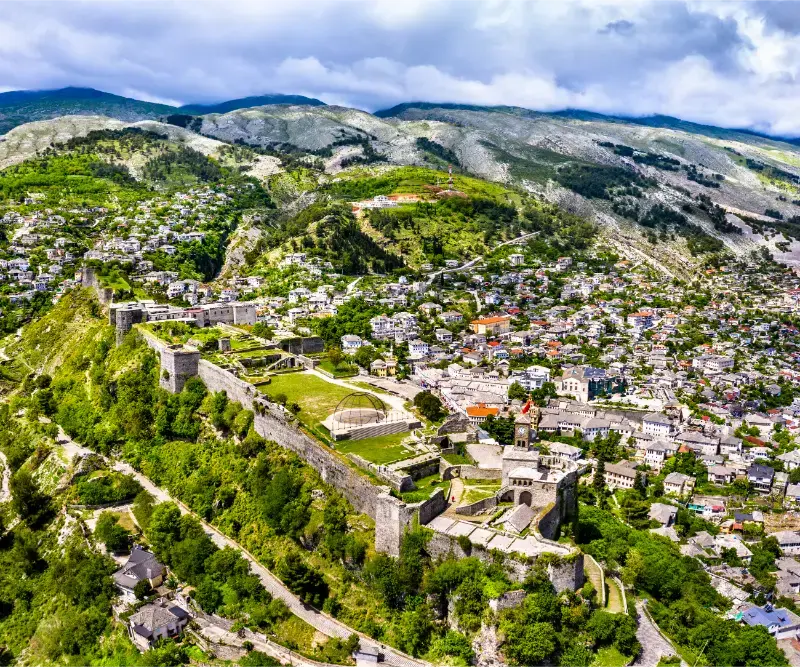
Gjirokastër has solid urban connectivity, but the city’s geography can make the experience uneven. The historic centre climbs steeply above the lower town and many guesthouses occupy thick-walled stone houses. That combination can produce excellent outdoor mobile signal and surprisingly weak indoor Wi-Fi in the same property. I therefore evaluate connectivity together with location: a beautiful room high above the bazaar is not automatically the easiest place for a full remote-work day.
My rule is simple: arrange one working connection before the first transfer, keep the expensive home line from using data accidentally, and download the essentials offline. That gives you enough redundancy to travel normally even if a hotel router fails or a mobile signal disappears for part of a day.
What mobile connectivity is like in Gjirokastër
Albania currently has two national mobile operators, One Albania and Vodafone Albania. The electronic-communications regulator AKEP reported for 2025 that 4G coverage had reached about 97% of the territory and roughly 100% of the population, while both operators continued expanding 5G under their 3.5 GHz authorisations. That national figure is useful context, but it is not a promise that every beach cove, mountain trail, stone guesthouse or basement room will have the same signal.
In practical terms, Gjirokastër is not a place where I would travel without offline backup, but neither is it a destination where I expect to be disconnected most of the time. The key is to distinguish normal urban use—maps, messages, booking apps and calls—from remote-work requirements or excursions into terrain where coverage can change quickly.
Albania is still outside EU Roam Like at Home
As of September 2026, Albania has not yet joined the EU Roam Like at Home area. The Council of the EU authorised negotiations with Albania and the other Western Balkan partners on 4 June 2026, but the official EU guidance still says there is no set completion date. That means an EU phone plan is not automatically domestic-price roaming in Albania. Some carriers include Albania voluntarily or sell a Balkan bundle, while others charge a separate daily or per-megabyte rate.
Before travelling, open your home carrier app and search specifically for Albania. Screenshot the tariff or bundle conditions. If the price is unattractive, disable data roaming on that line before arrival. Keep in mind that receiving an SMS is different from using mobile data: many travellers keep the home SIM active for verification codes while another SIM or eSIM handles data.
Arriving in Gjirokastër: the first 30 minutes
Most visitors arrive by road from Tirana, Berat, Sarandë or Greece. Keep data active before the final approach because the difference between the bus stopping area, the lower town and the Old Bazaar matters when you have luggage. Save the accommodation pin and ask where a taxi should drop you. If you are crossing from Greece, verify that the phone has moved to the intended Albanian or roaming network before using large amounts of data.
I also save the first-night address, phone number and check-in instructions as a screenshot. A travel day is the worst moment to depend on a cloud-only reservation. If an eSIM is your plan, install it before travel while you still have reliable Wi-Fi, but do not necessarily activate a validity period early if the provider starts counting from installation rather than first network connection.
Vodafone, One Albania, physical SIM or eSIM?
For most visitors, the choice is between a local Albanian package from Vodafone Albania or One Albania, a travel eSIM that roams on an Albanian network, or a home-carrier roaming add-on. There is no universal best option. A local SIM is attractive for a long stay, heavy hotspot use or when you want an Albanian phone number. A travel eSIM is attractive when you want data working before you land and do not need local voice service.
Vodafone Albania published new Tourist Pack offers for 2026 and currently maintains an official tourist/eSIM flow on its website. Because the operator changed its online tourist-eSIM plans during 2026, I would never copy a price from an old blog post and assume it is still valid. Check the live operator page immediately before purchase. One Albania is the other national mobile operator; compare the live prepaid offer, validity, hotspot rules and any Western Balkans roaming allowance rather than choosing only by the largest advertised data number.
A local SIM is easier to arrange in a larger city, but Gjirokastër still has normal telecom retail and top-up options. Use an operator-branded shop where possible, bring identification and confirm the exact package. If you are heading next to villages or remote southern roads, resolve activation problems before leaving the city. A working eSIM is often enough for a short cultural stay and avoids losing sightseeing time to a store visit.
What to check before paying for a SIM
- The exact validity period and when the clock starts.
- Whether the package includes a local phone number, ordinary calls and SMS, or data only.
- Whether hotspot/tethering is allowed and whether there is a fair-use limit.
- How much data, if any, can be used in Kosovo, Montenegro, North Macedonia, Serbia or Bosnia and Herzegovina.
- Whether Greece or another EU country is included; do not assume Western Balkans roaming covers it.
- How top-ups work and whether the operator app can be used with a foreign payment card.
- What identification is required for a physical prepaid SIM or online eSIM verification.
If a shop employee activates the SIM for you, open a webpage and a map before leaving. If the plan includes calls, make a quick test call. Take a photo of the package name or receipt so you know what you bought later. For eSIM, save the QR code or installation details securely in case you need to reinstall according to the provider rules.
Wi-Fi in hotels and apartments in Gjirokastër
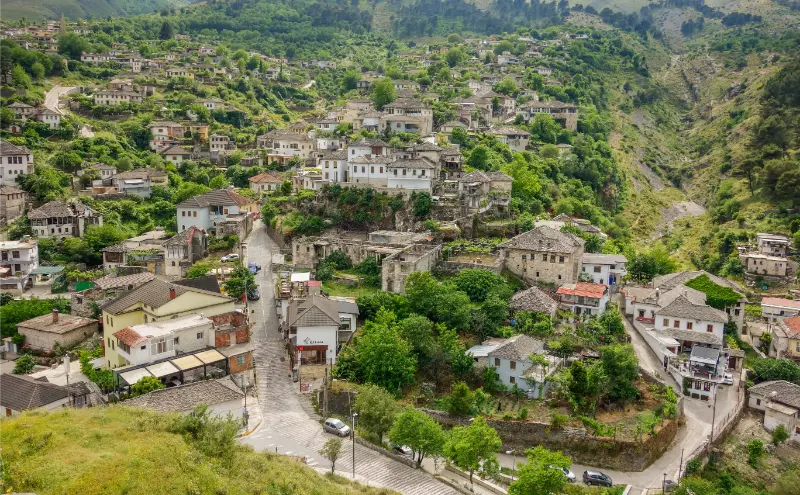
Traditional stone houses are the main variable. Thick walls, multiple levels and detached rooms can reduce Wi-Fi coverage even when the property’s main router is fast. Ask whether there are access points on every floor and request a recent speed test from the room if work is essential. Sometimes mobile data performs better near a window than the property’s Wi-Fi; sometimes the reverse is true. Test both before the call that matters.
When comparing accommodation, check places to stay in Gjirokastër, then message the property if internet is essential. Ask for a recent download/upload speed test, whether the test was taken in the room rather than the lobby, and whether there is a backup connection. A rating of 9/10 for “Wi-Fi” in guest reviews is useful, but a screenshot from this month is better evidence for a work trip.
Public Wi-Fi and café networks
Free Wi-Fi is common in cafés and restaurants in Gjirokastër, but I treat it as convenience rather than infrastructure. Public networks can be slow, shared or insecure, and passwords are often posted openly. For banking, account recovery or confidential work, use your own mobile connection or another security setup appropriate to your needs. Turn off automatic connection to unknown open networks so the phone does not join a similarly named hotspot without you noticing.
A café is also a business, not a free office. If you stay for more than a short email check, order appropriately, avoid occupying the best table through a busy meal period and use headphones for calls. The most reliable remote-work setup is usually accommodation Wi-Fi plus a mobile-data fallback, not a daily search for the fastest café.
Remote work in Gjirokastër
Gjirokastër is pleasant for a few slow workdays if you choose the base carefully. The lower town offers easier logistics, while the bazaar gives atmosphere but more hills and tourist activity. For long calls, use your accommodation rather than depending on a busy café table. In summer, afternoon heat makes repeated climbs more tiring, so a central property with reliable internet can save both bandwidth and energy.

For a work-heavy stay, run three tests on the first day: hotel Wi-Fi, mobile hotspot and an alternative place within walking distance. Also test upload speed, not only download speed, because video calls and cloud backups need upstream capacity. Turn off automatic photo and video backup during important calls; a phone silently uploading hundreds of holiday images can make an otherwise good connection feel unstable.
How much mobile data do you need?
Maps, messaging, email and ordinary browsing use surprisingly little data compared with video. A traveller who downloads offline maps and streams only on Wi-Fi may use a modest amount over a week. Reels, cloud photo backup, video calls, hotspot use and laptop updates can multiply that consumption. Instead of guessing, check your phone statistics before the trip, reset the counter on arrival and see what you actually use.
If two people travel together, one larger local package can sometimes serve as an emergency hotspot for both, but do not make one phone the single point of failure. Hotspot drains battery and can overheat a phone in summer. Each traveller should at least have the hotel address, tickets and critical contacts saved offline.
Offline maps, tickets and battery backup
Before every transfer I download the relevant Google Maps or other offline-map area, save tickets to the phone and take screenshots of hotel addresses, meeting points and transport confirmations. Offline navigation is especially valuable when a bus drops passengers at an informal stop or a beach road branches away from the route you expected.
Carry a power bank on long travel days. Weak signal makes a handset search harder for a network and can increase battery use. Keep the charging cable in your day bag, not inside luggage that is in a bus hold or ferry vehicle deck. For electricity and plug details, see the Albania plug and electricity guide.
Day trips from Gjirokastër: where the connection can change
Trips toward the Blue Eye, Përmet or small villages need more offline preparation than a day inside Gjirokastër. Download the route, save the driver’s contact and keep a power bank. Mountain and valley terrain can create abrupt coverage changes. If a tour depends on a WhatsApp pickup message, confirm the exact meeting point before you leave reliable Wi-Fi.
Even when mobile coverage is good, do not use live connectivity as the only safety layer for a hike, boat trip or isolated road. A phone can break, overheat, run out of power or lose signal. Save the route, carry water and follow local safety information. Connectivity is a convenience; in remote terrain it is not a substitute for preparation.
Border roaming and accidental network switching
Gjirokastër is closer to Greece than most inland Albanian destinations and cross-border itineraries are common. Your phone may not randomly attach to a Greek network in the city centre, but the issue becomes more relevant as you travel south or toward the frontier. Check the network name after crossing and remember that an Albanian domestic package and an EU home SIM can have very different prices on opposite sides.
If your phone has two active SIMs, disable automatic mobile-data switching when roaming prices differ. Near a border, set the preferred network manually if necessary. After intentionally crossing a frontier, switch back to automatic selection once you understand the new tariff. The mobile roaming in Albania guide explains the wider EU and Western Balkans context.
A simple setup that works for most trips
- Before departure: check whether the home plan includes Albania and disable expensive roaming if it does not.
- Install the chosen eSIM before travel or plan an official operator shop for a physical SIM.
- Keep the home number active for banking SMS if your phone supports dual SIM, but route mobile data through the cheaper line.
- Download offline maps, first-night directions and tickets.
- Turn off automatic cloud photo backup over mobile data unless you have a very large allowance.
- Carry a power bank and keep a second way to reach the hotel or driver.
- Recheck the network name near borders and on ferries or boat trips.
This setup is deliberately boring. That is the point: the best travel connectivity disappears into the background and lets you focus on the destination.
Useful official links
For market and coverage context, use AKEP, Albania’s electronic communications regulator. For current Vodafone tourist products, use Vodafone Albania’s 2026 Tourist Pack notice and check the live tourist/eSIM pages before buying. For the current EU roaming position, use the European Commission roaming Q&A. These are better sources for changing prices and rules than an old screenshot shared on social media.
Related Wonderful Albania guides
- Albania SIM card and eSIM guide
- Mobile roaming in Albania
- Digital nomad in Albania
- Gjirokastër travel guide
- Albania plug, voltage and electricity guide
Frequently asked questions
Can I buy a SIM card in Gjirokastër?
Yes. Gjirokastër has access to Albania’s national mobile services, although the number and convenience of operator shops vary by destination. Use an official operator channel where possible, bring identification, and test the connection before leaving the shop.
Is Albania included in EU free roaming in 2026?
Not automatically. Negotiations to extend EU Roam Like at Home to the Western Balkans were authorised in June 2026, but Albania has not yet joined the area. Check your own carrier because some plans voluntarily include Albania.
Is an eSIM better than a physical Albanian SIM?
An eSIM is usually easier for a short trip because it can work immediately and leaves your home SIM in place. A local physical SIM can be better for longer stays, large data use or when you want a local number. Compare live prices, validity and roaming allowances rather than deciding only by format.
Is hotel Wi-Fi reliable in Gjirokastër?
It can be very good, but quality depends on the individual property, room and season. If you need the connection for work, ask for a current speed test from the room and keep mobile hotspot data as backup.
Should I turn off my home SIM?
You do not necessarily need to turn it off. On a dual-SIM phone you can keep it active for incoming verification texts while disabling data roaming and assigning mobile data to the Albanian or travel line. Check your home carrier’s rules for calls, voicemail and SMS.
Can I use my phone normally near Albania’s borders?
Usually yes, but the phone may detect a neighbouring network in some coastal, lake or mountain areas. Check the network name when roaming costs differ and use manual network selection if automatic switching creates a problem.
Final advice
The best connectivity plan for Gjirokastër is not the package with the biggest number printed on it. It is the setup that works on arrival, keeps surprise roaming charges under control, gives you one backup when Wi-Fi fails and still leaves maps and tickets available offline. For most travellers, that means one tested mobile-data option, the home number protected from expensive data, and a few minutes of preparation before each excursion.
Leave a Reply