
Gjirokastër is a city of texture before it is a city of landmarks. Stone roofs, polished cobbles, wooden windows, steep lanes and massive defensive architecture create strong photographs in almost any weather. The main challenge is physical: the best compositions are often separated by gradients that make carrying too much equipment a mistake.
This guide is for travelers who want useful images rather than a race through Instagram coordinates. It combines practical access, light, weather, respectful street photography and realistic pacing. Keep the full Gjirokastër travel guide open for transport and sightseeing details, and use the national best photography spots in Albania guide when you are building a longer route.
Why Gjirokastër works for photography
The official tourism portal describes Gjirokastër as the “Stone City,” emphasizing its Ottoman-era tower houses, castle and bazaar. That identity translates directly into photography: look for repeating slate roofs, vertical streets, door frames and the contrast between dark stone and the green Drino Valley.
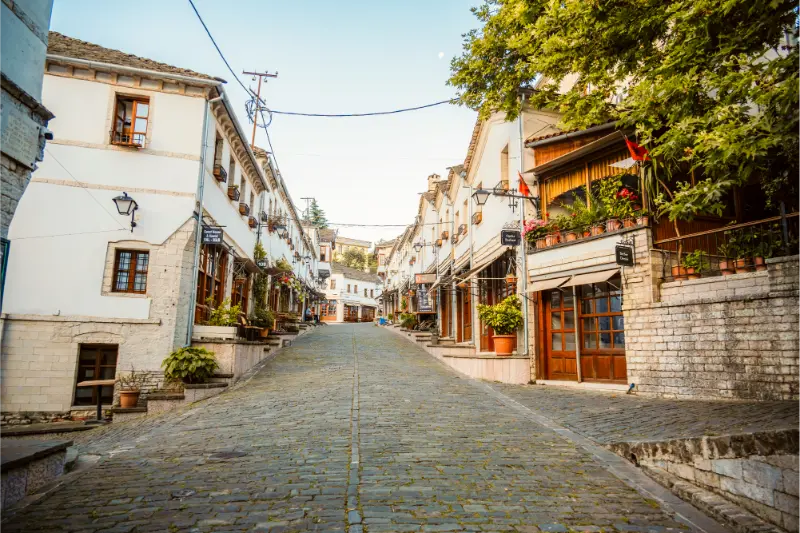
Before the trip, look at the official tourism information for Gjirokastër for current attractions and destination context. Opening arrangements, restoration work, seasonal access and events can change, so a photography plan should never depend on a single interior or viewpoint being available.
Photography at a glance
| Question | Practical answer |
|---|---|
| Best time of day | Early morning for clean compositions; late afternoon through blue hour for depth, people and atmosphere. |
| Best lens strategy | A wide or standard zoom plus a small prime; add a short telephoto when landscape layers or architectural details matter. |
| Tripod | Useful at dawn/blue hour when space allows; avoid blocking narrow streets, promenades or heritage paths. |
| Drone | Do not assume a scenic place is legal to fly. Check current Albanian airspace and site rules before every launch. |
| People photography | Prefer environmental scenes; ask before close portraits and always protect children’s privacy. |
| Bad-weather backup | Use the Gjirokastër rainy-day guide to turn wet weather into museums, reflections and sheltered street photography. |
Best photography spots in Gjirokastër
Gjirokastër Castle
The castle provides both monumental architecture and wide valley views. Side light emphasizes walls and defensive shapes; haze can reduce distant contrast, so use foreground stone to give the frame depth.
Old Bazaar
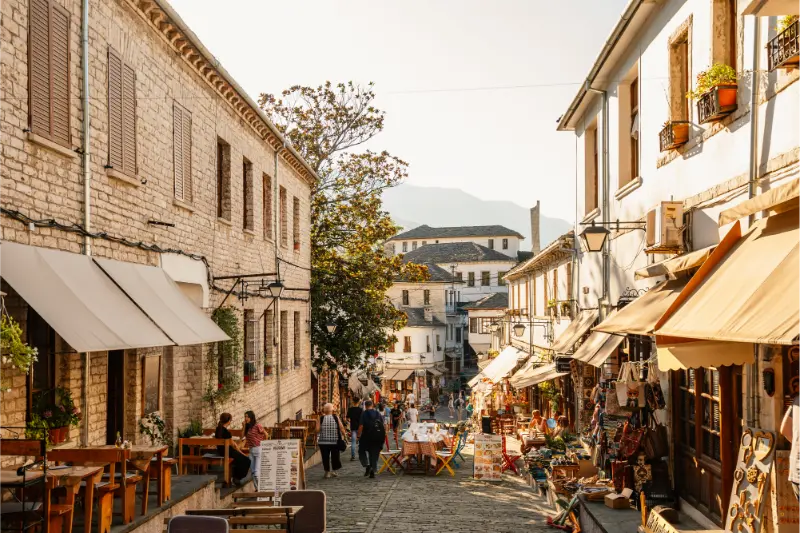
Early morning is quiet and architectural; late afternoon is better for people, shop lights and layered street scenes. Avoid blocking narrow lanes with a tripod.
Historic houses
Skënduli and other museum houses are valuable for interiors, woodwork and window light when photography is permitted. Check rules room by room and avoid flash around sensitive objects.
Stone-roof viewpoints
Small changes in elevation can reveal dozens of roof layers. A short telephoto is often more useful than an ultra-wide lens because it compresses patterns without including distracting modern streets.
Drino Valley
Use the valley as context from the castle or upper streets. Storm light, low cloud and autumn color can transform what looks flat in harsh noon sun.
Cobbled lanes after rain
Wet stone creates reflections and richer color, but it is extremely slippery. The photograph is not worth a fall; use shoes with grip and keep one hand free on steep descents.
How to plan the light instead of chasing locations
Start in the bazaar before shops fully open, climb to the castle while temperatures are lower, use the middle of the day for a historic house or lunch, then return to upper lanes for late light across roofs and the valley. Blue hour in the bazaar finishes the day well.
The most common photography mistake in Albania is treating golden hour as one exact moment. Mountains can block the sun earlier than the app suggests, coastal haze can reduce contrast, and historic streets may fall into shadow long before sunset. Scout one important location in daylight when possible, then return when the light improves. If clouds look promising, stay through blue hour rather than packing up immediately after the sun disappears.
Sunrise, golden hour and blue hour
Sunrise is valuable for more than color: streets are quieter, beaches are emptier and reflective surfaces are often calmer. Golden hour works best when side light can reveal stone, facades or hills. Blue hour is especially useful in Albanian towns because cafés, promenades and shopfronts become part of the scene while the sky still holds detail.
Use a weather app for direction and cloud, but observe the real horizon. A forecast showing clear sky can produce flat photographs; broken cloud can create far better light. If the forecast is poor, look for details, interiors, people and reflections rather than cancelling the camera day.
Street photography and photographing people
Artisans and shopkeepers can add scale and local character, but buy something, talk first and ask before making a close portrait. The bazaar is a workplace, not a portrait studio.
A useful rule is to separate public activity from private vulnerability. A wide frame of a market, promenade or café street is different from a telephoto portrait of somebody who does not know they are being photographed. Religious services, children, medical situations and people in swimwear deserve extra restraint. When a portrait is the point of the image, a simple request is usually the best approach.
Architecture and heritage: slow down
Old stone, churches, mosques, castles and archaeological sites often look better when you stop trying to photograph the entire building. Use arches as frames, look for repeating windows, isolate roof lines with a telephoto and include a person when scale helps. Inside museums and religious buildings, photography policies can vary by room or exhibition. Ask before using flash, tripod or professional-looking equipment.
Do not step beyond barriers, climb walls or move objects for a cleaner composition. Besides being unsafe, that turns cultural heritage into a prop. The best photographs make the site look worth protecting as well as worth visiting.
Drone photography: use the national rules guide
Albania has dramatic drone subjects, but a local photography guide should not be treated as flight permission. Airports, heliports, temporary restrictions, crowds, protected areas and individual heritage sites can all affect a launch. Read the current drone photography rules for Albania, check official airspace immediately before flying and keep a strong ground-photography plan so the trip still works when the drone stays packed.
On beaches and viewpoints, crowding is often the practical limit even when the landscape appears open. Wind is another major issue on ridges and along the Riviera: the conditions at your feet may be very different from those above a headland. Keep conservative battery reserves and never fly merely because other tourists are doing it.
What gear I would actually carry
- A standard zoom such as 24–70 mm equivalent for most city and travel work
- A small fast prime for evening street scenes and low-light interiors where photography is allowed
- A short telephoto for compressed landscapes, architectural layers and discreet detail
- A circular polarizer for water and foliage, used carefully so reflections do not disappear unnaturally
- One compact tripod only when dawn, blue hour or long exposure is a real priority
- Lens cloth, rain cover and a simple dry bag or zip pouch for electronics
- Spare battery or power bank; heat, cold and long screen use can reduce practical endurance
- Comfortable shoes with grip—often more important than carrying a fourth lens
Travel light enough that you can still explore normally. In steep cities and summer heat, an overloaded camera bag changes where you are willing to walk. I would rather carry two lenses and stay out until blue hour than carry every lens and return to the hotel exhausted at 16:00.
Phone photography: Albania is a good place to keep it simple
A recent phone is enough for many of the strongest travel images in Albania. Use the main camera for the best quality, clean the lens frequently, avoid excessive digital zoom and expose for highlights around white stone or bright water. Panorama mode is useful for viewpoints, but move slowly and avoid people close to the camera because stitching errors become obvious.
For night scenes, brace the phone against a stable surface instead of relying on extreme software brightening. If you edit, protect natural water and sky colors: the Ionian coast does not need maximum saturation to look impressive.
Seasonal photography
Spring and autumn give the best balance of greenery, clouds and comfortable walking. Summer is bright and hot on steep slopes. Winter can be atmospheric, with low cloud and quiet streets, but wet stone demands more caution.
Shoulder season is often the easiest choice for a photography-focused trip because you get usable daylight, fewer crowds and more flexible accommodation. Peak summer is still valuable if the goal includes beach culture and nightlife, but start early and accept that a busy resort is part of the real scene rather than something to erase from every frame.
Rain, cloud and imperfect weather
Do not automatically treat rain as a lost photography day. Wet stone, reflections, empty lanes and low cloud can produce some of the strongest frames. The Gjirokastër rainy-day guide gives indoor and sheltered alternatives, while a short shower can be the moment to wait under cover and photograph the light immediately after it passes.

Protect the camera before the rain becomes heavy, not after. Salt spray on the coast is especially important: wipe equipment with a clean damp cloth after exposure and never change lenses in blowing spray if you can avoid it.
Where to stay for a photography trip
Location changes photography more than hotel luxury. If dawn or blue hour matters, choose accommodation that lets you reach the first or final location without a complicated transfer. Compare accommodation in Gjirokastër on Booking.com, then check the actual map, walking gradient, parking and recent reviews rather than choosing only by the word “view.”
For camera equipment, a room safe is useful but not a substitute for normal care. Do not leave an entire camera bag visible in a parked vehicle. If charging multiple batteries, use reputable chargers and avoid covering them with clothing or leaving damaged batteries unattended.
A realistic one-day photography plan
Early morning
Photograph the location that depends most on empty streets, calm water or low-angle light. Keep breakfast flexible instead of sacrificing the first hour of good light.
Late morning
Switch to street detail, markets, interiors or architecture. This is a good time to visit a museum or scout the sunset location.
Midday
Use hard light deliberately for graphic architecture, or stop for lunch, backup files and a battery recharge. In July and August, this rest period also protects you from the least productive heat.
Late afternoon to blue hour
Return to the strongest viewpoint or social space and stay long enough for the scene to change. Photograph the transition rather than only the single sunset frame.
Extra photography excursion
Antigonea, the Blue Eye route or villages in the Drino Valley can add archaeological and rural landscapes to a city-focused set.
If you are building a longer route, the 10-day Albania photography road trip helps connect city, coast, lake and mountain locations without spending every golden hour driving.
Tours and guided experiences
A guided walk, boat trip, food experience or day tour can provide access and context that you would not find alone, but it should not be booked solely as a “photo tour” unless the operator says so. Ask whether there is time for photography, whether tripods or large bags are practical and whether a boat or vehicle has a dry place for equipment.
Common photography mistakes to avoid
- Arriving at the most famous location at midday and deciding the place is “not photogenic”
- Carrying so much equipment that steep streets, heat or long walks become unpleasant
- Using a tripod where it blocks pedestrians or narrow heritage lanes
- Over-saturating the sea, sky or old-town colors until the place no longer looks believable
- Photographing people closely without considering consent or context
- Assuming a drone can fly because another tourist launched one
- Leaving camera gear visible in a parked rental car
- Chasing a viewpoint in unsafe weather or after official closing time
- Ignoring blue hour and packing up immediately after sunset
Frequently asked questions
Is Gjirokastër good for photography?
Yes. Gjirokastër has enough variety for a dedicated photography day, especially if you plan around morning and evening light rather than trying to photograph every attraction at noon.
Do I need a professional camera?
No. A phone or small mirrorless camera is enough for most travel images. Timing, position and patience matter more than sensor size.
Can I use a tripod?
Usually in open public areas when it does not block anyone, but individual museums, archaeological sites and managed attractions can have separate rules. Ask when in doubt.
Can I fly a drone?
Possibly, but only when current Albanian aviation rules, airspace, crowd conditions and site-specific restrictions allow it. Check immediately before the flight.
What is the best season?
For most photographers, late spring and early autumn provide a strong balance of weather, daylight and manageable visitor numbers. Winter and peak summer can both work when their specific atmosphere is part of the story.
Final photography advice
The best Gjirokastër photographs will not come from collecting the greatest number of coordinates. Pick a few locations, learn how the light moves, stay through the transitions and include enough everyday life that the images could only have been made here. Use the destination as a place first and a backdrop second; the photographs normally improve as a result.
Leave a Reply