
Gjirokastër is defined by architecture more completely than almost any other Albanian city. Its stone-roofed houses, steep cobbled streets, bazaar and fortress form a coherent urban landscape adapted to the slopes above the Drino valley. UNESCO specifically recognizes its Ottoman-period tower houses and preserved historic urban form.
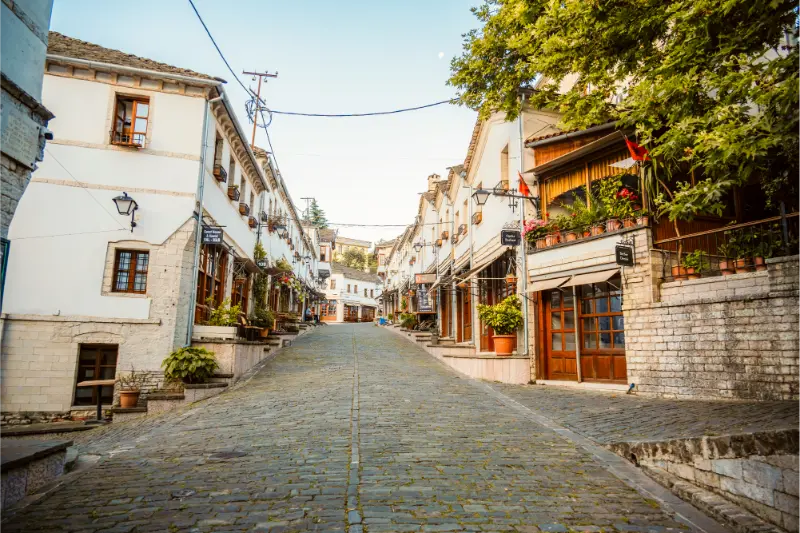
This architecture guide is for travelers who want to understand why Gjirokastër looks the way it does, not simply collect attractive façades. Use it together with the Gjirokastër travel guide and the national Traditional Albanian Architecture guide. Architecture in Albania is best read as a sequence of layers—ancient settlement, medieval defense, Ottoman urban life, religious coexistence, twentieth-century state building, socialism and rapid post-1990 change.
Why Gjirokastër matters architecturally
The castle dominates the defensive layer, but the houses explain daily life. Wealthy families developed fortified multi-storey residences—often described as tower houses or kulla—with stone lower levels, timber-framed upper spaces, service areas, guest rooms and carefully controlled openings. The bazaar organizes the commercial core, while mosques, churches and later civic buildings add further layers.
Do not look only for “old buildings.” Street width, topography, courtyards, defensive position, shopfronts, roof form and the relationship between sacred and civic buildings often explain the city better than one famous monument. Albania’s architecture is especially rewarding when you compare how the same materials—stone, brick, timber, plaster and concrete—are used for very different social purposes.
| What to notice | Why it matters in Gjirokastër |
|---|---|
| Street pattern | Shows whether the area grew organically, defensively, commercially or through formal planning. |
| Materials | Stone, brick, timber, plaster and concrete reveal local resources, technology and later restoration. |
| Roofline and skyline | Helps distinguish historic settlement form from later apartment, hotel or institutional development. |
| Religious buildings | Explain community history and the coexistence, suppression or revival of faith traditions. |
| Adaptation | Shows how old buildings are reused as homes, museums, hotels, shops, cafés or public spaces. |
| Topography | In Albania, slope, river, coast and fortress position often determine the architecture as much as style. |
The main architectural layers to look for
The castle dominates the defensive layer, but the houses explain daily life. Wealthy families developed fortified multi-storey residences—often described as tower houses or kulla—with stone lower levels, timber-framed upper spaces, service areas, guest rooms and carefully controlled openings. The bazaar organizes the commercial core, while mosques, churches and later civic buildings add further layers.
Keep period labels flexible. A building may have an ancient foundation, medieval walls, Ottoman alterations and a modern restoration. A neighborhood can preserve a historic street pattern even when individual façades are recent. The most accurate way to read the city is therefore to separate date, style, function and present condition rather than forcing every structure into one label.
A self-guided architecture route
Begin from the lower edge of the old town and climb gradually through the bazaar rather than taking a taxi straight to the castle. Visit one major house museum such as Zekate or Skënduli slowly enough to understand room hierarchy, heating, storage and hospitality. Then climb to the castle to read the entire settlement from above and see how the neighborhoods fit the slope.
- First stop: Zekate House Guide — use it to establish the oldest or most defining layer of the city.
- Second stop: Skënduli House Guide — compare a different function, period or type of building.
- Third stop: Gjirokastër Castle Guide — finish with a site that adds domestic, civic or later architectural context.
Allow at least one unplanned detour. The most revealing architecture is often between headline sights: a courtyard gate, a retaining wall, a row of shopfronts, an apartment entrance, a restored school or an ordinary house that still follows an older plot boundary.
Materials, construction and details
Stone is the city’s defining material: walls, roofs, paving and retaining structures create a heavy visual unity. Timber appears in upper floors, ceilings and carved interiors, while plastered rooms soften the domestic spaces inside. The architecture makes sense only when you connect materials with climate, defense and status.
Look at joints and transitions rather than surfaces alone. A new roof on an old stone wall, concrete added behind a historic façade or modern windows inserted into a traditional opening can tell you how a building has been repaired and adapted. Restoration is not automatically “fake,” and decay is not automatically “authentic.” Good conservation tries to keep cultural value while allowing safe contemporary use.
How the twentieth and twenty-first centuries changed the city
Modern construction mostly sits outside the tight historic core, but pressure from tourism, parking and accommodation conversion affects the old city. Restored houses can be excellent places to stay, yet changes for bathrooms, heating and safety need to respect historic fabric.
For national context, the Modernist and Communist-Era Architecture in Albania guide explains how public buildings, housing and urban space changed during the socialist period and after it. In cities where the Ottoman layer remains strong, the Ottoman Heritage in Albania guide helps separate surviving historic fabric from later reconstruction or tourist styling.
Architecture and topography
Always step back and ask why the settlement is exactly where it is. Hilltop castles control routes and views; rivers create bridge crossings and flood constraints; ports reorganize streets around trade; mountain slopes produce terraces and retaining walls; coastal tourism pushes development toward sea views. Gjirokastër becomes much easier to understand when the landscape is treated as part of the architecture rather than as background scenery.

Use a map before the walk, but do not let it flatten the city. Contour lines explain why a 600-metre route can feel difficult, and historic districts often use stairs or lanes that do not behave like modern roads. If mobility is limited, choose one architectural cluster and use a taxi between levels rather than forcing an exhausting “complete” route.
Religious architecture and respectful visiting
Albanian cities frequently place mosques, Orthodox churches, Catholic churches, tekkes and secular civic buildings within walking distance. This is not only visually interesting; it reflects periods of coexistence, political change and religious suppression followed by revival. Active places of worship should be visited as religious spaces first and architecture second.
- Check whether a service or prayer is taking place before entering.
- Dress with reasonable modesty and follow signs about shoes, head coverings or photography.
- Disable flash around frescoes, icons and delicate interiors.
- Do not photograph worshippers closely without permission.
- Keep voices low and move aside when local users need the space.
Conservation, restoration and what can change
Stone streets become slippery in rain, and old houses contain steep stairs and low thresholds. Heritage protection is also about behavior: avoid leaning on fragile railings, touching painted surfaces or entering private terraces for a view.
Heritage sites can close rooms, reroute visitors or begin restoration with little relevance to an old blog post. That is why this guide avoids promising access to every interior. Check the official site, museum page or local signage on the day. If a building is closed, use the exterior, street context and neighboring sites to keep the architectural walk meaningful.
Photography: the best way to document architecture
Early morning is usually best for streets and façades because traffic is lighter and shadows reveal depth. Late afternoon works well for hill towns, stone walls and west-facing waterfronts. Midday can be useful for interiors and narrow lanes where direct sun is less important. Take one wide establishing image, one medium view of the building in its street and several details—doors, masonry, roofs, inscriptions or joinery—rather than thirty nearly identical wide-angle shots.
Correct perspective sparingly if you edit photographs; extreme correction can make historic streets look unnaturally flat. A small lens or smartphone is often easier than a large camera inside religious buildings and homes. Tripods and drones deserve extra care because they can obstruct residents, violate site rules or create safety problems in tight streets.
Where to stay if architecture is your priority
Choose accommodation by neighborhood and building type, not only star rating. A restored historic house can add enormous value to the trip, but it may also mean steep stairs, small bathrooms, low ceilings, street noise or limited parking. A modern hotel outside the heritage core can be easier if you need an elevator, sound insulation or car access.
Compare accommodation in Gjirokastër on Booking.com, then read recent reviews for stairs, heating/air-conditioning, parking and noise. If a property claims to occupy a protected or historic building, ask what is original and what has been reconstructed rather than assuming every visible detail is centuries old.
Museums and interiors: when they add real value
An architecture trip improves when at least one interior explains how a building worked. House museums reveal room hierarchy, storage, heating, family privacy and hospitality. Archaeological museums explain construction fragments out of context. Religious interiors reveal iconography, fresco, woodwork and spatial ritual. Choose one or two meaningful interiors instead of paying for every museum simply because it is nearby.
Ask whether interpretation is available in English and whether photography is permitted. In traditional houses, a guided explanation can be more valuable than extra time because room function is not always obvious to a modern visitor.
A one-day architecture itinerary
- 08:00–10:00: photograph and walk the historic core while streets are quiet.
- 10:00–12:00: visit the first major monument and one interior or museum.
- 12:00–14:00: lunch and a slow street-level walk; notice ordinary buildings, not only landmarks.
- 14:00–16:00: rest, museum or shaded interior during the hottest hours in summer.
- 16:00–18:30: complete the second architectural cluster or viewpoint.
- Golden hour: return to the best skyline or façade rather than racing to another town.
Best season for architecture-focused travel
Spring and autumn are generally easiest: comfortable walking temperatures, longer daylight than winter and fewer peak-summer crowds. Summer works if you start early and protect the middle of the day. Winter can be excellent for museums and empty streets, but rain, short daylight and cold interiors matter—especially in stone cities and the southeast.
After rain, cobbles and polished stone can become slippery. In mountain or hill towns, frost may be a factor. Architecture travel is often slow by nature, so there is little reason to rush difficult surfaces simply to keep an itinerary on time.
The best architectural extension from Gjirokastër
Antigonea provides a completely different ancient urban plan nearby, while Labova of the Cross adds medieval religious architecture in a village setting. Either makes a better architectural extension than simply adding another panoramic café.
If your itinerary includes several heritage cities, use the UNESCO World Heritage Sites in Albania guide to decide how Berat, Gjirokastër and Butrint fit together. The strongest architecture trip mixes different building traditions rather than repeating ten fortresses in a row.
Official source for context
For destination and heritage context, consult UNESCO – Historic Centres of Berat and Gjirokastra. Use official sources for history and site significance, but recheck live opening hours, restoration work, ticketing and temporary access separately before the visit.
Tours and guided walks
A good guide is especially useful when you want to understand building function, restoration or historical layers rather than simply locate monuments. Read itineraries carefully: a “city highlights” tour may spend little time on architecture, while a private guide can often adapt the route around a specific interest.
Common architecture-travel mistakes
- Photographing façades without learning what the building was used for.
- Assuming every old-looking structure is original rather than restored or reconstructed.
- Ignoring ordinary residential streets because only monuments appear in guidebooks.
- Entering worship spaces during services for a photograph.
- Climbing walls, roofs or ruins for a better angle.
- Judging socialist or post-1990 architecture only as “ugly” instead of reading its historical function.
- Trying to cover an entire historic center at midday in July or August.
- Booking a historic hotel without checking stairs, heating, parking and sound insulation.
- Using a drone without checking aviation, heritage-site and privacy rules.
- Visiting ten sites quickly instead of revisiting one street in different light.
Frequently asked questions
How long do I need for an architecture-focused visit to Gjirokastër?
One full day is enough for the main urban layers if you plan carefully, but two nights make the experience much better because you can see key streets in both morning and evening light and include at least one interior without rushing.
Do I need an architecture guide or can I explore independently?
You can explore independently with this route and the linked site guides. A local guide becomes especially valuable for house interiors, archaeological phases, religious symbolism, restoration history and buildings that are easy to misread from the street.
Is the historic center easy to walk?
That depends heavily on topography. Old Albanian towns often have cobbles, slopes, stairs and irregular surfaces. Check the destination accessibility and taxi guides if mobility or endurance is a concern.
Can I photograph inside churches and mosques?
Rules vary. Look for signs, ask when unsure, avoid flash around delicate art and never prioritize a photograph over worship or privacy.
What is the best architecture book or theme to study before the trip?
Start with the national guides on traditional architecture, Ottoman heritage and modernist/communist architecture linked above. They give enough vocabulary to recognize houses, bazaars, mosques, civic planning and socialist-era buildings without turning the trip into an academic exercise.
Final advice
The best architecture walk in Gjirokastër is not the one with the most monuments. It is the one that helps you understand how landscape, materials, belief, trade, political power and daily life produced the city you see today. Slow down, compare periods, revisit one street in different light and leave enough space for ordinary buildings—the places between landmarks are often where Albania’s urban history becomes most visible.
How to read Gjirokastër like an architecture traveler
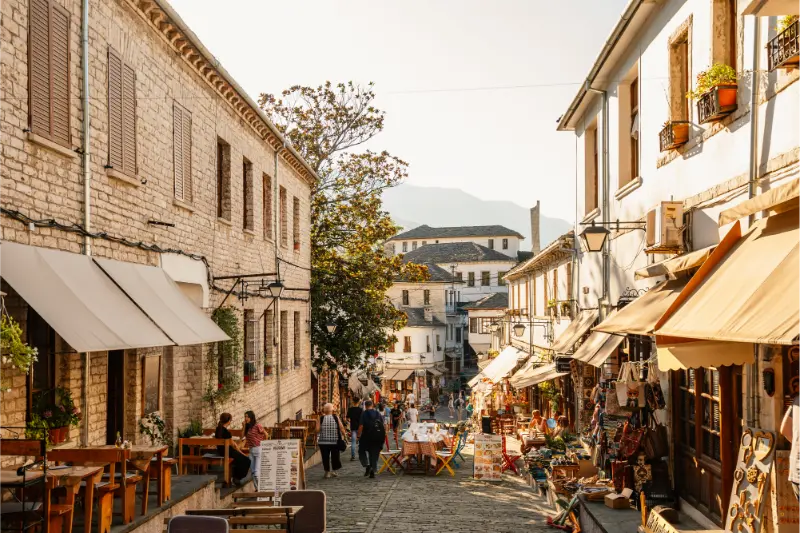
On your first pass, look at the whole street. On the second, compare ground floor and upper floor. On the third, notice what has been added: air-conditioning units, shop signs, new balconies, reinforced concrete, replacement windows, repaired roofs or repointed stone. These small interventions show how heritage adapts to present-day comfort and commerce.
Then ask who the building was designed for. A fortress protects movement; a bazaar organizes trade; a tower house separates service, family and guest space; a mosque or church directs attention toward worship; a socialist civic building projects state authority; a modern seafront hotel sells light and views. Function makes style much easier to understand.
Finally, compare the official monument with the neighborhood around it. The landmark may be restored and interpreted, but nearby houses, retaining walls, garages and cafés reveal how the city actually works. This is especially important in Albania, where tourism can concentrate attention on a very small number of photogenic buildings while equally informative urban fabric remains one street away.
Leave a Reply