
Accessible Travel in Vlorë: Lungomare, Beaches, Hotels and Mobility Planning is not a list of places that I am labelling wheelchair-accessible. It is a practical planning guide for travelers who use a wheelchair, have limited walking stamina, use a cane or rollator, travel with an older relative, or simply need to reduce steps, slopes and long transfers.
Accessibility in Albania is improving, but it remains inconsistent. Historic centers, public pavements, transport and older buildings can still present barriers, and a venue that is technically open to the public may not have a step-free route through every area. The safest approach is to plan around terrain first, then verify the exact hotel, attraction and transport features that matter to you.
Vlorë combines a long coastal city with older inland streets and hilly surroundings. The Lungomare and waterfront zones are the easiest foundation for mobility planning, while Kaninë, Llogara, hillside viewpoints and many nature excursions require more effort or vehicle support.
At a glance
| Question | Practical answer |
|---|---|
| Best base | For the simplest daily routine, stay directly on or just behind the Lungomare in a hotel with lift, step-free entrance and taxi access. The historic center is attractive but can involve mixed surfaces; Radhimë and Uji i Ftohtë are good only when your specific hotel solves beach access. |
| Getting around | Taxis are useful because Vlorë is elongated. A route that looks like one seaside district can still be several kilometers. Local buses exist, but accessible boarding and stop infrastructure should be checked if you rely on them independently. |
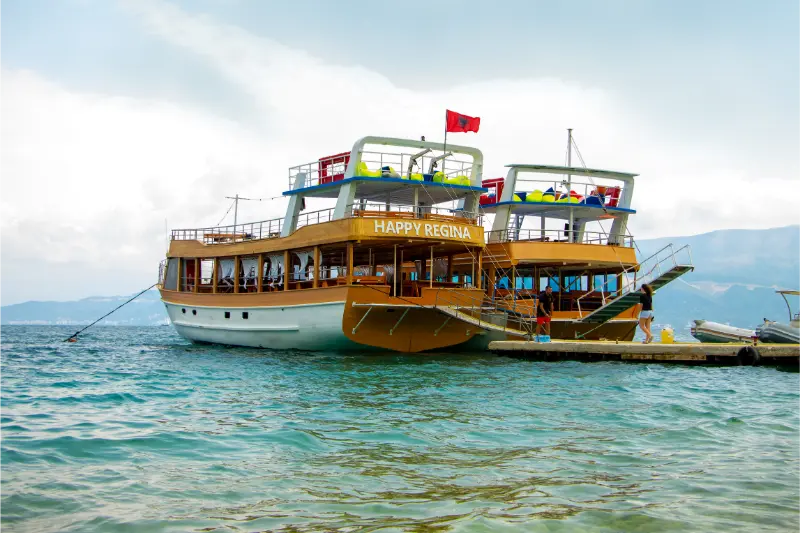
| Main challenge | Kaninë Castle, Llogara viewpoints, Karaburun boat excursions and wild beaches all need individual access checks. Boat boarding is particularly variable and may be unsuitable without a transfer plan. |
| Best season | May–June and September are the easiest. Peak summer heat makes long promenade distances more tiring, while winter wind can affect waterfront comfort and boat operation. |
Where to stay for easier access
For the simplest daily routine, stay directly on or just behind the Lungomare in a hotel with lift, step-free entrance and taxi access. The historic center is attractive but can involve mixed surfaces; Radhimë and Uji i Ftohtë are good only when your specific hotel solves beach access.
When booking, I would not rely only on an ‘accessible room’ filter. Message the property and ask for the exact route from street or taxi drop-off to reception and room. If the trip depends on a roll-in shower, grab bars, shower chair, bed height, lift dimensions or step-free breakfast access, request confirmation in writing.
Compare current accommodation in Vlore on Booking.com. Use the booking platform to shortlist properties, then contact the hotel directly about the specific access features you need.
Hotel accessibility checklist
- Step-free route from street or taxi drop-off to reception.
- Lift/elevator from entrance level to the room, with dimensions suitable for your mobility aid.
- No hidden steps between lift, room, breakfast area and main exit.
- Bathroom layout that matches your needs: roll-in shower, grab rails, shower seat or enough turning space.
- Bed height and clearance that work for transfers if that is relevant.
- A taxi can stop close to the entrance rather than at the bottom of a historic lane.
- Air conditioning or heating appropriate to the season.
- A quiet room if fatigue or sensory overload makes nightlife noise difficult.
Getting around
Taxis are useful because Vlorë is elongated. A route that looks like one seaside district can still be several kilometers. Local buses exist, but accessible boarding and stop infrastructure should be checked if you rely on them independently.
If a standard taxi cannot accommodate your wheelchair or mobility equipment, arrange transport before arrival rather than expecting an accessible vehicle to be available on demand. If you travel with a foldable wheelchair or rollator, tell the driver in advance so the boot space is not a surprise.
For public transport, route existence does not equal accessible boarding. Low-floor vehicles, ramp deployment, stop design and crowding can vary. If independent boarding is essential, confirm locally and keep a taxi alternative in the plan.
Areas and sights that are easier to plan
Lungomare
The waterfront is the strongest low-gradient public-space option, with cafés, sea views and many places to pause. Surface changes and crossings still require attention, but it is easier than many historic cores.
Independence Square / historic center with short transfer
A taxi can reduce the distance and let you explore one compact cultural block rather than crossing the whole city on foot.
Uji i Ftohtë hotel zone
If your hotel has direct lift-to-street access and a manageable beach path, this can be an excellent low-transfer base. Do not assume sea-view equals easy water access.
Zvernec by private vehicle
The lagoon can be a scenic drive, but the monastery approach includes a footbridge and natural surfaces. Enjoy viewpoints even if the full walking route is not practical.
The main accessibility barriers
Kaninë Castle, Llogara viewpoints, Karaburun boat excursions and wild beaches all need individual access checks. Boat boarding is particularly variable and may be unsuitable without a transfer plan.
Historic authenticity often creates exactly the obstacles that modern accessibility standards try to remove: cobbles, thresholds, steep ramps, narrow doors, irregular stairs and buildings spread across several levels. It is better to enjoy a meaningful part of a site than to treat the inaccessible section as a failed visit.
A realistic low-strain day
Use one day for the Lungomare and central history, with taxi transfers between them. Keep a second day for one carefully chosen coast or lagoon excursion. This prevents the common mistake of combining several long coastal transfers with substantial walking.
I would leave at least one empty hour in the middle of the day. That buffer can become a rest, a taxi delay, a longer lunch or simply time to recover from a surface that was harder than expected. A flexible schedule is one of the most effective accessibility tools.
Wheelchair users: what to verify before arrival
- The exact surface between vehicle drop-off and entrance: smooth pavement, cobbles, gravel, sand or steps.
- The steepest gradient on the route, not just the total distance.
- Whether doors are wide enough and thresholds are flush.
- Whether lifts actually reach all public floors.
- Accessible toilet availability and whether it is kept unlocked for visitors.
- Whether a companion is required for any ramp, transfer or boat boarding.
- If batteries or powered mobility equipment are involved, charging arrangements at the hotel.
Travelers with limited walking stamina
Limited stamina can be easier to plan for than strict step-free access because taxis can remove many long transfers. I would build the day from short clusters: one museum plus lunch, one promenade section plus dinner, or one castle viewpoint with a vehicle drop-off. Avoid itineraries that cross the destination repeatedly just because the map makes the distances look small.
Benches and café stops are valuable, but they should not be the only rest strategy. A proper hotel break can prevent the second half of the day from becoming uncomfortable.
Visual, hearing and sensory access
Vlorë can work very well when the hotel, promenade and restaurant zone are chosen as one cluster. The city becomes harder when you book a cheap room far inland and then need multiple long taxi or walking transfers to every activity.

For visual or hearing access more generally, contact the attraction before the visit and ask about written material, audio guides, captioning, lighting, staff-guided alternatives and whether assistance animals are accepted under the venue’s current rules. These services are not consistent enough to assume across Albania.
Weather and season
May–June and September are the easiest. Peak summer heat makes long promenade distances more tiring, while winter wind can affect waterfront comfort and boat operation.
Weather can turn a manageable route into a difficult one. Rain makes stone and polished paving more slippery, heat increases fatigue and dehydration, and snow or ice can transform southeastern or mountain destinations. Check the short-range forecast and be willing to change the order of the itinerary.
Day trips and excursions
For a mobility-sensitive day trip, a private scenic drive through Radhimë/Orikum can be easier than a full Karaburun boat tour or Llogara hike. Ask the driver to plan frequent close-to-car viewpoints.
For any excursion sold as ‘easy’, ask for actual walking distance, surface, number of steps, toilet access and the distance between the vehicle and the attraction. Marketing language such as ‘easy tour’ often refers to the average traveler, not to a specific access requirement.
Traveling with a companion or personal assistant
A companion can help with luggage, kerbs, doors and communication, but the itinerary should not assume that another person can safely lift a wheelchair or physically compensate for a badly designed route. If a transfer requires lifting or specialist handling, arrange trained assistance rather than improvising.
Arrival day strategy
I keep arrival day intentionally light. Check in, test the hotel entrance and lift, identify the nearest pharmacy or supermarket, confirm how taxis pick up from the property, then do one short outing close to the hotel. This gives you real information about the destination before the first full sightseeing day.
What I would not pre-book too tightly
I avoid stacking a non-refundable morning attraction, a fixed lunch, a long afternoon tour and a timed evening experience. If the first route takes longer because of paving, a lift issue or taxi delay, the entire day becomes stressful. One fixed booking per half-day is usually enough.
Medical and practical preparation
Bring essential medication in hand luggage and keep a written list of generic medicine names. If you use mobility equipment, carry basic repair items that are appropriate for your device. Travel insurance should match your personal circumstances and planned activities. For individual medical fitness-to-travel questions, use your own clinician rather than relying on a destination article.
National accessibility context
Albania has legal and policy commitments on disability inclusion, but practical accessibility remains uneven. Recent Council of Europe work in Albania continues to identify accessibility in buildings, sidewalks and transport as a real inclusion issue. That is why this guide avoids promising that an attraction is fully accessible unless the venue itself can confirm the exact feature you need.
Read the Council of Europe discussion of accessibility and disability barriers in Albania.
Useful related guides
- Accessible Travel in Albania
- Main destination travel guide
- Where to Stay guide
- Transport / without-a-car planning
- Related easier-paced planning guide
Official destination information
For current destination attractions and tourism information, see Albania’s official tourism page for this destination. Opening times, construction work and access arrangements can change, so confirm any essential feature shortly before the visit.
Frequently asked questions
Is Vlore wheelchair accessible?
I would not describe the entire destination that way. Some zones are much easier than others, while historic sites, cobbles, hills and older buildings can create significant barriers. The practical answer depends on your wheelchair, transfer ability, companion support and the exact places you want to visit.
Can I rely on taxis?
Standard taxis are useful for reducing walking, but they are not automatically wheelchair-accessible vehicles. If you need to remain seated in your wheelchair during transport, arrange a suitable vehicle in advance.
How should I choose a hotel?
Choose location and verified physical access before décor. Ask about steps, lift dimensions, bathroom layout and taxi drop-off, and request photos or video when one feature is essential.
Should I rent a car?
A car can reduce transfers outside city centers, but parking, cobbled historic zones and getting in and out of the vehicle can add their own barriers. A private driver is often easier when you want close drop-offs without managing parking.
What is the best season for travelers with limited mobility?
Usually spring or early autumn because temperatures are milder and crowds are lower. The destination-specific weather section above explains the main local exception.
Final recommendation
The best accessible itinerary is not the one that proves you can complete every famous sight. It is the one that gives you the destination’s character with the least avoidable friction. Verify the hotel carefully, use taxis strategically, choose one demanding historic site only when it matters to you, and keep enough flexibility to replace a difficult route with an easier cultural, food or waterfront experience.
Leave a Reply