
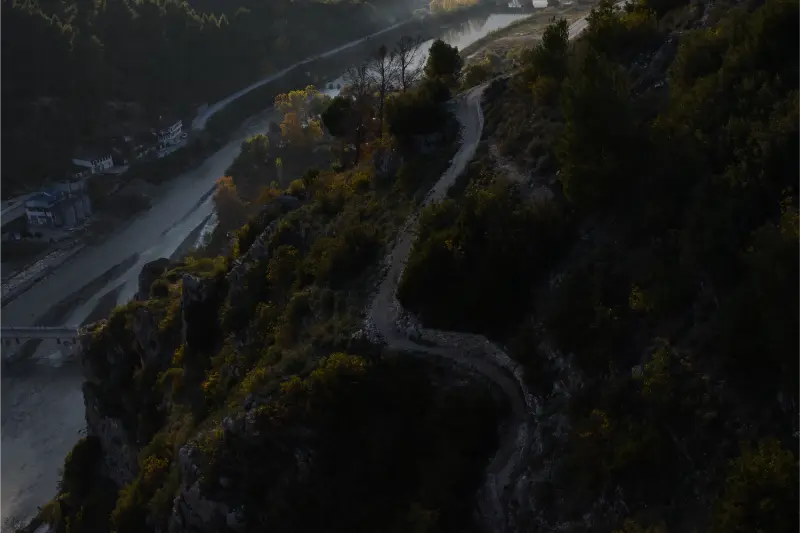
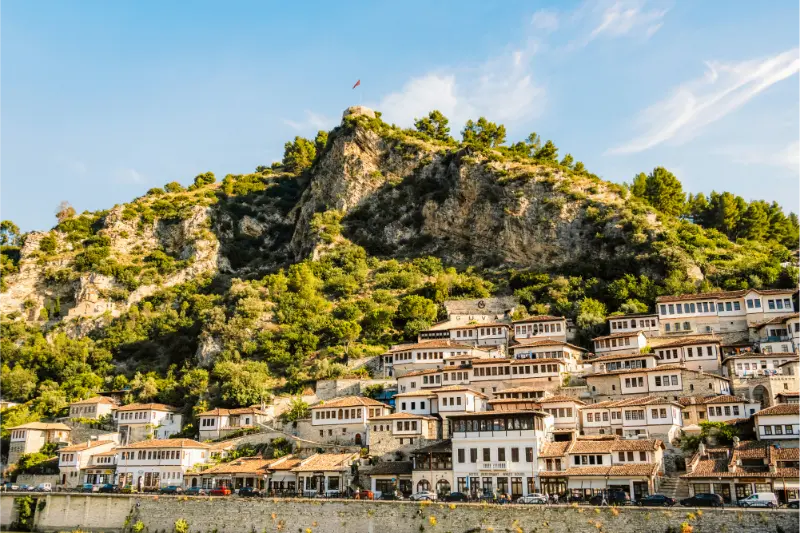
accessible Berat is best approached as a route-planning question rather than a yes-or-no label. Berat is beautiful precisely because it climbs the slopes around the Osum River, and that historic form creates genuine accessibility challenges. The riverfront and newer city areas are comparatively easy, while Mangalem, Gorica and especially the castle introduce cobbles, gradients and steps. A traveller with reduced mobility should not write Berat off, but the successful version of the trip is selective: stay in the right area, use a vehicle strategically and focus on the views and heritage that can be reached safely.
This guide is for travellers who use a wheelchair, walker or cane, people with temporary injuries, reduced stamina, balance limitations, sensory needs, and anyone travelling with a companion who benefits from fewer stairs and more predictable transfers. It is not an accessibility certification. Conditions can change, and two rooms in the same hotel can have completely different bathroom layouts. Confirm every non-negotiable requirement directly before paying a non-refundable rate.
How accessible is Berat in practical terms?
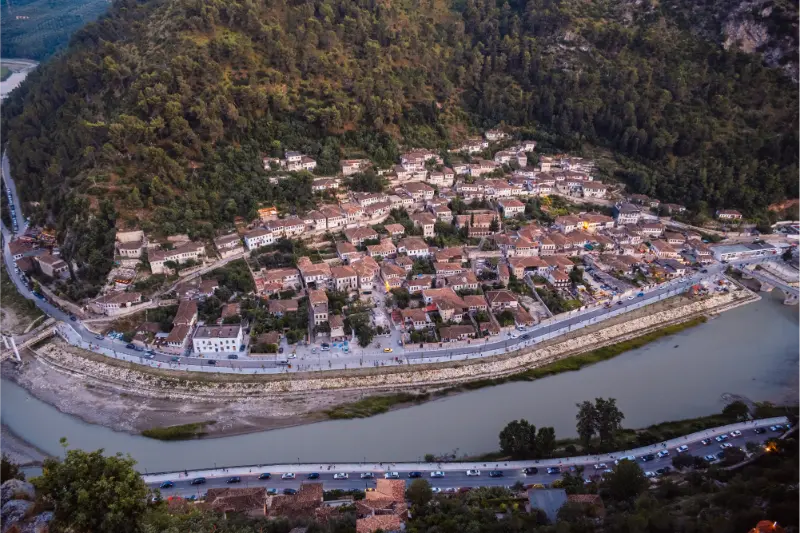
The riverfront provides the gentlest orientation route and views toward Mangalem. Crossing to Gorica and entering historic lanes introduces more uneven stone. Mangalem’s beauty comes from its hillside layout, so there is no honest way to describe it as uniformly easy. Plan short loops, use café breaks and turn back before fatigue makes the descent unsafe. A cane user may find polished stones harder downhill than uphill.
I separate access into four layers: getting to Berat, reaching the hotel entrance, moving around the neighbourhood, and entering the specific attraction or beach. Solving three of those layers does not automatically solve the fourth. A taxi may bring you to a castle gate, for example, while the internal route still uses uneven stone. This layered way of planning prevents the common mistake of calling an entire destination accessible because one part of the journey is easy.
The best area to stay for easier mobility
For easier daily movement, choose a modern hotel near the river or in the flatter central area rather than inside the castle. Mangalem is atmospheric, but traditional guesthouses may involve steep approaches and internal stairs. Before booking, ask whether a vehicle can stop at the entrance, whether reception and breakfast are step-free, and whether the room itself requires stairs. A few saved metres of climbing can transform the stay.
When comparing hotels, open the map and examine the final block rather than only the distance to the centre. Then compare accommodation in Berat and contact the short-listed properties. Ask for photographs if a shower threshold, turning circle, grab rail, lift size or doorway width matters. A written reply is much more useful than a generic filter saying “facilities for disabled guests”.
- Is there a step-free route from street or parking area to reception?
- Does the lift start at entrance level and reach the room, breakfast area and any pool?
- Can the bathroom be entered and used with my exact mobility equipment?
- Can a taxi or adapted vehicle stop close to the entrance?
- Are there steps to the restaurant, terrace, beach or other facilities I plan to use?
- If a feature is essential, can the property confirm it in writing and identify the exact room type?
Arrival and transfers
The intercity bus station is outside the postcard core, so a taxi from the station to the hotel is sensible for many travellers with mobility limitations. Tell the driver about a folding wheelchair or walker before pickup if luggage space matters. If arriving by private car, confirm parking because the most charming lanes may have limited vehicle access. The final transfer from car to door is often more important than the motorway journey.
If you can transfer into a normal car and use a folding wheelchair, ordinary taxis may be workable, but boot size varies. Tell the company the chair dimensions and number of bags. If you need a ramp or lift-equipped vehicle, treat that as a specialist service and reserve it well in advance. The Berat without a car guide is useful for understanding normal transport, but do not assume a standard bus or taxi meets a specific accessibility requirement.
Street surfaces, kerbs and crossing roads
In Berat, the condition of the next 100 metres matters more than a city-wide accessibility score. Look for high kerbs, drainage channels, broken paving, steep driveways, parked scooters and café furniture. A route that is comfortable in the morning may become narrower in the evening when restaurant terraces expand. If you use a manual wheelchair, small front casters are especially sensitive to gaps and textured paving; a companion may be useful even on routes that appear level.
Download offline maps and save the hotel, pharmacy, taxi pickup point and two or three reliable restaurants. The shortest walking route is not always the easiest route. If a longer road has a smoother pavement or gentler gradient, use it. Ask hotel reception which side of a square or promenade has the simplest surface; local staff often know practical details that mapping apps do not show.
Sightseeing: choose the experience, not the checklist
Berat Castle is a living historic citadel on high ground. Driving or taking a taxi toward the entrance can remove much of the climb, but the internal lanes, church approaches and viewpoints remain uneven. Decide in advance what you most want to see rather than trying to cover every corner. The Onufri Museum and religious buildings should be contacted directly if step-free entry or an adapted toilet is essential.
For any must-see venue in Berat, contact the operator close to your travel date if you need step-free entry. Ask about the entire visitor route, not only the front door. Useful questions include the number and height of steps, lift dimensions, surface type, distance from vehicle drop-off, seating, accessible toilets and whether staff assistance is normally available. If the answer is vague, assume you need a backup plan.
Taxis, private drivers and mobility equipment
A private driver can be one of the highest-value upgrades in Berat because it eliminates repeated boarding, long waits and unnecessary walking between transport nodes. It is especially helpful when a day includes a hill, a rural restaurant or an attraction outside the centre. Send a photo of the wheelchair or walker if storage could be an issue. Confirm whether the driver can physically assist with equipment; do not assume lifting is part of the service.
Wheelchair-accessible vans with ramps or lifts are a different category from ordinary taxis and may be limited. Reserve early. If you can transfer independently, ask for a vehicle with a seat height that works for you. Someone with knee or hip limitations may prefer a higher vehicle, while another traveller may find a high SUV difficult. “Accessible transport” is personal, so describe the transfer you actually need.
Toilets, cafés and rest breaks
Accessible public toilets are not something I would rely on finding spontaneously throughout Berat. Plan around your hotel, larger modern restaurants, shopping centres where relevant, museums that confirm adapted facilities, or another venue you have checked. Ask before ordering if the toilet matters; a ground-floor dining room can still have a bathroom up a narrow staircase.
For reduced stamina, cafés are part of the accessibility plan rather than an afterthought. Build a route with a seated break every 45–90 minutes depending on your needs. A short taxi ride back to the hotel at midday can preserve enough energy for an evening outing. This is particularly important in summer, when heat can magnify fatigue and make an otherwise manageable slope much harder.
Health, medication and a backup plan
Carry essential medication and any specialised consumables you cannot easily replace. Keep a concise medication list and emergency contact on the phone and offline. For destination-specific medical logistics, save the Berat health and pharmacy guide. For a medical emergency in Albania, call 127. If a chronic condition can worsen with heat, exertion or long transfers, follow your clinician’s individual advice rather than a generic travel itinerary.
Have a “short day” version of every plan. That might mean the promenade and lunch instead of a castle, one museum instead of three, or a taxi viewpoint instead of a long walk. This is not a lesser trip. It is a resilient itinerary that can adapt to pain, fatigue, weather or an equipment problem without losing the whole day.
Day trips and nearby places
Osum Canyon and rural wineries add vehicle access and natural terrain to the equation. A scenic drive to viewpoints or a winery with level parking may be realistic, while rafting and rough canyon trails require a different level of mobility. Ask tour companies to describe walking distance from vehicle to activity, number of steps and toilet conditions before booking. ‘Easy tour’ is too vague for accessibility planning.
When booking a tour from Berat, tell the operator what matters operationally without sharing unnecessary medical details. Ask how many times you enter and exit the vehicle, the longest walking segment, surface type, number of steps, toilet availability and whether the schedule can pause. A tour advertised as “easy” may still mean 800 metres of cobbles; numbers are more useful than adjectives.
Weather and the best season for easier travel
Summer heat intensifies Berat’s slopes, particularly on exposed stone around the castle. Early morning is the best time for uphill sightseeing, with the riverfront saved for evening. Rain can make cobbles slippery. Spring and autumn are often preferable for reduced-stamina travellers, though shorter daylight means you should not rush a historic route late in the day.
Weather also affects surfaces. Rain can make marble, polished stone, boardwalks and old paving slippery. Strong sun can create glare for travellers with low vision, while crowded peak-season pavements can be stressful for people who need more processing time or personal space. Choose the season that reduces the barrier most relevant to you rather than following a generic “best time to visit Albania” recommendation.
Sensory and invisible disabilities
Accessibility is not only about steps. If you are deaf or hard of hearing, prefer written confirmations for transfers and hotel arrangements and keep the address visible on your phone. If you have low vision, ask the property about stair contrast, lift controls and lighting. Travellers with autism, cognitive disabilities or anxiety may benefit from a predictable first day, a quieter hotel room and prearranged transfers that remove negotiation after arrival.
Noise levels in central Berat can change sharply between day and night. If sleep or sensory load is important, ask for a room away from bars, elevators and street traffic. A central location can reduce transport stress, but the quietest room may face an inner courtyard rather than the main view. The best accessible room is the one that fits the whole set of needs, not just physical entry.
A realistic one-day accessible itinerary
Start with breakfast at the hotel and one easy central route rather than a long transfer. Visit the most important sight that has confirmed access, then take a seated lunch close by. Return to the hotel for a rest or use a taxi to avoid repeating difficult pavement. In the late afternoon, choose a promenade, square, café district or viewpoint that fits your energy. Keep dinner within a short ride of the hotel. This structure leaves enough margin for slower crossings, waiting for lifts and unexpected barriers.
For a two- or three-night stay, use the Berat travel guide to choose the experiences that matter most, then apply the accessibility filter described here. Do not attempt to convert the standard itinerary line by line. A route designed around your actual mobility usually produces a better trip than a conventional itinerary with emergency modifications.
Common accessibility mistakes to avoid
- Booking from an accessibility filter without confirming the exact room and bathroom.
- Assuming a flat city means every pavement, kerb and attraction is step-free.
- Choosing a picturesque historic guesthouse without checking stairs from street to room.
- Planning several hilltop or archaeological attractions on the same day.
- Expecting a normal taxi to carry a rigid or powered wheelchair without advance notice.
- Relying on old reviews for lifts, ramps or beach decking that may have changed.
- Forgetting that heat, rain and crowding can turn a manageable route into a difficult one.
- Treating “wheelchair friendly” as a technical specification instead of asking for measurements and photos.
Useful official and practical links
For broad planning, use UNESCO Historic Centres of Berat and Gjirokastra for heritage context. Official information is useful, but it does not replace confirmation from the individual hotel, attraction, ferry, airline or tour operator. Keep screenshots of important replies offline in case mobile data is weak when you arrive.
For tours and bookable activities, compare the activity description carefully and message the operator about access before booking. “Private” does not automatically mean accessible, but a private format can make pacing and pickup much easier.
Frequently asked questions
Is Berat wheelchair accessible?
Parts of Berat can work well, but the destination should not be described as uniformly wheelchair accessible. Hotel design, street surfaces, gradients and attraction entrances vary. Build the trip around verified routes and reserve specialist transport in advance if you require a ramp or lift-equipped vehicle.
Where should I stay in Berat with reduced mobility?
Choose a modern property in the most practical central or waterfront area rather than the most atmospheric hillside location. Confirm step-free access from street to room, lift coverage, bathroom layout and taxi drop-off. Location can remove more barriers than hotel category.
Can I rely on accessibility filters on Booking or Google Maps?
Use them to create a shortlist, not as final proof. Accessibility labels are often self-reported and may describe only one feature. Ask the property or venue to confirm the exact element you need and request photos or measurements when a mismatch would make the booking unusable.
Are Albanian buses wheelchair accessible?
Vehicle type and boarding conditions vary, so you should not assume consistent low-floor access on intercity or local services. Contact the operator when possible. If independent boarding is essential, a prearranged private transfer is usually more predictable.
Can I find an accessible taxi with a ramp?
Specialist ramp- or lift-equipped vehicles may be limited and should be arranged in advance. Ordinary taxis are much easier to find but may only work for travellers who can transfer and use a folding mobility device. Describe your equipment and transfer needs when booking.
What should I do if access is different from what was promised?
Photograph the barrier, speak to the property or operator immediately and ask for a practical alternative such as another room, entrance or pickup point. Keep written booking confirmations. If an essential feature cannot be provided, contact the booking platform or insurer as appropriate rather than forcing an unsafe transfer.
Final practical advice
The best way to plan accessible Berat is to identify the two or three access features that are non-negotiable, verify them directly and keep the itinerary slower than a standard city break. Berat can still deliver memorable food, scenery, history and local life when some attractions are difficult. Good accessibility planning is not about doing everything; it is about removing avoidable barriers so your energy goes into the experience rather than logistics.
Prefer a slower, comfort-focused itinerary? Read Berat for Senior Travelers: Mangalem, Gorica, Castle Access and Comfortable Pacing for hotel location, walking effort, taxis, heat, health preparation and realistic pacing.
Leave a Reply