Tag: Campervan

Campervan and motorhome travel advice for Albania.

  • Campervan & Camping in Sarandë & Ksamil: Summer Traffic, Butrint and Southern Albania Tips

    Campervan & Camping in Sarandë & Ksamil: Summer Traffic, Butrint and Southern Albania Tips

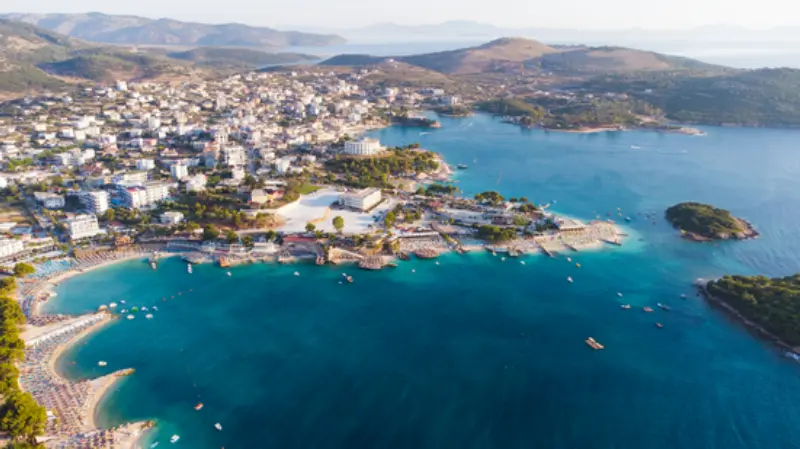
    Sarandë & Ksamil by campervan or motorhome works best when you separate three different needs: somewhere legal to sleep, somewhere practical to park for sightseeing, and a route that your vehicle can handle without turning a holiday into a driving test. Beautiful but demanding in midsummer; much easier if you park once and use local transport for beaches and Butrint. This guide focuses on the decisions that matter once your vehicle is longer, taller and heavier than a normal rental car.

    For country-wide rules and route planning, start with my Camping & Campervan Travel in Albania guide and the 10-day Albania campervan road-trip itinerary. For ordinary sightseeing, keep the Sarandë & Ksamil travel guide open as well. If you only need urban parking rather than an overnight pitch, use the Sarandë & Ksamil parking guide.

    Quick verdict: is Sarandë & Ksamil good for campervans?

    Overall verdictBeautiful but demanding in midsummer; much easier if you park once and use local transport for beaches and Butrint.
    Main difficultyTight summer roads, beach traffic and very limited value in moving a large vehicle between Sarandë, Ksamil and individual coves every day.
    Best overnight strategyChoose a legal campsite or camper-friendly base outside the most congested beachfront streets and leave the vehicle there for several nights.
    Best seasonMay, June, September and early October are far easier than peak July–August.
    How long to stayTwo nights is a comfortable default; add a third if you want a day trip without moving the camper.
    Logical next stopGjirokastër, Himarë, the Greek border or a slow route north along the Riviera.

    Why Sarandë & Ksamil needs a campervan-specific plan

    A motorhome changes small travel decisions. A restaurant car park that works for a hatchback may have a low entrance; a “ten-minute drive” can end in a lane with no turning space; a scenic parking area may permit daytime parking but prohibit overnight camping. In Sarandë, Ksamil and the far south coast, the smartest route is rarely the one that gets the vehicle closest to every attraction. It is the one that keeps the vehicle somewhere appropriate while you enjoy the destination with less friction.

    The far south can look easy on a map because the distances are short. In July and August, however, traffic between Sarandë, Ksamil and Butrint can be slow, roadside parking spills into travel lanes and the last access road to a beach may be unsuitable for a long vehicle. A campervan is most useful here when it becomes a stationary base rather than a car you move for every swim.

    Parking is not the same as camping

    This distinction is the foundation of responsible motorhome travel in Albania. Parking means leaving the vehicle in a place where parking is permitted. Camping usually involves staying overnight and may include levelling ramps, an awning, chairs, cooking outside, extending steps or disposing of water. A place that allows the first does not automatically allow the second.

    When you are unsure, ask. A simple question to a campsite, property owner, municipality or protected-area staff is better than assuming that “nobody stopped the previous van” is permission. On beaches and in residential areas, keep noise low, never block access and do not empty grey or black water outside a proper disposal point.

    Where to base the camper

    Sarandë is the service base

    Sarandë has supermarkets, repair options, restaurants and onward roads, but the seafront and hillside streets are not ideal places to search for an improvised overnight stop. Use a proper overnight base with clear access instructions, then visit the promenade and centre without the motorhome if possible.

    Ksamil rewards parking once

    Ksamil is compact but extremely busy in peak season. The beach you want may have limited turning room, private parking or a lane that becomes awkward once cars line both sides. If your campsite or camper base is within reasonable local-transport distance, leave the vehicle and use bus, taxi or walking for beach days.
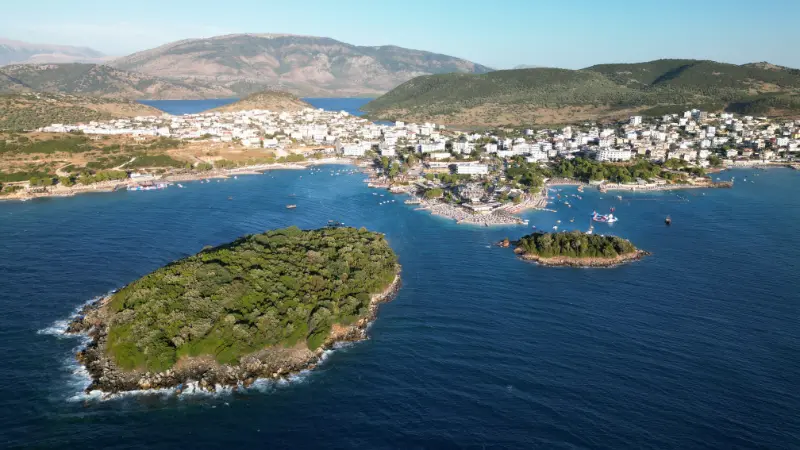
    Drone View Of Ksamil Islands Albania

    Butrint is a protected archaeological landscape

    Butrint is an essential visit but should be treated as a sightseeing stop, not an overnight camping opportunity. Drive or take local transport during visiting hours, use legitimate visitor parking and leave the site area afterward. Do not treat quieter roadside space inside or beside the protected landscape as a free campsite.

    What to confirm before booking a campsite or camper-friendly stay

    • Maximum vehicle length and height. Do not rely on a generic “campervan welcome” label if you drive a long motorhome or have bikes on the rear.
    • Final access road. Ask whether the last kilometre is paved, steep, narrow or crossed by low branches.
    • Electric hook-up. Confirm connector type, amperage and whether electricity is included or charged separately.
    • Fresh water. Ask whether it is potable and whether a hose connection is available.
    • Grey and black-water disposal. A real disposal point is more important than a pretty view on a multi-day trip.
    • Surface and levelling. Gravel, grass and steep terracing behave very differently after heavy rain.
    • Shade and ventilation. In summer, a shaded pitch can change the quality of the entire stay.
    • Opening dates. Many coastal and rural sites are seasonal; never assume a place listed online is staffed in winter.
    • Late arrival. If a ferry, border crossing or mountain road may delay you, get written instructions before setting off.
    • Pets and children. Confirm fencing, road proximity and any extra rules if you travel with a dog or young children.

    Protected areas: the rule that matters

    Albania’s National Agency of Protected Areas (AKZM) stated in a 2026 response that camping inside protected areas is permitted only in areas specifically designated for camping and is subject to the applicable rules and fees. You can read the agency’s 2026 public-response register here. Butrint National Park and other protected coastal areas around the south are exactly where the distinction between parking and camping matters. Use designated visitor infrastructure and dedicated camping zones only where camping is explicitly permitted.

    That means “wild-looking” does not mean “free to camp.” National parks, archaeological landscapes, wetlands, river corridors and marine/coastal protected areas may have different zoning and visitor rules. Use existing public roads and visitor infrastructure, respect signs and move on if the status of an overnight stop is unclear.

    Water, waste and electricity: plan before the tank is full

    Campervan travel becomes stressful when service tasks are postponed until they become urgent. Refill fresh water when you have a trusted source, empty wastewater only at a proper facility and keep enough toilet capacity for the next planned campsite. Do not use storm drains, beach edges, fields or riverbanks for grey or black water. Even biodegradable soap changes water chemistry and belongs in the correct system.

    Electricity deserves the same planning. Albania’s summer coast can make a camper extremely hot, while the southeast and mountain regions can be cold outside summer. Know what your battery, solar setup and heating or ventilation can realistically support. A campsite with reliable power is often cheaper than solving a flat leisure battery or spoiled food later.

    Driving a large vehicle around Sarandë & Ksamil

    The normal car-driving advice in the Sarandë & Ksamil parking guide still applies, but a motorhome magnifies every constraint. Leave more braking distance, avoid entering a lane unless you know where you can exit, and do not let an impatient car behind you choose your speed. If a route feels wrong, stop somewhere safe and reassess rather than continuing simply because the navigation app says the destination is close.
    Aerial View Of Ksamil Islands Albania

    Download offline maps but do not treat them as a vehicle-size routing system. They may show narrow village roads, height restrictions or steep shortcuts without understanding your dimensions. When a campsite gives you a recommended approach, follow it even if the route is a few kilometres longer.

    Security and leaving the camper unattended

    Use ordinary road-trip precautions rather than fear. Lock doors and windows, keep passports and electronics out of sight and avoid advertising that the vehicle will be empty all day. A dedicated campsite or supervised property is especially useful when you want to leave the motorhome for a boat trip, hike or full-day city visit.

    Photograph the exterior, roof accessories and bike rack before a long trip, and know your vehicle height. If you use LPG, check connections and keep ventilation clear. Never run a combustion heater or cooker in a way that conflicts with the manufacturer’s ventilation requirements.

    Weather and season

    Peak summer combines heat, traffic and little shade. A site with shade and electricity can be more valuable than one directly beside the water. Storms and strong sea winds are less predictable in shoulder season, so secure awnings and avoid setting up more equipment than necessary when the forecast is unsettled.

    Whatever the season, avoid arriving at an unfamiliar campsite after dark if you can. Albania’s most beautiful overnight areas are often reached by smaller roads where gate width, trees, drainage and pitch slope are much easier to judge in daylight.

    A realistic 2-day campervan plan for Sarandë & Ksamil

    Day 1 — arrive, establish the base, then stop driving

    Day 1: arrive, establish a legal base and do not move again. Spend the afternoon in Sarandë or Ksamil by local transport, then return to the camper after dinner without fighting for a nighttime beach parking space.

    Aerial View White Sand Beach Turquoise Water Relaxing People Sunny Ksamil Albania

    Day 2 — one main excursion, not five parking searches

    Day 2: visit Butrint early, then choose one beach area instead of moving through several. On Day 3, leave for Gjirokastër or Himarë before the busiest beach traffic builds.

    Where to go next

    Gjirokastër is the easiest inland contrast and usually a better large-vehicle day than another crowded beach. Northbound toward Himarë, the Riviera becomes more mountainous and winding; southbound toward Greece, check insurance and border documents before leaving your campsite rather than at the crossing.

    If you need a hotel night instead

    Campervan travel does not have to mean sleeping in the vehicle every night. A hotel can be useful after a late ferry, during extreme heat, when someone is ill, or when you want a secure base while the vehicle is serviced. For Sarandë & Ksamil, you can compare hotels, apartments and backup stays on Booking.com. Always confirm parking dimensions directly with the property if you intend to leave a motorhome there.

    Common mistakes to avoid

    • Treating every legal parking space as permission to camp overnight.
    • Following a normal-car navigation shortcut without checking width, gradient or turning room.
    • Arriving at a coastal or mountain campsite after dark without confirming the final approach.
    • Waiting until the fresh-water tank is empty or the wastewater tank is full before looking for services.
    • Driving the camper to every attraction instead of using it as a base for walking, taxis, buses or boat trips.
    • Opening awnings or putting chairs out in an ordinary car park.
    • Assuming a beach, riverbank or protected-area pull-off is a free campsite because another van is already there.
    • Ignoring vehicle height in underground or covered parking.
    • Leaving food, passports, laptops or cameras visible when the camper is unattended.
    • Planning too many one-night stops and spending the holiday levelling, packing and driving instead of exploring.

    FAQ

    Can I wild camp around Sarandë & Ksamil?

    Do not rely on a blanket yes-or-no answer. Land ownership, municipal rules, protected-area zoning and local restrictions matter. In protected areas, AKZM’s 2026 guidance is clear that camping is limited to designated camping zones. Elsewhere, use a dedicated campsite or obtain explicit permission from the landowner/property whenever possible.

    Can I sleep in a normal city parking space?

    A parked vehicle and an overnight camping setup are not the same thing. Even where overnight parking is not explicitly signed against, local rules, private-property conditions or security concerns may make it inappropriate. For a planned stay, use a campsite or place that clearly accepts campervans.

    Do I need to reserve campsites in Albania?

    In July and August on the coast, reserving or at least messaging ahead is sensible—especially for a large motorhome, a vehicle needing electricity, or a late arrival. Outside peak season, checking opening dates is just as important as checking availability.

    Is Albania suitable for a large motorhome?

    Yes, if you adapt the route. Main intercity roads and many established campsites are manageable, but historic centres, mountain villages and beach access lanes can be awkward. Plan the motorhome route around suitable bases and use smaller-scale transport for the final kilometres when needed.

    What should I do before crossing into another country?

    Check passport rules, vehicle registration, insurance/Green Card requirements where applicable, rental-company permission if the camper is hired, and any rules for pets. Do this before the travel day rather than at the border queue.

    Final advice

    The best campervan trip around Sarandë & Ksamil is not the one with the most dramatic overnight pin. It is the one where you know you are allowed to stay, can service the vehicle responsibly and can leave it parked while you actually experience the destination. Use proper campsites when they solve water, waste, electricity and security at once; use ordinary parking only for parking; and let Sarandë & Ksamil be part of the journey rather than another place where the whole day disappears into manoeuvring a large vehicle.

  • Campervan & Camping in Himarë: Livadhi, Riviera Roads, Beaches and Overnight Planning

    Campervan & Camping in Himarë: Livadhi, Riviera Roads, Beaches and Overnight Planning

    Himarë by campervan or motorhome works best when you separate three different needs: somewhere legal to sleep, somewhere practical to park for sightseeing, and a route that your vehicle can handle without turning a holiday into a driving test. Excellent for a slower campervan stay if you choose one base and resist driving down every beach access road. This guide focuses on the decisions that matter once your vehicle is longer, taller and heavier than a normal rental car.

    Porto Palermo Beach Himare Albanian Riviera Panoramic 2

    For country-wide rules and route planning, start with my Camping & Campervan Travel in Albania guide and the 10-day Albania campervan road-trip itinerary. For ordinary sightseeing, keep the Himarë travel guide open as well. If you only need urban parking rather than an overnight pitch, use the Himarë parking guide.

    Quick verdict: is Himarë good for campervans?

    Overall verdictExcellent for a slower campervan stay if you choose one base and resist driving down every beach access road.
    Main difficultyNarrow Riviera roads, steep beach approaches and limited turning space around small bays and old villages.
    Best overnight strategyUse an organised campsite or camper-friendly property on the wider coastal edge, then reach beaches on foot, by taxi or with a smaller local vehicle when needed.
    Best seasonMay–June and September are superb; July–August need advance planning and early arrivals.
    How long to stayTwo nights is a comfortable default; add a third if you want a day trip without moving the camper.
    Logical next stopVlorë/Llogara northbound, Sarandë southbound, or inland toward Gjirokastër.

    Why Himarë needs a campervan-specific plan

    A motorhome changes small travel decisions. A restaurant car park that works for a hatchback may have a low entrance; a “ten-minute drive” can end in a lane with no turning space; a scenic parking area may permit daytime parking but prohibit overnight camping. In Himarë and the central Albanian Riviera, the smartest route is rarely the one that gets the vehicle closest to every attraction. It is the one that keeps the vehicle somewhere appropriate while you enjoy the destination with less friction.

    Himare Beach Sunny Albanian Riviera Coastline

    Himarë sits in the section of the Riviera where beautiful views and difficult manoeuvring often come together. The SH8 itself is paved and scenic, but side roads to beaches, village lanes and improvised parking areas can become narrow or steep. A long motorhome should not follow every map pin simply because a normal car can reach it.

    Parking is not the same as camping

    This distinction is the foundation of responsible motorhome travel in Albania. Parking means leaving the vehicle in a place where parking is permitted. Camping usually involves staying overnight and may include levelling ramps, an awning, chairs, cooking outside, extending steps or disposing of water. A place that allows the first does not automatically allow the second.

    When you are unsure, ask. A simple question to a campsite, property owner, municipality or protected-area staff is better than assuming that “nobody stopped the previous van” is permission. On beaches and in residential areas, keep noise low, never block access and do not empty grey or black water outside a proper disposal point.

    Where to base the camper

    Livadhi and the wider outskirts are easier than the old core

    The most comfortable campervan strategy is to use a legal base with enough space outside the tightest streets. Livadhi and other wider coastal areas can be more practical than trying to sleep beside Spile or climb toward Old Himara. Even there, confirm the final access road and gate dimensions because coastal lanes vary enormously.

    Beach access is often the weak point

    A famous beach may be only a few kilometres away yet still be a poor campervan destination if the final road is steep, rough or too tight to turn around. Ask your host or campsite which beaches are realistically accessible with your exact vehicle. It is often better to park once and use a taxi, boat or walk for the last stretch.

    Old Himara and Porto Palermo are visits, not campsite searches

    Old Himara rewards a late-afternoon walk, while Porto Palermo is a superb road stop. Neither should be approached with the assumption that any scenic pull-off is suitable for an overnight setup. Keep visits compact, use legitimate parking and return to your established base.

    What to confirm before booking a campsite or camper-friendly stay

    • Maximum vehicle length and height. Do not rely on a generic “campervan welcome” label if you drive a long motorhome or have bikes on the rear.
    • Final access road. Ask whether the last kilometre is paved, steep, narrow or crossed by low branches.
    • Electric hook-up. Confirm connector type, amperage and whether electricity is included or charged separately.
    • Fresh water. Ask whether it is potable and whether a hose connection is available.
    • Grey and black-water disposal. A real disposal point is more important than a pretty view on a multi-day trip.
    • Surface and levelling. Gravel, grass and steep terracing behave very differently after heavy rain.
    • Shade and ventilation. In summer, a shaded pitch can change the quality of the entire stay.
    • Opening dates. Many coastal and rural sites are seasonal; never assume a place listed online is staffed in winter.
    • Late arrival. If a ferry, border crossing or mountain road may delay you, get written instructions before setting off.
    • Pets and children. Confirm fencing, road proximity and any extra rules if you travel with a dog or young children.

    Protected areas: the rule that matters

    Albania’s National Agency of Protected Areas (AKZM) stated in a 2026 response that camping inside protected areas is permitted only in areas specifically designated for camping and is subject to the applicable rules and fees. You can read the agency’s 2026 public-response register here. Porto Palermo and nearby protected coastal landscapes have conservation rules in addition to ordinary parking rules. Do not confuse an empty shoreline with a designated camping area.

    That means “wild-looking” does not mean “free to camp.” National parks, archaeological landscapes, wetlands, river corridors and marine/coastal protected areas may have different zoning and visitor rules. Use existing public roads and visitor infrastructure, respect signs and move on if the status of an overnight stop is unclear.

    Water, waste and electricity: plan before the tank is full

    Campervan travel becomes stressful when service tasks are postponed until they become urgent. Refill fresh water when you have a trusted source, empty wastewater only at a proper facility and keep enough toilet capacity for the next planned campsite. Do not use storm drains, beach edges, fields or riverbanks for grey or black water. Even biodegradable soap changes water chemistry and belongs in the correct system.

    Electricity deserves the same planning. Albania’s summer coast can make a camper extremely hot, while the southeast and mountain regions can be cold outside summer. Know what your battery, solar setup and heating or ventilation can realistically support. A campsite with reliable power is often cheaper than solving a flat leisure battery or spoiled food later.

    Driving a large vehicle around Himarë

    The normal car-driving advice in the Himarë parking guide still applies, but a motorhome magnifies every constraint. Leave more braking distance, avoid entering a lane unless you know where you can exit, and do not let an impatient car behind you choose your speed. If a route feels wrong, stop somewhere safe and reassess rather than continuing simply because the navigation app says the destination is close.

    Download offline maps but do not treat them as a vehicle-size routing system. They may show narrow village roads, height restrictions or steep shortcuts without understanding your dimensions. When a campsite gives you a recommended approach, follow it even if the route is a few kilometres longer.

    Security and leaving the camper unattended

    Use ordinary road-trip precautions rather than fear. Lock doors and windows, keep passports and electronics out of sight and avoid advertising that the vehicle will be empty all day. A dedicated campsite or supervised property is especially useful when you want to leave the motorhome for a boat trip, hike or full-day city visit.

    Photograph the exterior, roof accessories and bike rack before a long trip, and know your vehicle height. If you use LPG, check connections and keep ventilation clear. Never run a combustion heater or cooker in a way that conflicts with the manufacturer’s ventilation requirements.

    Weather and season

    Summer heat is softened by the sea but the vehicle can still become extremely hot in full sun. Riviera storms can bring sudden wind, and exposed awnings are vulnerable. Shoulder season is excellent, but some seasonal campsites or restaurants may reduce hours, so confirm opening dates before committing to a remote base.

    Whatever the season, avoid arriving at an unfamiliar campsite after dark if you can. Albania’s most beautiful overnight areas are often reached by smaller roads where gate width, trees, drainage and pitch slope are much easier to judge in daylight.

    A realistic 2-day campervan plan for Himarë

    Day 1 — arrive, establish the base, then stop driving

    Arrive before late afternoon, establish your base and walk or taxi into Himarë for dinner. The first night should be about settling in rather than squeezing a large vehicle through the waterfront during the evening peak.

    Day 2 — one main excursion, not five parking searches

    Use Day 2 for one beach plus Porto Palermo or Old Himara. If continuing to Sarandë, leave early the following morning and treat Qeparo/Borsh viewpoints as short road stops, not opportunities to hunt for an unplanned overnight pitch.

    Where to go next

    Northbound, Llogara and Vlorë require mountain-road concentration; southbound, Sarandë and Ksamil become much busier. Inland connections toward Gjirokastër can be useful if you want to break up the coast and find cooler nights.

    If you need a hotel night instead

    Campervan travel does not have to mean sleeping in the vehicle every night. A hotel can be useful after a late ferry, during extreme heat, when someone is ill, or when you want a secure base while the vehicle is serviced. For Himarë, you can compare hotels, apartments and backup stays on Booking.com. Always confirm parking dimensions directly with the property if you intend to leave a motorhome there.

    Porto Palermo Beach Himare Albanian Riviera Panoramic

    Common mistakes to avoid

    • Treating every legal parking space as permission to camp overnight.
    • Following a normal-car navigation shortcut without checking width, gradient or turning room.
    • Arriving at a coastal or mountain campsite after dark without confirming the final approach.
    • Waiting until the fresh-water tank is empty or the wastewater tank is full before looking for services.
    • Driving the camper to every attraction instead of using it as a base for walking, taxis, buses or boat trips.
    • Opening awnings or putting chairs out in an ordinary car park.
    • Assuming a beach, riverbank or protected-area pull-off is a free campsite because another van is already there.
    • Ignoring vehicle height in underground or covered parking.
    • Leaving food, passports, laptops or cameras visible when the camper is unattended.
    • Planning too many one-night stops and spending the holiday levelling, packing and driving instead of exploring.

    FAQ

    Can I wild camp around Himarë?

    Do not rely on a blanket yes-or-no answer. Land ownership, municipal rules, protected-area zoning and local restrictions matter. In protected areas, AKZM’s 2026 guidance is clear that camping is limited to designated camping zones. Elsewhere, use a dedicated campsite or obtain explicit permission from the landowner/property whenever possible.

    Can I sleep in a normal city parking space?

    A parked vehicle and an overnight camping setup are not the same thing. Even where overnight parking is not explicitly signed against, local rules, private-property conditions or security concerns may make it inappropriate. For a planned stay, use a campsite or place that clearly accepts campervans.

    Do I need to reserve campsites in Albania?

    In July and August on the coast, reserving or at least messaging ahead is sensible—especially for a large motorhome, a vehicle needing electricity, or a late arrival. Outside peak season, checking opening dates is just as important as checking availability.

    Is Albania suitable for a large motorhome?

    Yes, if you adapt the route. Main intercity roads and many established campsites are manageable, but historic centres, mountain villages and beach access lanes can be awkward. Plan the motorhome route around suitable bases and use smaller-scale transport for the final kilometres when needed.

    What should I do before crossing into another country?

    Check passport rules, vehicle registration, insurance/Green Card requirements where applicable, rental-company permission if the camper is hired, and any rules for pets. Do this before the travel day rather than at the border queue.

    Final advice

    The best campervan trip around Himarë is not the one with the most dramatic overnight pin. It is the one where you know you are allowed to stay, can service the vehicle responsibly and can leave it parked while you actually experience the destination. Use proper campsites when they solve water, waste, electricity and security at once; use ordinary parking only for parking; and let Himarë be part of the journey rather than another place where the whole day disappears into manoeuvring a large vehicle.

  • Campervan & Camping in Tirana: Parking, Campsites, Dajti and Road-Trip Planning

    Campervan & Camping in Tirana: Parking, Campsites, Dajti and Road-Trip Planning

    Tirana by campervan or motorhome works best when you separate three different needs: somewhere legal to sleep, somewhere practical to park for sightseeing, and a route that your vehicle can handle without turning a holiday into a driving test. Excellent as a logistics stop, less suitable for sleeping in the city centre itself. This guide focuses on the decisions that matter once your vehicle is longer, taller and heavier than a normal rental car.

    For country-wide rules and route planning, start with my Camping & Campervan Travel in Albania guide and the 10-day Albania campervan road-trip itinerary. For ordinary sightseeing, keep the Tirana travel guide open as well. If you only need urban parking rather than an overnight pitch, use the Tirana parking guide.

    Quick verdict: is Tirana good for campervans?

    Overall verdictExcellent as a logistics stop, less suitable for sleeping in the city centre itself.
    Main difficultyDense central traffic, limited space for a large vehicle and the temptation to treat ordinary parking as an overnight campsite.
    Best overnight strategyUse a dedicated campsite or camper-friendly property outside the tight centre, then enter central Tirana without the motorhome whenever possible.
    Best seasonApril–June and September–October for easier temperatures; summer needs heat planning, winter needs rain flexibility.
    How long to stayTwo nights is a comfortable default; add a third if you want a day trip without moving the camper.
    Logical next stopKrujë, Durrës, Berat or Shkodër depending on your route.

    Why Tirana needs a campervan-specific plan

    A motorhome changes small travel decisions. A restaurant car park that works for a hatchback may have a low entrance; a “ten-minute drive” can end in a lane with no turning space; a scenic parking area may permit daytime parking but prohibit overnight camping. In the capital and its outer districts, the smartest route is rarely the one that gets the vehicle closest to every attraction. It is the one that keeps the vehicle somewhere appropriate while you enjoy the destination with less friction.

    Tirana is the place where many Albania road trips begin, whether the vehicle is collected near the airport or driven in from Durrës. The capital’s ring roads and main approaches are manageable, but the final kilometre into a central hotel or parking space can be the stressful part. Scooters, taxis, buses, pedestrians and frequent lane changes demand more attention than the open road.

    Parking is not the same as camping

    This distinction is the foundation of responsible motorhome travel in Albania. Parking means leaving the vehicle in a place where parking is permitted. Camping usually involves staying overnight and may include levelling ramps, an awning, chairs, cooking outside, extending steps or disposing of water. A place that allows the first does not automatically allow the second.

    When you are unsure, ask. A simple question to a campsite, property owner, municipality or protected-area staff is better than assuming that “nobody stopped the previous van” is permission. On beaches and in residential areas, keep noise low, never block access and do not empty grey or black water outside a proper disposal point.

    Where to base the camper

    Outer Tirana is usually the smarter overnight base

    For a motorhome, the best Tirana strategy is often to sleep outside the tight central core and treat the city as a day visit. A campsite, guesthouse or camper-friendly property on the outer urban edge gives you room to level the vehicle, open doors safely and deal with water or electricity without blocking a residential street. Ask for exact gate width, vehicle-length limits and whether late arrival is possible before booking.

    Sunset Tirana Albania Aerial Panoramic View 2

    Central Tirana is better for sightseeing than camping

    Skanderbeg Square, Blloku, Pazari i Ri and the central museums are places to explore on foot, not places to hunt for a legal overnight motorhome pitch. If you drive into the centre, use a legitimate parking facility that accepts your vehicle height and length, then keep awnings, chairs and levelling equipment packed away. Better still, leave the camper at your overnight base and use a taxi or public transport for the final stretch.

    Dajti and Bovilla need a different mindset

    The mountains east of Tirana are attractive, but they are not an invitation to drive a large camper down every scenic side road. Dajti lies within a protected landscape, while routes toward Bovilla can become narrow, rough and awkward for long vehicles. Use the camper as a base, then switch to a smaller transfer, organised excursion or carefully researched day drive if the road and turning space suit your vehicle.

    What to confirm before booking a campsite or camper-friendly stay

    • Maximum vehicle length and height. Do not rely on a generic “campervan welcome” label if you drive a long motorhome or have bikes on the rear.
    • Final access road. Ask whether the last kilometre is paved, steep, narrow or crossed by low branches.
    • Electric hook-up. Confirm connector type, amperage and whether electricity is included or charged separately.
    • Fresh water. Ask whether it is potable and whether a hose connection is available.
    • Grey and black-water disposal. A real disposal point is more important than a pretty view on a multi-day trip.
    • Surface and levelling. Gravel, grass and steep terracing behave very differently after heavy rain.
    • Shade and ventilation. In summer, a shaded pitch can change the quality of the entire stay.
    • Opening dates. Many coastal and rural sites are seasonal; never assume a place listed online is staffed in winter.
    • Late arrival. If a ferry, border crossing or mountain road may delay you, get written instructions before setting off.
    • Pets and children. Confirm fencing, road proximity and any extra rules if you travel with a dog or young children.

    Protected areas: the rule that matters

    Albania’s National Agency of Protected Areas (AKZM) stated in a 2026 response that camping inside protected areas is permitted only in areas specifically designated for camping and is subject to the applicable rules and fees. You can read the agency’s 2026 public-response register here. Dajti National Park and other protected landscapes around Tirana require more care than an ordinary roadside stop. Do not assume a viewpoint, forest pull-off or trail access point is an overnight camping area.

    That means “wild-looking” does not mean “free to camp.” National parks, archaeological landscapes, wetlands, river corridors and marine/coastal protected areas may have different zoning and visitor rules. Use existing public roads and visitor infrastructure, respect signs and move on if the status of an overnight stop is unclear.

    Water, waste and electricity: plan before the tank is full

    Campervan travel becomes stressful when service tasks are postponed until they become urgent. Refill fresh water when you have a trusted source, empty wastewater only at a proper facility and keep enough toilet capacity for the next planned campsite. Do not use storm drains, beach edges, fields or riverbanks for grey or black water. Even biodegradable soap changes water chemistry and belongs in the correct system.

    Electricity deserves the same planning. Albania’s summer coast can make a camper extremely hot, while the southeast and mountain regions can be cold outside summer. Know what your battery, solar setup and heating or ventilation can realistically support. A campsite with reliable power is often cheaper than solving a flat leisure battery or spoiled food later.

    Driving a large vehicle around Tirana

    The normal car-driving advice in the Tirana parking guide still applies, but a motorhome magnifies every constraint. Leave more braking distance, avoid entering a lane unless you know where you can exit, and do not let an impatient car behind you choose your speed. If a route feels wrong, stop somewhere safe and reassess rather than continuing simply because the navigation app says the destination is close.

    Sunset Tirana Albania Aerial Panoramic View 3

    Download offline maps but do not treat them as a vehicle-size routing system. They may show narrow village roads, height restrictions or steep shortcuts without understanding your dimensions. When a campsite gives you a recommended approach, follow it even if the route is a few kilometres longer.

    Security and leaving the camper unattended

    Use ordinary road-trip precautions rather than fear. Lock doors and windows, keep passports and electronics out of sight and avoid advertising that the vehicle will be empty all day. A dedicated campsite or supervised property is especially useful when you want to leave the motorhome for a boat trip, hike or full-day city visit.

    Photograph the exterior, roof accessories and bike rack before a long trip, and know your vehicle height. If you use LPG, check connections and keep ventilation clear. Never run a combustion heater or cooker in a way that conflicts with the manufacturer’s ventilation requirements.

    Weather and season

    Summer heat builds quickly on asphalt and inside a parked vehicle. Shade, ventilation and a campsite with electricity can be worth paying for in July and August. Spring and autumn are easier for city walking; winter rain can make muddy or unpaved pitches less pleasant, so ask about surface drainage.

    Whatever the season, avoid arriving at an unfamiliar campsite after dark if you can. Albania’s most beautiful overnight areas are often reached by smaller roads where gate width, trees, drainage and pitch slope are much easier to judge in daylight.

    A realistic 2-day campervan plan for Tirana

    Day 1 — arrive, establish the base, then stop driving

    Arrive at your overnight base before late afternoon, connect only the services you are permitted to use, and leave the vehicle there. Spend the evening in central Tirana by taxi or public transport, concentrating on Skanderbeg Square, Blloku or Pazari i Ri rather than driving between sights.

    Day 2 — one main excursion, not five parking searches

    Use the second day for one excursion: Dajti if you want mountain views, Krujë if history is the priority, or an easy repositioning toward Durrës or Berat. If you are continuing south, stock up before leaving the capital rather than searching for specialist camper supplies on a mountain road.

    Where to go next

    From Tirana, Durrës is the easiest westbound move; Berat is a logical southbound cultural stop; Shkodër is the gateway to the north. If your next destination is Theth or Koman, consider leaving the motorhome at a secure base in Shkodër and using local transport for the most demanding mountain sections.

    If you need a hotel night instead

    Campervan travel does not have to mean sleeping in the vehicle every night. A hotel can be useful after a late ferry, during extreme heat, when someone is ill, or when you want a secure base while the vehicle is serviced. For Tirana, you can compare hotels, apartments and backup stays on Booking.com. Always confirm parking dimensions directly with the property if you intend to leave a motorhome there.

    Aerial Drone View Tirana Albania 3

    Common mistakes to avoid

    • Treating every legal parking space as permission to camp overnight.
    • Following a normal-car navigation shortcut without checking width, gradient or turning room.
    • Arriving at a coastal or mountain campsite after dark without confirming the final approach.
    • Waiting until the fresh-water tank is empty or the wastewater tank is full before looking for services.
    • Driving the camper to every attraction instead of using it as a base for walking, taxis, buses or boat trips.
    • Opening awnings or putting chairs out in an ordinary car park.
    • Assuming a beach, riverbank or protected-area pull-off is a free campsite because another van is already there.
    • Ignoring vehicle height in underground or covered parking.
    • Leaving food, passports, laptops or cameras visible when the camper is unattended.
    • Planning too many one-night stops and spending the holiday levelling, packing and driving instead of exploring.

    FAQ

    Can I wild camp around Tirana?

    Do not rely on a blanket yes-or-no answer. Land ownership, municipal rules, protected-area zoning and local restrictions matter. In protected areas, AKZM’s 2026 guidance is clear that camping is limited to designated camping zones. Elsewhere, use a dedicated campsite or obtain explicit permission from the landowner/property whenever possible.

    Can I sleep in a normal city parking space?

    A parked vehicle and an overnight camping setup are not the same thing. Even where overnight parking is not explicitly signed against, local rules, private-property conditions or security concerns may make it inappropriate. For a planned stay, use a campsite or place that clearly accepts campervans.

    Do I need to reserve campsites in Albania?

    In July and August on the coast, reserving or at least messaging ahead is sensible—especially for a large motorhome, a vehicle needing electricity, or a late arrival. Outside peak season, checking opening dates is just as important as checking availability.

    Is Albania suitable for a large motorhome?

    Yes, if you adapt the route. Main intercity roads and many established campsites are manageable, but historic centres, mountain villages and beach access lanes can be awkward. Plan the motorhome route around suitable bases and use smaller-scale transport for the final kilometres when needed.

    What should I do before crossing into another country?

    Check passport rules, vehicle registration, insurance/Green Card requirements where applicable, rental-company permission if the camper is hired, and any rules for pets. Do this before the travel day rather than at the border queue.

    Final advice

    The best campervan trip around Tirana is not the one with the most dramatic overnight pin. It is the one where you know you are allowed to stay, can service the vehicle responsibly and can leave it parked while you actually experience the destination. Use proper campsites when they solve water, waste, electricity and security at once; use ordinary parking only for parking; and let Tirana be part of the journey rather than another place where the whole day disappears into manoeuvring a large vehicle.

  • Campervan & Camping in Durrës: Ferry Port, Beach Bases, Parking and Road-Trip Tips

    Campervan & Camping in Durrës: Ferry Port, Beach Bases, Parking and Road-Trip Tips

    Durrës by campervan or motorhome works best when you separate three different needs: somewhere legal to sleep, somewhere practical to park for sightseeing, and a route that your vehicle can handle without turning a holiday into a driving test. One of Albania’s most practical campervan entry points, especially after arriving by ferry. This guide focuses on the decisions that matter once your vehicle is longer, taller and heavier than a normal rental car.

    For country-wide rules and route planning, start with my Camping & Campervan Travel in Albania guide and the 10-day Albania campervan road-trip itinerary. For ordinary sightseeing, keep the Durrës travel guide open as well. If you only need urban parking rather than an overnight pitch, use the Durrës parking guide.

    Quick verdict: is Durrës good for campervans?

    Overall verdictOne of Albania’s most practical campervan entry points, especially after arriving by ferry.
    Main difficultySeparating port logistics, city sightseeing and beach camping instead of expecting one parking place to do all three jobs.
    Best overnight strategyUse a dedicated coastal campsite or camper-friendly property outside the historic core, then visit central Durrës separately.
    Best seasonMay–June and September are especially easy; July–August are hot and crowded along the beach strip.
    How long to stayTwo nights is a comfortable default; add a third if you want a day trip without moving the camper.
    Logical next stopTirana, Cape of Rodon, Berat or the southern coast.

    Why Durrës needs a campervan-specific plan

    A motorhome changes small travel decisions. A restaurant car park that works for a hatchback may have a low entrance; a “ten-minute drive” can end in a lane with no turning space; a scenic parking area may permit daytime parking but prohibit overnight camping. In the Adriatic coast and ferry-port area, the smartest route is rarely the one that gets the vehicle closest to every attraction. It is the one that keeps the vehicle somewhere appropriate while you enjoy the destination with less friction.

    Durrës is the Albanian city most campervan travellers associate with ferry arrival. That makes the first hours important: clear the port, check fuel and supplies, and avoid trying to solve sightseeing, groceries and overnight camping while still tired from an overnight crossing. Port lanes and city streets are not a campsite, even if you see other vehicles waiting nearby.

    Parking is not the same as camping

    This distinction is the foundation of responsible motorhome travel in Albania. Parking means leaving the vehicle in a place where parking is permitted. Camping usually involves staying overnight and may include levelling ramps, an awning, chairs, cooking outside, extending steps or disposing of water. A place that allows the first does not automatically allow the second.

    When you are unsure, ask. A simple question to a campsite, property owner, municipality or protected-area staff is better than assuming that “nobody stopped the previous van” is permission. On beaches and in residential areas, keep noise low, never block access and do not empty grey or black water outside a proper disposal point.

    Where to base the camper

    The ferry port is an arrival zone, not an overnight plan

    After disembarking, follow port instructions, leave the controlled area and move to a place where your vehicle is actually allowed to stay. Do not set out chairs, levellers or cooking equipment in port-side parking. If the ferry arrives late, pre-book a campsite or camper-friendly accommodation and save its access instructions offline before sailing.

    Historic Durrës works best as a day stop

    The amphitheatre, Venetian Tower and central seafront are worth seeing, but a long motorhome adds friction in streets designed for ordinary urban traffic. Use a suitable day-parking space, walk the Roman centre and Vollga, then move back to your overnight base rather than trying to camp beside the monuments.

    The long beach strip gives you more room

    South of the centre, the Plazh and Golem direction has more tourism infrastructure and is usually a more logical area to search for organised camping or properties that explicitly accept campervans. In midsummer, however, beach traffic and full car parks can erase that advantage. Arrive earlier in the day and confirm that the entrance can accommodate your vehicle.

    What to confirm before booking a campsite or camper-friendly stay

    • Maximum vehicle length and height. Do not rely on a generic “campervan welcome” label if you drive a long motorhome or have bikes on the rear.
    • Final access road. Ask whether the last kilometre is paved, steep, narrow or crossed by low branches.
    • Electric hook-up. Confirm connector type, amperage and whether electricity is included or charged separately.
    • Fresh water. Ask whether it is potable and whether a hose connection is available.
    • Grey and black-water disposal. A real disposal point is more important than a pretty view on a multi-day trip.
    • Surface and levelling. Gravel, grass and steep terracing behave very differently after heavy rain.
    • Shade and ventilation. In summer, a shaded pitch can change the quality of the entire stay.
    • Opening dates. Many coastal and rural sites are seasonal; never assume a place listed online is staffed in winter.
    • Late arrival. If a ferry, border crossing or mountain road may delay you, get written instructions before setting off.
    • Pets and children. Confirm fencing, road proximity and any extra rules if you travel with a dog or young children.

    Protected areas: the rule that matters

    Albania’s National Agency of Protected Areas (AKZM) stated in a 2026 response that camping inside protected areas is permitted only in areas specifically designated for camping and is subject to the applicable rules and fees. You can read the agency’s 2026 public-response register here. Cape of Rodon and coastal nature areas make good excursions, but road width and final access vary. Scenic coastal land is not automatically a legal overnight pitch, and protected or privately managed areas may have their own restrictions.

    That means “wild-looking” does not mean “free to camp.” National parks, archaeological landscapes, wetlands, river corridors and marine/coastal protected areas may have different zoning and visitor rules. Use existing public roads and visitor infrastructure, respect signs and move on if the status of an overnight stop is unclear.

    Water, waste and electricity: plan before the tank is full

    Campervan travel becomes stressful when service tasks are postponed until they become urgent. Refill fresh water when you have a trusted source, empty wastewater only at a proper facility and keep enough toilet capacity for the next planned campsite. Do not use storm drains, beach edges, fields or riverbanks for grey or black water. Even biodegradable soap changes water chemistry and belongs in the correct system.

    Electricity deserves the same planning. Albania’s summer coast can make a camper extremely hot, while the southeast and mountain regions can be cold outside summer. Know what your battery, solar setup and heating or ventilation can realistically support. A campsite with reliable power is often cheaper than solving a flat leisure battery or spoiled food later.

    Driving a large vehicle around Durrës

    The normal car-driving advice in the Durrës parking guide still applies, but a motorhome magnifies every constraint. Leave more braking distance, avoid entering a lane unless you know where you can exit, and do not let an impatient car behind you choose your speed. If a route feels wrong, stop somewhere safe and reassess rather than continuing simply because the navigation app says the destination is close.

    Download offline maps but do not treat them as a vehicle-size routing system. They may show narrow village roads, height restrictions or steep shortcuts without understanding your dimensions. When a campsite gives you a recommended approach, follow it even if the route is a few kilometres longer.

    Security and leaving the camper unattended

    Use ordinary road-trip precautions rather than fear. Lock doors and windows, keep passports and electronics out of sight and avoid advertising that the vehicle will be empty all day. A dedicated campsite or supervised property is especially useful when you want to leave the motorhome for a boat trip, hike or full-day city visit.

    Photograph the exterior, roof accessories and bike rack before a long trip, and know your vehicle height. If you use LPG, check connections and keep ventilation clear. Never run a combustion heater or cooker in a way that conflicts with the manufacturer’s ventilation requirements.

    Weather and season

    Durrës is hot, humid and busy in peak summer. An electrical hook-up for ventilation can matter more than a sea view. Strong autumn or winter weather can make exposed coastal pitches uncomfortable, while shoulder season often gives the best balance of open services and space.

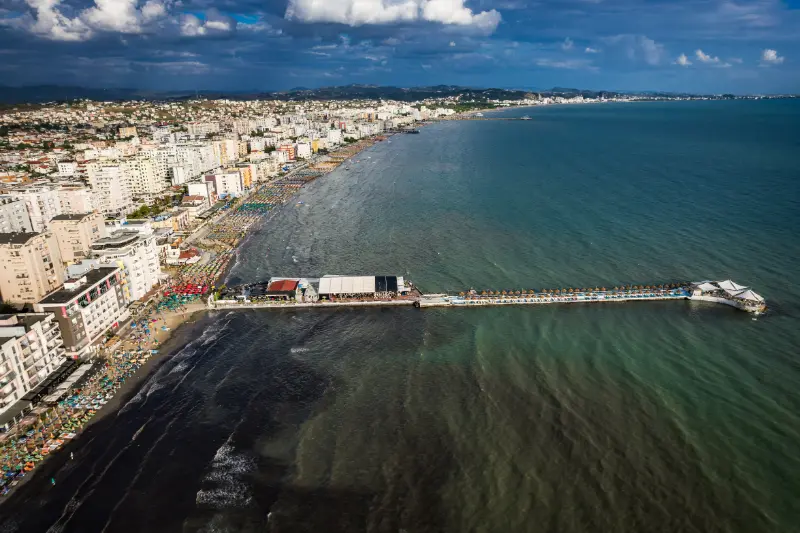
    Durres Albania Aerial Drone View Durres Beach Rows Hotel Apartmans

    Whatever the season, avoid arriving at an unfamiliar campsite after dark if you can. Albania’s most beautiful overnight areas are often reached by smaller roads where gate width, trees, drainage and pitch slope are much easier to judge in daylight.

    A realistic 2-day campervan plan for Durrës

    Day 1 — arrive, establish the base, then stop driving

    If you arrive by ferry, make Day 1 deliberately easy: leave the port, settle into a legal overnight base, shower, shop and then visit the historic centre without the pressure of moving again before dark.

    Day 2 — one main excursion, not five parking searches

    On Day 2, choose either a relaxed beach morning or a coastal excursion, then reposition toward Tirana or Berat before the evening rush. If you are catching a ferry the next morning, reverse the plan and sleep close enough to the port that check-in is simple without using port parking as a campsite.

    Where to go next

    Durrës connects naturally to Tirana in under a full travel day and is also a useful first stop before Berat. If you are heading north toward Cape of Rodon or Shëngjin, check rural road conditions and turning room rather than assuming a route suitable for cars is comfortable for a long motorhome.

    If you need a hotel night instead

    Campervan travel does not have to mean sleeping in the vehicle every night. A hotel can be useful after a late ferry, during extreme heat, when someone is ill, or when you want a secure base while the vehicle is serviced. For Durrës, you can compare hotels, apartments and backup stays on Booking.com. Always confirm parking dimensions directly with the property if you intend to leave a motorhome there.

    Aerial View Of Durres Beach And Hotels Albania

    Common mistakes to avoid

    • Treating every legal parking space as permission to camp overnight.
    • Following a normal-car navigation shortcut without checking width, gradient or turning room.
    • Arriving at a coastal or mountain campsite after dark without confirming the final approach.
    • Waiting until the fresh-water tank is empty or the wastewater tank is full before looking for services.
    • Driving the camper to every attraction instead of using it as a base for walking, taxis, buses or boat trips.
    • Opening awnings or putting chairs out in an ordinary car park.
    • Assuming a beach, riverbank or protected-area pull-off is a free campsite because another van is already there.
    • Ignoring vehicle height in underground or covered parking.
    • Leaving food, passports, laptops or cameras visible when the camper is unattended.
    • Planning too many one-night stops and spending the holiday levelling, packing and driving instead of exploring.

    FAQ

    Can I wild camp around Durrës?

    Do not rely on a blanket yes-or-no answer. Land ownership, municipal rules, protected-area zoning and local restrictions matter. In protected areas, AKZM’s 2026 guidance is clear that camping is limited to designated camping zones. Elsewhere, use a dedicated campsite or obtain explicit permission from the landowner/property whenever possible.

    Can I sleep in a normal city parking space?

    A parked vehicle and an overnight camping setup are not the same thing. Even where overnight parking is not explicitly signed against, local rules, private-property conditions or security concerns may make it inappropriate. For a planned stay, use a campsite or place that clearly accepts campervans.

    Do I need to reserve campsites in Albania?

    In July and August on the coast, reserving or at least messaging ahead is sensible—especially for a large motorhome, a vehicle needing electricity, or a late arrival. Outside peak season, checking opening dates is just as important as checking availability.

    Is Albania suitable for a large motorhome?

    Yes, if you adapt the route. Main intercity roads and many established campsites are manageable, but historic centres, mountain villages and beach access lanes can be awkward. Plan the motorhome route around suitable bases and use smaller-scale transport for the final kilometres when needed.

    What should I do before crossing into another country?

    Check passport rules, vehicle registration, insurance/Green Card requirements where applicable, rental-company permission if the camper is hired, and any rules for pets. Do this before the travel day rather than at the border queue.

    Final advice

    The best campervan trip around Durrës is not the one with the most dramatic overnight pin. It is the one where you know you are allowed to stay, can service the vehicle responsibly and can leave it parked while you actually experience the destination. Use proper campsites when they solve water, waste, electricity and security at once; use ordinary parking only for parking; and let Durrës be part of the journey rather than another place where the whole day disappears into manoeuvring a large vehicle.

    Currilave Beach Shoreline Hotels Durres Albania Sunset 2
  • Camping and Campervan Travel in Albania: What to Know Before a Road Trip

    Camping and Campervan Travel in Albania: What to Know Before a Road Trip

    Albania has become increasingly popular with campervan and camping travellers because the country combines mountains, lakes and a long coastline within manageable distances. The freedom is real, but the old idea that you can simply park anywhere and call it camping is too simplistic. Rules vary by municipality, land ownership and protected-area status, and responsible travellers need to distinguish between a legal campsite, tolerated overnight parking and camping in a place where it is prohibited.

    The official Albanian tourism portal says camping facilities exist across the country and specifically warns that some areas prohibit camping, advising travellers to consult the National Agency of Protected Areas or the relevant municipality. That matches 2026 information from the protected-areas agency, which states that within protected areas camping may be allowed only in designated zones. Start with the official camping tourism page rather than assuming social-media advice is universal.

    Campsite versus overnight parking

    A campsite provides an established place to sleep and may offer toilets, showers, electricity, water, waste disposal and local advice. Overnight parking means you are simply stopping in a vehicle, ideally without putting out tables, awnings or other equipment. Wild camping adds tents or a camp setup outside formal facilities and can be subject to stricter rules.

    The distinction matters because behaviour that looks harmless in an ordinary parking area may count as unauthorised camping in a protected landscape or beach zone.

    Protected areas require extra care

    In national parks and other protected areas, use designated camping zones and follow local authority instructions. A 2026 response published by Albania’s National Agency of Protected Areas states that camping inside protected areas is permitted only in dedicated zones and can be subject to fees.

    This is particularly relevant if your road trip includes mountain landscapes around Theth, Valbona or protected river and coastal areas. Do not interpret the absence of a “no camping” sign as permission.

    Greek Style Village Dhermi Coastal Road Albania

    Choose established campsites when possible

    Formal campsites reduce the biggest practical problems: fresh water, toilets, waste, security and finding a legal overnight location. They also support local businesses. Farm stays and agrotourism properties increasingly cater to campervans; the official tourism portal, for example, notes that Sotira Farm has space for camper vans.

    On the coast in July and August, reserving or calling ahead can prevent a long evening of driving between full sites.

    Road conditions and vehicle size

    Albania’s main roads have improved greatly, but a large camper behaves differently from a compact rental car. Narrow village streets, steep access roads and tight beach parking can become stressful. Use the Albania transport guide and ask campsites about the final approach if your vehicle is long or high.

    Never follow a navigation app blindly onto a shortcut simply because it saves five kilometres. Satellite view and recent reviews can reveal whether a road is actually suitable for a motorhome.

    The Albanian Riviera by camper

    The Albanian Riviera is spectacular but can be the most challenging region in peak season because of traffic, steep roads and scarce parking near famous beaches. Base at a campsite and explore locally rather than moving the camper to a different cove every few hours.

    Greek Style Village Dhermi Coastal Road Albania 2

    Arrive earlier in the day, avoid blocking narrow access roads and never empty wastewater near beaches or drainage channels.

    Northern Albania by camper

    Shkoder is a good staging point for the north. For Theth and other mountain areas, check road conditions, vehicle dimensions and campsite access before committing. A shuttle or guesthouse transfer can sometimes be smarter than taking a large vehicle into a tight valley.

    If Lake Koman and Valbona are part of your plan, read the Lake Koman and Valbona guide because ferry and transfer logistics require more preparation than a normal road day.

    Tourist Walking Road Valbona Valley Enjoying Freedom Theth National Park Albanian Alps Valbona Albania

    Water and waste

    Fill fresh-water tanks at legitimate sources and campsites rather than assuming every roadside tap is potable. Carry enough capacity for rural nights but avoid unnecessary weight. For grey and black water, use designated disposal points and ask campsite staff when unsure.

    Leave-no-trace principles are not just environmental etiquette; they protect access for future camper travellers in communities that may already feel pressure from tourism.

    Electricity, gas and supplies

    Electric hookups vary, so bring the adapters your vehicle system requires and confirm voltage compatibility. Gas-cylinder exchange can be complicated across borders because fittings and brands differ. If you enter Albania from Italy by ferry, start with sufficient legal supplies and research refill options for your exact system.

    For ferry planning with a camper, see the ferries to Albania guide. Operators often have vehicle-specific booking fields, so enter accurate length and height.

    Security

    Normal travel precautions apply: lock the vehicle, keep passports and electronics out of sight and avoid isolated overnight stops that feel uncomfortable. Formal campsites are especially valuable when you want to leave the vehicle and spend a full day sightseeing.

    Do not publish your exact remote overnight location publicly in real time. This is sensible privacy practice anywhere, not a warning unique to Albania.

    Camping with children

    Families benefit from established sites with shade, toilets, safe play space and easy food access. A dramatic cliffside parking spot may look beautiful online but create unnecessary stress with small children. The family travel guide gives broader advice on heat and pacing.

    Plan shorter drive days and choose two-night campsite stays so every morning does not begin with packing the entire setup.

    A practical camper route

    A straightforward two-week route could be Durres/Tirana → Shkoder → northern base → Berat → Gjirokaster → Saranda → Himare/Riviera → Vlore → Durres. Skip roads or beaches that require questionable access and use ordinary parking or public transport for city centres.

    Budget travellers should still compare campsite fees, fuel, tolls abroad, ferry costs and vehicle rental against a small car plus guesthouses. See the travel cost guide before assuming a camper is automatically cheaper.

    Final planning notes

    Responsible camper travel means asking when you are unsure. Municipalities, campsite owners and protected-area administrations have better local knowledge than a map pin uploaded years ago.

    The freedom of a camper is most valuable when you do not spend every evening searching for a free place to sleep. A mix of proper campsites and flexible daytime exploration usually produces the best trip.

    Extra practical advice

    A basic recovery kit—warning triangle, reflective vest, tyre tools, torch and first-aid supplies—should be easy to reach rather than buried under camping equipment. If renting a camper, check what roadside-assistance service is included and how to contact it from Albania.

    Open fires deserve particular caution in hot, dry months. Follow local bans and campsite rules, use designated cooking areas and never assume a beach or forest clearing is a safe place for a fire simply because someone used it previously.

    When planning camping in Albania, I would also keep the wider route in mind. Albania rewards travellers who leave realistic margins between stops, confirm seasonal services directly and avoid basing an entire day on one old timetable or price. Save addresses and confirmations offline, carry some cash as a backup, and ask accommodation hosts for current local conditions when roads, weather or opening times could affect the plan. The most useful approach is to separate fixed decisions from flexible ones: book transport or accommodation that would be difficult to replace, but leave ordinary meals, viewpoints and minor stops open. That balance keeps the trip organised without making it rigid. It also allows you to change direction when a beach is crowded, a mountain road is slow or a local recommendation sounds better than the original plan.

    When planning camping in Albania, I would also keep the wider route in mind. Albania rewards travellers who leave realistic margins between stops, confirm seasonal services directly and avoid basing an entire day on one old timetable or price. Save addresses and confirmations offline, carry some cash as a backup, and ask accommodation hosts for current local conditions when roads, weather or opening times could affect the plan. The most useful approach is to separate fixed decisions from flexible ones: book transport or accommodation that would be difficult to replace, but leave ordinary meals, viewpoints and minor stops open. That balance keeps the trip organised without making it rigid. It also allows you to change direction when a beach is crowded, a mountain road is slow or a local recommendation sounds better than the original plan.

    When planning camping in Albania, I would also keep the wider route in mind. Albania rewards travellers who leave realistic margins between stops, confirm seasonal services directly and avoid basing an entire day on one old timetable or price. Save addresses and confirmations offline, carry some cash as a backup, and ask accommodation hosts for current local conditions when roads, weather or opening times could affect the plan. The most useful approach is to separate fixed decisions from flexible ones: book transport or accommodation that would be difficult to replace, but leave ordinary meals, viewpoints and minor stops open. That balance keeps the trip organised without making it rigid. It also allows you to change direction when a beach is crowded, a mountain road is slow or a local recommendation sounds better than the original plan.

    \n\n

    More targeted Albania trip planning

    \n\n\n\n\n

    More specialist Albania guides

    \n\n

    More Albania planning guides

    \n

    Campervan guides by destination

    These destination guides explain where a motorhome is useful, where it creates friction, and how to separate legal overnight camping from ordinary sightseeing parking.

  • Campervan & Camping in Gjirokastër: Old Bazaar Hills, Parking, Vjosa and Road-Trip Planning

    Campervan & Camping in Gjirokastër: Old Bazaar Hills, Parking, Vjosa and Road-Trip Planning

    Gjirokastër by campervan or motorhome works best when you separate three different needs: somewhere legal to sleep, somewhere practical to park for sightseeing, and a route that your vehicle can handle without turning a holiday into a driving test. A superb cultural stop, but the motorhome belongs in the lower city or a proper campsite—not in the steep UNESCO lanes. This guide focuses on the decisions that matter once your vehicle is longer, taller and heavier than a normal rental car.

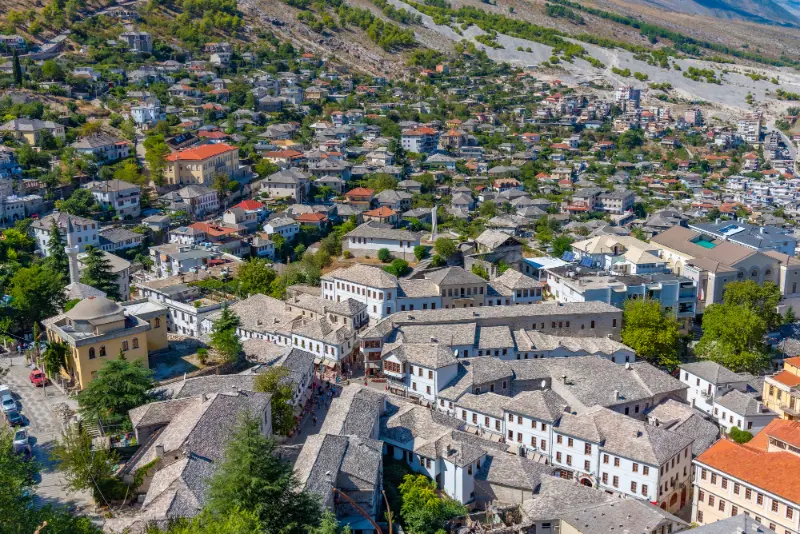
    Aerial View Of Gjirokaster Old Town Albania

    For country-wide rules and route planning, start with my Camping & Campervan Travel in Albania guide and the 10-day Albania campervan road-trip itinerary. For ordinary sightseeing, keep the Gjirokastër travel guide open as well. If you only need urban parking rather than an overnight pitch, use the Gjirokastër parking guide.

    Quick verdict: is Gjirokastër good for campervans?

    Overall verdictA superb cultural stop, but the motorhome belongs in the lower city or a proper campsite—not in the steep UNESCO lanes.
    Main difficultyVery steep, polished-stone streets around the Old Bazaar and castle, plus awkward turning space for long vehicles.
    Best overnight strategyStay low or outside the old town and use a taxi or walking route for the bazaar and castle.
    Best seasonApril–June and September–October are easiest; summer heat makes uphill sightseeing harder.
    How long to stayTwo nights is a comfortable default; add a third if you want a day trip without moving the camper.
    Logical next stopSarandë, Përmet/Vjosa, Berat or the Greek border.

    Why Gjirokastër needs a campervan-specific plan

    A motorhome changes small travel decisions. A restaurant car park that works for a hatchback may have a low entrance; a “ten-minute drive” can end in a lane with no turning space; a scenic parking area may permit daytime parking but prohibit overnight camping. In Gjirokastër and the Drino/Vjosa region, the smartest route is rarely the one that gets the vehicle closest to every attraction. It is the one that keeps the vehicle somewhere appropriate while you enjoy the destination with less friction.

    Gjirokastër makes the basic campervan rule obvious: a road can be technically drivable yet still be a bad place for a large vehicle. The UNESCO old town climbs sharply above the valley floor, and the stone streets around the bazaar are designed for a very different scale of transport. Keep the motorhome lower and make the last part of the journey without it.

    Gjirokaster Old Bazaar Street Albania

    Parking is not the same as camping

    This distinction is the foundation of responsible motorhome travel in Albania. Parking means leaving the vehicle in a place where parking is permitted. Camping usually involves staying overnight and may include levelling ramps, an awning, chairs, cooking outside, extending steps or disposing of water. A place that allows the first does not automatically allow the second.

    When you are unsure, ask. A simple question to a campsite, property owner, municipality or protected-area staff is better than assuming that “nobody stopped the previous van” is permission. On beaches and in residential areas, keep noise low, never block access and do not empty grey or black water outside a proper disposal point.

    Where to base the camper

    Base in the lower city or outside the historic core

    A campsite or camper-friendly property in the valley/lower city gives you easier access and less anxiety about gradients. From there, use a taxi to the bazaar or walk if you are comfortable with the climb. Ask your host exactly where a vehicle of your height and length can enter before following a pin through residential lanes.

    Do not chase the castle with the camper

    The castle is one of Albania’s great sights, but it should be approached as a pedestrian visit. Large-vehicle drivers gain little by climbing higher into the historic fabric. Park legally lower down and use your energy for the museum, views and bazaar rather than reversing out of a narrow corner.

    Përmet and the Vjosa make a natural next stage

    The Vjosa corridor is a beautiful road-trip continuation, but protected-area status changes the camping question. Use established overnight places and dedicated camping zones. Riverbanks, gravel bars and quiet access tracks are not automatically legal campsites simply because they look empty.

    What to confirm before booking a campsite or camper-friendly stay

    • Maximum vehicle length and height. Do not rely on a generic “campervan welcome” label if you drive a long motorhome or have bikes on the rear.
    • Final access road. Ask whether the last kilometre is paved, steep, narrow or crossed by low branches.
    • Electric hook-up. Confirm connector type, amperage and whether electricity is included or charged separately.
    • Fresh water. Ask whether it is potable and whether a hose connection is available.
    • Grey and black-water disposal. A real disposal point is more important than a pretty view on a multi-day trip.
    • Surface and levelling. Gravel, grass and steep terracing behave very differently after heavy rain.
    • Shade and ventilation. In summer, a shaded pitch can change the quality of the entire stay.
    • Opening dates. Many coastal and rural sites are seasonal; never assume a place listed online is staffed in winter.
    • Late arrival. If a ferry, border crossing or mountain road may delay you, get written instructions before setting off.
    • Pets and children. Confirm fencing, road proximity and any extra rules if you travel with a dog or young children.

    Protected areas: the rule that matters

    Albania’s National Agency of Protected Areas (AKZM) stated in a 2026 response that camping inside protected areas is permitted only in areas specifically designated for camping and is subject to the applicable rules and fees. You can read the agency’s 2026 public-response register here. The Vjosa is now a national park, and AKZM’s protected-area guidance is especially relevant: camping must be in designated zones. This is a clear reason to plan a recognised overnight stop rather than improvising beside the river.

    That means “wild-looking” does not mean “free to camp.” National parks, archaeological landscapes, wetlands, river corridors and marine/coastal protected areas may have different zoning and visitor rules. Use existing public roads and visitor infrastructure, respect signs and move on if the status of an overnight stop is unclear.

    Water, waste and electricity: plan before the tank is full

    Campervan travel becomes stressful when service tasks are postponed until they become urgent. Refill fresh water when you have a trusted source, empty wastewater only at a proper facility and keep enough toilet capacity for the next planned campsite. Do not use storm drains, beach edges, fields or riverbanks for grey or black water. Even biodegradable soap changes water chemistry and belongs in the correct system.

    Electricity deserves the same planning. Albania’s summer coast can make a camper extremely hot, while the southeast and mountain regions can be cold outside summer. Know what your battery, solar setup and heating or ventilation can realistically support. A campsite with reliable power is often cheaper than solving a flat leisure battery or spoiled food later.

    Driving a large vehicle around Gjirokastër

    The normal car-driving advice in the Gjirokastër parking guide still applies, but a motorhome magnifies every constraint. Leave more braking distance, avoid entering a lane unless you know where you can exit, and do not let an impatient car behind you choose your speed. If a route feels wrong, stop somewhere safe and reassess rather than continuing simply because the navigation app says the destination is close.

    Download offline maps but do not treat them as a vehicle-size routing system. They may show narrow village roads, height restrictions or steep shortcuts without understanding your dimensions. When a campsite gives you a recommended approach, follow it even if the route is a few kilometres longer.

    Security and leaving the camper unattended

    Use ordinary road-trip precautions rather than fear. Lock doors and windows, keep passports and electronics out of sight and avoid advertising that the vehicle will be empty all day. A dedicated campsite or supervised property is especially useful when you want to leave the motorhome for a boat trip, hike or full-day city visit.

    Photograph the exterior, roof accessories and bike rack before a long trip, and know your vehicle height. If you use LPG, check connections and keep ventilation clear. Never run a combustion heater or cooker in a way that conflicts with the manufacturer’s ventilation requirements.

    Weather and season

    Gjirokastër can be extremely hot in summer and surprisingly slippery after rain because of polished stone. A level, shaded campsite is worth more than a dramatic old-town address for a heavy vehicle. Spring and autumn are particularly good for combining the city with Përmet.

    Aerial View Of Gjirokaster Old Town Albania 2

    Whatever the season, avoid arriving at an unfamiliar campsite after dark if you can. Albania’s most beautiful overnight areas are often reached by smaller roads where gate width, trees, drainage and pitch slope are much easier to judge in daylight.

    A realistic 2-day campervan plan for Gjirokastër

    Day 1 — arrive, establish the base, then stop driving

    Day 1: arrive in daylight, establish your base and take a taxi or walk into the Old Bazaar. Visit the castle and traditional houses without moving the motorhome again.

    Day 2 — one main excursion, not five parking searches

    Day 2: choose either a relaxed second city morning or depart for Përmet/Vjosa. If you are continuing to Sarandë, make the road transfer before late afternoon so you are not searching for a southern-coast campsite after dark.

    Where to go next

    Gjirokastër is one of the best junctions in a southern campervan itinerary: Sarandë lies toward the coast, Përmet follows the Vjosa landscape and the Kakavijë crossing leads toward Greece. Cross-border travellers should check insurance and vehicle documents before the travel day.

    If you need a hotel night instead

    Campervan travel does not have to mean sleeping in the vehicle every night. A hotel can be useful after a late ferry, during extreme heat, when someone is ill, or when you want a secure base while the vehicle is serviced. For Gjirokastër, you can compare hotels, apartments and backup stays on Booking.com. Always confirm parking dimensions directly with the property if you intend to leave a motorhome there.

    Common mistakes to avoid

    • Treating every legal parking space as permission to camp overnight.
    • Following a normal-car navigation shortcut without checking width, gradient or turning room.
    • Arriving at a coastal or mountain campsite after dark without confirming the final approach.
    • Waiting until the fresh-water tank is empty or the wastewater tank is full before looking for services.
    • Driving the camper to every attraction instead of using it as a base for walking, taxis, buses or boat trips.
    • Opening awnings or putting chairs out in an ordinary car park.
    • Assuming a beach, riverbank or protected-area pull-off is a free campsite because another van is already there.
    • Ignoring vehicle height in underground or covered parking.
    • Leaving food, passports, laptops or cameras visible when the camper is unattended.
    • Planning too many one-night stops and spending the holiday levelling, packing and driving instead of exploring.

    FAQ

    Can I wild camp around Gjirokastër?

    Do not rely on a blanket yes-or-no answer. Land ownership, municipal rules, protected-area zoning and local restrictions matter. In protected areas, AKZM’s 2026 guidance is clear that camping is limited to designated camping zones. Elsewhere, use a dedicated campsite or obtain explicit permission from the landowner/property whenever possible.

    Can I sleep in a normal city parking space?

    A parked vehicle and an overnight camping setup are not the same thing. Even where overnight parking is not explicitly signed against, local rules, private-property conditions or security concerns may make it inappropriate. For a planned stay, use a campsite or place that clearly accepts campervans.

    Do I need to reserve campsites in Albania?

    In July and August on the coast, reserving or at least messaging ahead is sensible—especially for a large motorhome, a vehicle needing electricity, or a late arrival. Outside peak season, checking opening dates is just as important as checking availability.

    Is Albania suitable for a large motorhome?

    Yes, if you adapt the route. Main intercity roads and many established campsites are manageable, but historic centres, mountain villages and beach access lanes can be awkward. Plan the motorhome route around suitable bases and use smaller-scale transport for the final kilometres when needed.

    What should I do before crossing into another country?

    Check passport rules, vehicle registration, insurance/Green Card requirements where applicable, rental-company permission if the camper is hired, and any rules for pets. Do this before the travel day rather than at the border queue.

    Final advice

    The best campervan trip around Gjirokastër is not the one with the most dramatic overnight pin. It is the one where you know you are allowed to stay, can service the vehicle responsibly and can leave it parked while you actually experience the destination. Use proper campsites when they solve water, waste, electricity and security at once; use ordinary parking only for parking; and let Gjirokastër be part of the journey rather than another place where the whole day disappears into manoeuvring a large vehicle.

  • Campervan & Camping in Berat: UNESCO Old Town, Parking, Osum and Road-Trip Tips

    Campervan & Camping in Berat: UNESCO Old Town, Parking, Osum and Road-Trip Tips

    Berat by campervan or motorhome works best when you separate three different needs: somewhere legal to sleep, somewhere practical to park for sightseeing, and a route that your vehicle can handle without turning a holiday into a driving test. A rewarding campervan stop if you sleep outside the UNESCO lanes and visit Mangalem/Castle on foot or by local transport. This guide focuses on the decisions that matter once your vehicle is longer, taller and heavier than a normal rental car.

    Albanian Old Berat View Berat Castle Walls Tiled Roofs Houses 11

    For country-wide rules and route planning, start with my Camping & Campervan Travel in Albania guide and the 10-day Albania campervan road-trip itinerary. For ordinary sightseeing, keep the Berat travel guide open as well. If you only need urban parking rather than an overnight pitch, use the Berat parking guide.

    Quick verdict: is Berat good for campervans?

    Overall verdictA rewarding campervan stop if you sleep outside the UNESCO lanes and visit Mangalem/Castle on foot or by local transport.
    Main difficultySteep historic streets and the temptation to drive the motorhome closer to Berat Castle than is comfortable.
    Best overnight strategyChoose a campsite, agrotourism-style property or camper-friendly stay outside the tight old quarters and use city parking only for sightseeing.
    Best seasonSpring and autumn are easiest; midsummer is hot and the castle climb is demanding.
    How long to stayTwo nights is a comfortable default; add a third if you want a day trip without moving the camper.
    Logical next stopTirana/Durrës northbound, Gjirokastër southbound, or the Osum/Çorovodë direction.

    Why Berat needs a campervan-specific plan

    A motorhome changes small travel decisions. A restaurant car park that works for a hatchback may have a low entrance; a “ten-minute drive” can end in a lane with no turning space; a scenic parking area may permit daytime parking but prohibit overnight camping. In Berat and the Osum valley, the smartest route is rarely the one that gets the vehicle closest to every attraction. It is the one that keeps the vehicle somewhere appropriate while you enjoy the destination with less friction.

    Berat looks compact on a map but the old quarters are divided by the Osum River and backed by steep slopes. Mangalem, Gorica and the castle are wonderful on foot; they are not places to test how far a motorhome can climb. Arrive with an overnight plan already chosen so you are not improvising on narrow streets at dusk.

    Berat Old Town And Osumi River Albania

    Parking is not the same as camping

    This distinction is the foundation of responsible motorhome travel in Albania. Parking means leaving the vehicle in a place where parking is permitted. Camping usually involves staying overnight and may include levelling ramps, an awning, chairs, cooking outside, extending steps or disposing of water. A place that allows the first does not automatically allow the second.

    When you are unsure, ask. A simple question to a campsite, property owner, municipality or protected-area staff is better than assuming that “nobody stopped the previous van” is permission. On beaches and in residential areas, keep noise low, never block access and do not empty grey or black water outside a proper disposal point.

    Where to base the camper

    Sleep outside the UNESCO lanes

    A legal campsite or camper-friendly rural property outside the old quarters is the low-stress option. You gain space, easier vehicle access and a better chance of water or electricity. Then visit Mangalem and Gorica on foot, by taxi or from a legitimate day-parking space.

    Berat Castle is not a motorhome challenge

    Even if navigation apps show a drivable route toward the castle, steep gradients, local traffic and limited manoeuvring can make a large vehicle a poor choice. Park lower down and walk or take a taxi. The objective is to see the castle, not prove that the camper can reach its gate.

    Osum and Tomorr excursions need vehicle judgement

    The road toward Çorovodë and the Osum Canyon is a logical extension, but a canyon viewpoint or rafting meeting point does not automatically include overnight motorhome facilities. Mount Tomorr requires even more caution: use local operators for rougher mountain access rather than assuming a heavy camper belongs on every scenic track.

    What to confirm before booking a campsite or camper-friendly stay

    • Maximum vehicle length and height. Do not rely on a generic “campervan welcome” label if you drive a long motorhome or have bikes on the rear.
    • Final access road. Ask whether the last kilometre is paved, steep, narrow or crossed by low branches.
    • Electric hook-up. Confirm connector type, amperage and whether electricity is included or charged separately.
    • Fresh water. Ask whether it is potable and whether a hose connection is available.
    • Grey and black-water disposal. A real disposal point is more important than a pretty view on a multi-day trip.
    • Surface and levelling. Gravel, grass and steep terracing behave very differently after heavy rain.
    • Shade and ventilation. In summer, a shaded pitch can change the quality of the entire stay.
    • Opening dates. Many coastal and rural sites are seasonal; never assume a place listed online is staffed in winter.
    • Late arrival. If a ferry, border crossing or mountain road may delay you, get written instructions before setting off.
    • Pets and children. Confirm fencing, road proximity and any extra rules if you travel with a dog or young children.

    Protected areas: the rule that matters

    Albania’s National Agency of Protected Areas (AKZM) stated in a 2026 response that camping inside protected areas is permitted only in areas specifically designated for camping and is subject to the applicable rules and fees. You can read the agency’s 2026 public-response register here. Protected mountain and canyon areas around Berat may have specific access and camping rules. When in doubt, use a dedicated campsite or ask the local protected-area administration rather than treating open ground as free camping.

    That means “wild-looking” does not mean “free to camp.” National parks, archaeological landscapes, wetlands, river corridors and marine/coastal protected areas may have different zoning and visitor rules. Use existing public roads and visitor infrastructure, respect signs and move on if the status of an overnight stop is unclear.

    Water, waste and electricity: plan before the tank is full

    Campervan travel becomes stressful when service tasks are postponed until they become urgent. Refill fresh water when you have a trusted source, empty wastewater only at a proper facility and keep enough toilet capacity for the next planned campsite. Do not use storm drains, beach edges, fields or riverbanks for grey or black water. Even biodegradable soap changes water chemistry and belongs in the correct system.

    Electricity deserves the same planning. Albania’s summer coast can make a camper extremely hot, while the southeast and mountain regions can be cold outside summer. Know what your battery, solar setup and heating or ventilation can realistically support. A campsite with reliable power is often cheaper than solving a flat leisure battery or spoiled food later.

    Driving a large vehicle around Berat

    The normal car-driving advice in the Berat parking guide still applies, but a motorhome magnifies every constraint. Leave more braking distance, avoid entering a lane unless you know where you can exit, and do not let an impatient car behind you choose your speed. If a route feels wrong, stop somewhere safe and reassess rather than continuing simply because the navigation app says the destination is close.

    Download offline maps but do not treat them as a vehicle-size routing system. They may show narrow village roads, height restrictions or steep shortcuts without understanding your dimensions. When a campsite gives you a recommended approach, follow it even if the route is a few kilometres longer.

    Security and leaving the camper unattended

    Use ordinary road-trip precautions rather than fear. Lock doors and windows, keep passports and electronics out of sight and avoid advertising that the vehicle will be empty all day. A dedicated campsite or supervised property is especially useful when you want to leave the motorhome for a boat trip, hike or full-day city visit.

    Photograph the exterior, roof accessories and bike rack before a long trip, and know your vehicle height. If you use LPG, check connections and keep ventilation clear. Never run a combustion heater or cooker in a way that conflicts with the manufacturer’s ventilation requirements.

    Weather and season

    Berat is one of the hottest major cultural stops in summer. Shade and reliable ventilation are priorities for an overnight pitch, and sightseeing is best early or late. Spring brings greener landscapes; autumn is excellent for food and wine travel, while winter can make unpaved campsite surfaces muddy.

    Whatever the season, avoid arriving at an unfamiliar campsite after dark if you can. Albania’s most beautiful overnight areas are often reached by smaller roads where gate width, trees, drainage and pitch slope are much easier to judge in daylight.

    A realistic 2-day campervan plan for Berat

    Day 1 — arrive, establish the base, then stop driving

    Arrive, settle outside the historic core and spend the late afternoon in Mangalem and Gorica. Keep the camper parked overnight and enjoy dinner without worrying about moving it after dark.

    Day 2 — one main excursion, not five parking searches

    On Day 2, visit the castle early, then either stay a second night for wineries/agrotourism or continue toward the Osum valley. If heading south to Gjirokastër, leave before late afternoon so you arrive before the steep old-town streets become part of the navigation problem.

    Where to go next

    Berat fits perfectly between Tirana/Durrës and Gjirokastër. Campervan travellers who want more nature can add the Osum valley, but should plan services and overnight stops in advance because rural sightseeing areas do not necessarily provide wastewater disposal or electricity.

    Old Gorica Bridge Osum River Berat Albania Cityscape As Backdrop

    If you need a hotel night instead

    Campervan travel does not have to mean sleeping in the vehicle every night. A hotel can be useful after a late ferry, during extreme heat, when someone is ill, or when you want a secure base while the vehicle is serviced. For Berat, you can compare hotels, apartments and backup stays on Booking.com. Always confirm parking dimensions directly with the property if you intend to leave a motorhome there.

    Common mistakes to avoid

    • Treating every legal parking space as permission to camp overnight.
    • Following a normal-car navigation shortcut without checking width, gradient or turning room.
    • Arriving at a coastal or mountain campsite after dark without confirming the final approach.
    • Waiting until the fresh-water tank is empty or the wastewater tank is full before looking for services.
    • Driving the camper to every attraction instead of using it as a base for walking, taxis, buses or boat trips.
    • Opening awnings or putting chairs out in an ordinary car park.
    • Assuming a beach, riverbank or protected-area pull-off is a free campsite because another van is already there.
    • Ignoring vehicle height in underground or covered parking.
    • Leaving food, passports, laptops or cameras visible when the camper is unattended.
    • Planning too many one-night stops and spending the holiday levelling, packing and driving instead of exploring.

    FAQ

    Can I wild camp around Berat?

    Do not rely on a blanket yes-or-no answer. Land ownership, municipal rules, protected-area zoning and local restrictions matter. In protected areas, AKZM’s 2026 guidance is clear that camping is limited to designated camping zones. Elsewhere, use a dedicated campsite or obtain explicit permission from the landowner/property whenever possible.

    Can I sleep in a normal city parking space?

    A parked vehicle and an overnight camping setup are not the same thing. Even where overnight parking is not explicitly signed against, local rules, private-property conditions or security concerns may make it inappropriate. For a planned stay, use a campsite or place that clearly accepts campervans.

    Do I need to reserve campsites in Albania?

    In July and August on the coast, reserving or at least messaging ahead is sensible—especially for a large motorhome, a vehicle needing electricity, or a late arrival. Outside peak season, checking opening dates is just as important as checking availability.

    Is Albania suitable for a large motorhome?

    Yes, if you adapt the route. Main intercity roads and many established campsites are manageable, but historic centres, mountain villages and beach access lanes can be awkward. Plan the motorhome route around suitable bases and use smaller-scale transport for the final kilometres when needed.

    What should I do before crossing into another country?

    Check passport rules, vehicle registration, insurance/Green Card requirements where applicable, rental-company permission if the camper is hired, and any rules for pets. Do this before the travel day rather than at the border queue.

    Final advice

    The best campervan trip around Berat is not the one with the most dramatic overnight pin. It is the one where you know you are allowed to stay, can service the vehicle responsibly and can leave it parked while you actually experience the destination. Use proper campsites when they solve water, waste, electricity and security at once; use ordinary parking only for parking; and let Berat be part of the journey rather than another place where the whole day disappears into manoeuvring a large vehicle.
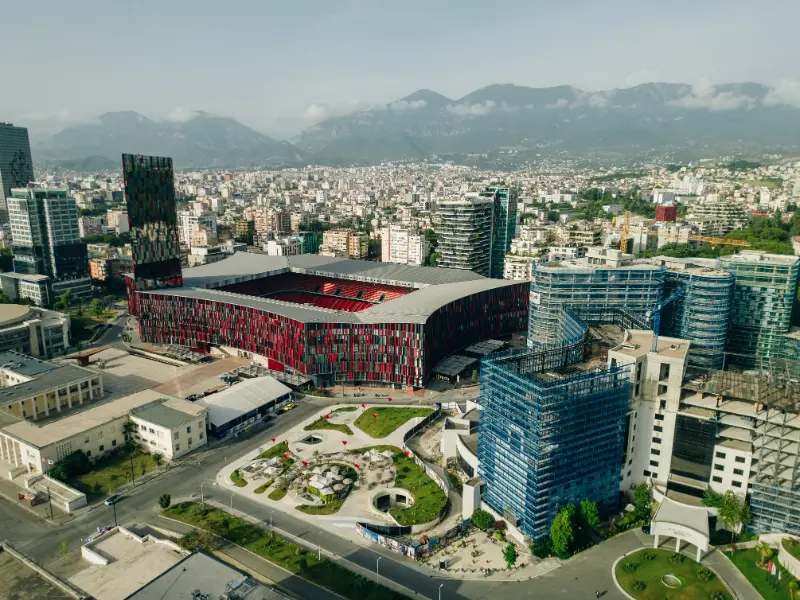
  • Campervan & Camping in Vlorë: Radhimë, Orikum, Llogara and Riviera Road Tips

    Campervan & Camping in Vlorë: Radhimë, Orikum, Llogara and Riviera Road Tips

    Vlorë by campervan or motorhome works best when you separate three different needs: somewhere legal to sleep, somewhere practical to park for sightseeing, and a route that your vehicle can handle without turning a holiday into a driving test. A strong campervan base if you sleep outside the tight Lungomare core and plan the Riviera road carefully. This guide focuses on the decisions that matter once your vehicle is longer, taller and heavier than a normal rental car.

    For country-wide rules and route planning, start with my Camping & Campervan Travel in Albania guide and the 10-day Albania campervan road-trip itinerary. For ordinary sightseeing, keep the Vlorë travel guide open as well. If you only need urban parking rather than an overnight pitch, use the Vlorë parking guide.

    Quick verdict: is Vlorë good for campervans?

    Overall verdictA strong campervan base if you sleep outside the tight Lungomare core and plan the Riviera road carefully.
    Main difficultySummer congestion and the transition from urban Vlorë to the winding SH8 coast beyond Orikum and Llogara.
    Best overnight strategyLook for organised camping or camper-friendly stays around the wider coastal belt, especially outside the busiest central waterfront.
    Best seasonMay–June and September are ideal; midsummer needs reservations and early driving.
    How long to stayTwo nights is a comfortable default; add a third if you want a day trip without moving the camper.
    Logical next stopHimarë and the Riviera, Berat, or the Narta/Zvërnec area.

    Why Vlorë needs a campervan-specific plan

    A motorhome changes small travel decisions. A restaurant car park that works for a hatchback may have a low entrance; a “ten-minute drive” can end in a lane with no turning space; a scenic parking area may permit daytime parking but prohibit overnight camping. In Vlorë, Radhimë, Orikum and the northern Riviera, the smartest route is rarely the one that gets the vehicle closest to every attraction. It is the one that keeps the vehicle somewhere appropriate while you enjoy the destination with less friction.

    Vlorë is where a straightforward coastal road trip starts to become a mountain-and-sea journey. The city itself is broad enough for normal driving, but the tourist waterfront can be congested in summer. South of Orikum, the route climbs toward Llogara and then drops onto the Riviera, so vehicle size, brakes and driver confidence matter more than they did on the Adriatic plain.

    Parking is not the same as camping

    This distinction is the foundation of responsible motorhome travel in Albania. Parking means leaving the vehicle in a place where parking is permitted. Camping usually involves staying overnight and may include levelling ramps, an awning, chairs, cooking outside, extending steps or disposing of water. A place that allows the first does not automatically allow the second.

    When you are unsure, ask. A simple question to a campsite, property owner, municipality or protected-area staff is better than assuming that “nobody stopped the previous van” is permission. On beaches and in residential areas, keep noise low, never block access and do not empty grey or black water outside a proper disposal point.

    Where to base the camper

    Do not build your overnight plan around the Lungomare

    The Lungomare is excellent for an evening walk, restaurants and sea views, but a legal urban parking space is not the same as a camping pitch. For an overnight stay, look farther from the busiest promenade where an organised campsite or camper-friendly property can provide actual space, services and permission to remain overnight.

    Radhimë and Orikum are practical staging areas

    The coast south of Vlorë gives road-trippers a useful compromise: close enough to return to the city, but positioned for an early start toward Llogara and Himarë. Confirm access before arrival because some seaside lanes are narrow, steep or blocked by parked cars in July and August.

    Llogara changes the driving day

    The climb and descent around Llogara are scenic but should not be rushed in a heavy vehicle. Use lower gears appropriately, leave a larger following distance and stop only where there is genuine room. A viewpoint is not a campsite, and protected-area rules apply inside the national park.

    What to confirm before booking a campsite or camper-friendly stay

    • Maximum vehicle length and height. Do not rely on a generic “campervan welcome” label if you drive a long motorhome or have bikes on the rear.
    • Final access road. Ask whether the last kilometre is paved, steep, narrow or crossed by low branches.
    • Electric hook-up. Confirm connector type, amperage and whether electricity is included or charged separately.
    • Fresh water. Ask whether it is potable and whether a hose connection is available.
    • Grey and black-water disposal. A real disposal point is more important than a pretty view on a multi-day trip.
    • Surface and levelling. Gravel, grass and steep terracing behave very differently after heavy rain.
    • Shade and ventilation. In summer, a shaded pitch can change the quality of the entire stay.
    • Opening dates. Many coastal and rural sites are seasonal; never assume a place listed online is staffed in winter.
    • Late arrival. If a ferry, border crossing or mountain road may delay you, get written instructions before setting off.
    • Pets and children. Confirm fencing, road proximity and any extra rules if you travel with a dog or young children.

    Protected areas: the rule that matters

    Albania’s National Agency of Protected Areas (AKZM) stated in a 2026 response that camping inside protected areas is permitted only in areas specifically designated for camping and is subject to the applicable rules and fees. You can read the agency’s 2026 public-response register here. Llogara National Park and the Karaburun–Sazan protected landscape require extra discipline. The official protected-area framework does not treat arbitrary forest pull-offs or coastal viewpoints as camping zones.

    That means “wild-looking” does not mean “free to camp.” National parks, archaeological landscapes, wetlands, river corridors and marine/coastal protected areas may have different zoning and visitor rules. Use existing public roads and visitor infrastructure, respect signs and move on if the status of an overnight stop is unclear.

    Water, waste and electricity: plan before the tank is full

    Campervan travel becomes stressful when service tasks are postponed until they become urgent. Refill fresh water when you have a trusted source, empty wastewater only at a proper facility and keep enough toilet capacity for the next planned campsite. Do not use storm drains, beach edges, fields or riverbanks for grey or black water. Even biodegradable soap changes water chemistry and belongs in the correct system.

    Electricity deserves the same planning. Albania’s summer coast can make a camper extremely hot, while the southeast and mountain regions can be cold outside summer. Know what your battery, solar setup and heating or ventilation can realistically support. A campsite with reliable power is often cheaper than solving a flat leisure battery or spoiled food later.

    Driving a large vehicle around Vlorë

    The normal car-driving advice in the Vlorë parking guide still applies, but a motorhome magnifies every constraint. Leave more braking distance, avoid entering a lane unless you know where you can exit, and do not let an impatient car behind you choose your speed. If a route feels wrong, stop somewhere safe and reassess rather than continuing simply because the navigation app says the destination is close.

    Albania Vlore Large Palm Tree Seashore Cottages Tourists

    Download offline maps but do not treat them as a vehicle-size routing system. They may show narrow village roads, height restrictions or steep shortcuts without understanding your dimensions. When a campsite gives you a recommended approach, follow it even if the route is a few kilometres longer.

    Security and leaving the camper unattended

    Use ordinary road-trip precautions rather than fear. Lock doors and windows, keep passports and electronics out of sight and avoid advertising that the vehicle will be empty all day. A dedicated campsite or supervised property is especially useful when you want to leave the motorhome for a boat trip, hike or full-day city visit.

    Photograph the exterior, roof accessories and bike rack before a long trip, and know your vehicle height. If you use LPG, check connections and keep ventilation clear. Never run a combustion heater or cooker in a way that conflicts with the manufacturer’s ventilation requirements.

    Weather and season

    Wind matters around Vlorë and Llogara as much as heat. Check the forecast before a mountain driving day or exposed coastal overnight. In summer, drive the SH8 earlier in the morning; in cooler months, rain, fog and low cloud can turn a scenic road into a concentration-heavy drive.

    Vlore Port And Ferry Albania

    Whatever the season, avoid arriving at an unfamiliar campsite after dark if you can. Albania’s most beautiful overnight areas are often reached by smaller roads where gate width, trees, drainage and pitch slope are much easier to judge in daylight.

    A realistic 2-day campervan plan for Vlorë

    Day 1 — arrive, establish the base, then stop driving

    Use Day 1 for the city: park or camp outside the busiest waterfront, then visit the historic centre and Lungomare without moving the vehicle repeatedly. Stock food and water before the Riviera leg.

    Day 2 — one main excursion, not five parking searches

    Leave early on Day 2 for Orikum and Llogara. If your vehicle is large or the weather is poor, treat Himarë as a separate relocation rather than combining multiple beaches and mountain stops into the same day.

    Where to go next

    Southbound, Himarë is the natural next overnight base. North or east, Berat is a good cultural contrast. If your plan includes boat trips to Karaburun or Sazan, keep the camper on land in a legal base and take the boat as a day excursion rather than trying to combine boat departure parking with overnight camping.

    If you need a hotel night instead

    Campervan travel does not have to mean sleeping in the vehicle every night. A hotel can be useful after a late ferry, during extreme heat, when someone is ill, or when you want a secure base while the vehicle is serviced. For Vlorë, you can compare hotels, apartments and backup stays on Booking.com. Always confirm parking dimensions directly with the property if you intend to leave a motorhome there.

    Vlore Albania Seascape Yachts Pier

    Common mistakes to avoid

    • Treating every legal parking space as permission to camp overnight.
    • Following a normal-car navigation shortcut without checking width, gradient or turning room.
    • Arriving at a coastal or mountain campsite after dark without confirming the final approach.
    • Waiting until the fresh-water tank is empty or the wastewater tank is full before looking for services.
    • Driving the camper to every attraction instead of using it as a base for walking, taxis, buses or boat trips.
    • Opening awnings or putting chairs out in an ordinary car park.
    • Assuming a beach, riverbank or protected-area pull-off is a free campsite because another van is already there.
    • Ignoring vehicle height in underground or covered parking.
    • Leaving food, passports, laptops or cameras visible when the camper is unattended.
    • Planning too many one-night stops and spending the holiday levelling, packing and driving instead of exploring.

    FAQ

    Can I wild camp around Vlorë?

    Do not rely on a blanket yes-or-no answer. Land ownership, municipal rules, protected-area zoning and local restrictions matter. In protected areas, AKZM’s 2026 guidance is clear that camping is limited to designated camping zones. Elsewhere, use a dedicated campsite or obtain explicit permission from the landowner/property whenever possible.

    Can I sleep in a normal city parking space?

    A parked vehicle and an overnight camping setup are not the same thing. Even where overnight parking is not explicitly signed against, local rules, private-property conditions or security concerns may make it inappropriate. For a planned stay, use a campsite or place that clearly accepts campervans.

    Do I need to reserve campsites in Albania?

    In July and August on the coast, reserving or at least messaging ahead is sensible—especially for a large motorhome, a vehicle needing electricity, or a late arrival. Outside peak season, checking opening dates is just as important as checking availability.

    Is Albania suitable for a large motorhome?

    Yes, if you adapt the route. Main intercity roads and many established campsites are manageable, but historic centres, mountain villages and beach access lanes can be awkward. Plan the motorhome route around suitable bases and use smaller-scale transport for the final kilometres when needed.

    What should I do before crossing into another country?

    Check passport rules, vehicle registration, insurance/Green Card requirements where applicable, rental-company permission if the camper is hired, and any rules for pets. Do this before the travel day rather than at the border queue.

    Final advice

    The best campervan trip around Vlorë is not the one with the most dramatic overnight pin. It is the one where you know you are allowed to stay, can service the vehicle responsibly and can leave it parked while you actually experience the destination. Use proper campsites when they solve water, waste, electricity and security at once; use ordinary parking only for parking; and let Vlorë be part of the journey rather than another place where the whole day disappears into manoeuvring a large vehicle.