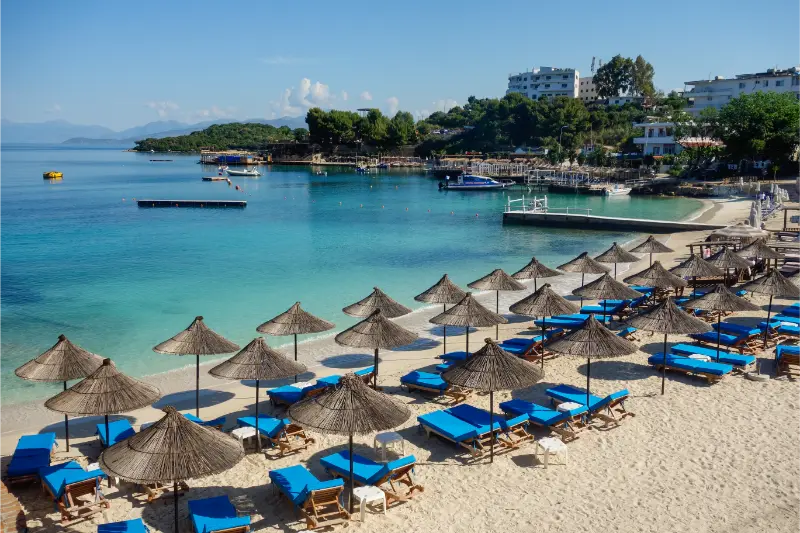
Sarande Ksamil for senior travelers is best planned around comfort, not a stereotype about age. Some travelers in their seventies happily hike for hours; others in their fifties need to protect a knee, avoid heat or limit stairs. Sarandë and Ksamil can be excellent for senior travelers, but they reward careful hotel selection more than almost any other Albanian coastal base. Sarandë climbs steeply behind the waterfront, while Ksamil is spread across small roads and separate beach pockets. A sea view may come with a daily hill or staircase, so location and entrance design matter as much as room quality.
This guide focuses on practical choices that reduce unnecessary strain: where to stay, how much walking to schedule, when a taxi is worth it, how to manage heat and medication, and which excursions deserve more scrutiny. For a country-wide route, start with my Albania for Senior Travelers guide; for ordinary sightseeing detail, keep the Sarandë & Ksamil travel guide open as well.
Is Sarandë & Ksamil a good destination for senior travelers?
Yes, with the right expectations. The most important question is not “Am I too old for Sarandë & Ksamil?” but “Which parts of Sarandë & Ksamil match the way I currently like to travel?” Good senior travel planning removes avoidable friction—long luggage carries, steep hotel approaches, midday heat, uncertain late-night transport—while keeping the experiences that made you choose Albania in the first place.
Sarandë’s promenade is the easiest walking environment, but many hotels sit uphill. Ksamil is less steep overall yet sidewalks can be discontinuous and beach entrances vary. Butrint includes uneven archaeological surfaces, while the Blue Eye can involve walking from the parking/arrival area; decide whether those distances fit your stamina before committing.
Choose the hotel for access, not only for the view
In Sarandë, a hotel close to the promenade can dramatically reduce effort. In Ksamil, choose the specific beach area first and then find accommodation nearby rather than selecting a property solely by rating. Confirm lift access, number of entrance steps and whether the restaurant/breakfast room is on another floor without lift service.

Before booking, use Booking.com accommodation options in Sarandë & Ksamil to compare location, lift information and recent reviews. Then contact the property directly if an access feature is non-negotiable. “Elevator” does not always mean step-free from the street, and “ground floor” can still include entrance steps.
- Ask how many steps there are from the street to reception and from the lift to the room.
- Confirm whether the shower is walk-in or inside a high bathtub if that matters to you.
- Check whether breakfast is served on a floor reached by the lift.
- Ask where a taxi can stop, especially in historic or pedestrian areas.
- If you sleep lightly, request a room away from late-night bars, lifts and busy roads.
- For longer stays, a small fridge can be useful for medication, drinks and simple snacks.
Walking: plan by surface and gradient, not kilometres
A four-kilometre day on smooth level pavement can be easier than one kilometre on polished stone, stairs and steep lanes. In Sarandë & Ksamil, separate “distance” from “effort.” Build the day around one physically demanding block, then add seated experiences—lunch, museum, café, scenic drive or waterfront time—rather than stacking several walking-heavy attractions.
If reduced mobility is a central issue rather than simply a preference for slower travel, read the dedicated accessible Sarandë & Ksamil guide. It focuses more specifically on gradients, surfaces, wheelchair/reduced-mobility planning and what needs direct confirmation.
Use taxis to protect the best part of the day
For ferry arrivals from Corfu, a pre-arranged transfer is worth considering if you have luggage or arrive in heat. The Sarandë–Ksamil road can be crowded in summer, so taxis and transfers often preserve more energy than waiting for a packed bus. Agree pickup details carefully because beach addresses can be confusing in peak season.
See the local Sarandë & Ksamil taxi and transfer guide for practical transport planning. A ten-minute taxi can be excellent value if it prevents a difficult approach, preserves energy for a museum or lets you enjoy dinner without worrying about the walk back uphill.
A comfortable sightseeing rhythm
A comfortable plan uses Sarandë as the service base, Ksamil for selected beach time and Butrint for one cultural half-day. Avoid combining Butrint, Blue Eye and a full beach afternoon in one compressed tour unless you are very comfortable with heat and repeated vehicle entries/exits.
The 90-minute rule
For many travelers, ninety minutes is a useful maximum for a continuous sightseeing block before a real seated break. It is not a medical rule; it is a planning tool. A coffee, lunch or hotel rest before fatigue becomes obvious usually preserves the afternoon better than pushing until someone is exhausted.
Do the hardest thing first
If the day includes a castle, archaeological site, long promenade or excursion, schedule the most demanding element in the coolest and freshest part of the day. Leave flexible, seated or air-conditioned activities for later. This is especially important in July and August.
Heat, hydration and sun
Albanian summer heat can turn an ordinary walking day into a much harder one. Carry water, use a hat and sunscreen, and plan shade before you need it. If you take medication affected by dehydration, heat or sun exposure, follow your clinician’s advice rather than generic travel tips. Do not reduce prescribed medication or change timing simply because a travel day is inconvenient.
June and September are much easier than peak July/August because Ksamil’s crowds, traffic and heat amplify every small mobility challenge. May and October can also be rewarding for sightseeing, although sea temperatures and seasonal beach services are less predictable. In midsummer, book shade and transport before you are tired.
Medication, pharmacies and medical planning
Bring enough regular medication for the trip plus a small buffer, keep essential medicines in hand luggage and carry a copy of the prescription or a clinician letter when appropriate. The health and pharmacies guide for Sarandë & Ksamil explains local planning in more detail.
Albania’s Ministry of Health identifies 127 as the national number for medical emergencies. Save it before travel; the official information is available on the Ministry of Health emergency page. Travel insurance should include the activities you actually plan to do, not merely basic city sightseeing.
Arriving through Tirana Airport: assistance can be requested
Tirana International Airport states that passengers who need reduced-mobility assistance should notify their airline or travel agent in advance, ideally when booking and at least 48 hours before travel. This can be useful even if you do not normally use a wheelchair but need help with long terminal distances or boarding. Check the current process on the official TIA PRM page and request assistance through the airline rather than waiting until arrival.
Luggage: remove unnecessary lifting
A comfortable Albania trip improves immediately when luggage is smaller and easier to manage. Use a wheeled case that you can control yourself, but remember that wheels are less helpful on historic cobbles. If your hotel is on a steep lane, ask for luggage help or arrange a taxi to the closest vehicle-access point. Avoid building an itinerary with one-night stays if every transfer requires repacking and carrying bags.
Food and meal timing
Long lunches work well with a slower Albania itinerary because they combine rest with an important part of the travel experience. In Sarandë & Ksamil, do not wait until fatigue or heat has already made everyone irritable. Eat before the next demanding walk, keep a small snack if medication requires food, and ask for less salt or other modifications when needed rather than assuming a dish can be changed after it reaches the table.
Driving versus private transfers
A rental car provides freedom, but it also creates a workload: navigation, parking, unfamiliar driving styles and concentration on mountain or coastal roads. If one person in the group would spend the entire trip as the driver, compare the cost of selected private transfers. Paying for two or three strategic driver days can be more relaxing than renting a car for the whole trip.
Best easy-paced experiences in Sarandë & Ksamil
- Choose one major sight per half-day instead of collecting attractions.
- Pair a cultural visit with a scenic café, waterfront or park stop.
- Use taxis for the least interesting uphill or roadside section.
- Return to the hotel before dinner if a rest improves the evening.
- Keep one flexible period every two days for weather, fatigue or an unexpected place you want to enjoy longer.
- Book tours only after confirming walking distance, stairs, boat boarding and toilet access when those matter to you.
Day trips: comfort matters more than the number of stops
Butrint is the strongest cultural outing. Blue Eye is beautiful but should be assessed as a walking-and-heat excursion, not only a photo stop. If you enjoy Corfu, a ferry day is possible, but border formalities and boat timing make it a longer day than the short sea distance suggests.
When comparing tours, ask concrete questions: How long is the longest continuous drive? How many stairs are unavoidable? Is there a toilet on the boat or vehicle route? Can the vehicle get close to the attraction? How much free walking time is expected? A tour labelled “easy” by an operator may still include conditions that are difficult for a specific traveler.
If you use a cane, walker or wheelchair
Do not rely on a generic accessibility icon. Historic Albania includes irregular kerbs, polished cobbles, steps into restaurants and older lifts. Contact the hotel and any essential attraction directly. If you travel with mobility equipment, carry basic spare parts that are hard to source quickly and photograph the equipment before flights or transfers.
Hearing, vision and sensory comfort
Senior travel is not only about walking. If hearing is limited, ask guides to face you and choose smaller tours. If vision is limited, avoid poorly lit uneven lanes after dark and use a companion or taxi where surfaces are unpredictable. Bright summer sun can make shaded-to-sun transitions harder, so sunglasses and a hat are practical safety tools rather than accessories.
A realistic 2-day plan
Day 1 — easy orientation
Start after breakfast with the easiest central part of Sarandë & Ksamil. Choose one important sight, sit for coffee, then have a proper lunch. Return to the hotel for an hour if the afternoon is hot. In the evening, use the most walkable local area for dinner and a short promenade rather than adding another formal attraction.
Day 2 — one headline experience
Use the second day for the experience that makes Sarandë & Ksamil distinctive: a castle, lake, beach, boat, mountain view or archaeological site. Arrange transport in advance if the approach is demanding. Keep the remainder of the day flexible so a longer lunch or rest does not create a chain of missed reservations.
Common mistakes on an easier-paced Albania trip
- Choosing a beautiful hotel before checking the final hill, stairs or taxi access.
- Planning several one-night stays and spending too much energy on luggage and check-in.
- Doing castles or archaeological sites at midday in summer.
- Avoiding taxis on principle even when a short ride would preserve the day.
- Assuming every bus has easy boarding, guaranteed seating or space for mobility aids.
- Booking a boat or adventure tour without asking about boarding, toilets and walking at stops.
- Carrying all medication in checked luggage.
- Treating rest as “wasted holiday time” and then losing the next day to fatigue.
FAQ
How many nights should senior travelers spend in Sarandë & Ksamil?
Two nights is the practical minimum for most travelers, while three nights creates a much more comfortable rhythm if Sarandë & Ksamil is a major stop. The extra night allows one full sightseeing day plus one excursion or slower day without combining everything into a single morning.
Is a private driver necessary?
Not always. Central sightseeing can often be done independently, but a driver is useful for difficult approaches, day trips and routes where public transport would require multiple changes. The decision should be based on comfort and energy, not on age alone.
What is the best season for a senior trip to Albania?
For most comfort-focused itineraries, late April to June and September to October balance daylight, temperatures and services well. July and August are workable if you build around heat and crowds; winter is attractive for culture-focused trips but requires more weather flexibility.
Should I buy travel insurance?
Travel insurance is strongly worth considering, particularly for medical costs, cancellations and activities beyond ordinary city sightseeing. Read exclusions carefully and declare pre-existing conditions when the policy requires it.
Final advice
The best way to enjoy Sarandë & Ksamil as a senior traveler is to spend money and planning effort on the parts that protect your energy: the right hotel location, occasional taxis, sensible timing and enough nights. Comfort is not the opposite of adventure. It is what allows you to notice the food, history, landscapes and conversations instead of remembering only the climb back to the hotel.
Leave a Reply