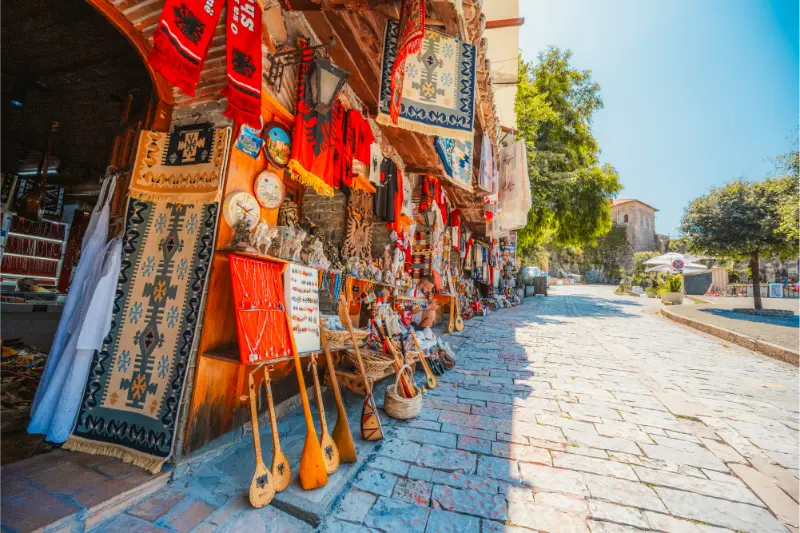
Krujë has one of Albania’s clearest self-guided routes: the Old Bazaar leads uphill to the castle, where the Skanderbeg Museum, traditional architecture and viewpoints sit inside one compact complex. Navigation is easy; the main decision is how much museum time to add.

The core route takes 2.5–3.5 hours depending on museums and uses compact but uphill on cobbled streets. The best timing is early morning or late afternoon outside the busiest day-trip period. The estimate does not include a long museum visit or a full restaurant meal.
Route at a glance
| Question | Answer |
|---|---|
| Core walking time | 2.5–3.5 hours depending on museums |
| Terrain | compact but uphill on cobbled streets |
| Best timing | early morning or late afternoon outside the busiest day-trip period |
| Navigation | Easy with an offline map |
| Best for | First-time visitors who want to understand the city at street level |
Before you start
Save the next few stops offline before leaving the hotel. A self-guided route is most enjoyable when you are not staring at the phone at every corner. Wear shoes that match the surface: polished stone, cobbles and steep castle lanes matter more than distance in several Albanian historic towns.
Treat the route as a framework rather than a contract. If one museum becomes unexpectedly interesting, stay longer and remove a weaker later stop. The aim is to understand the destination, not to complete a list.
Step-by-step walking route
1. Old Bazaar
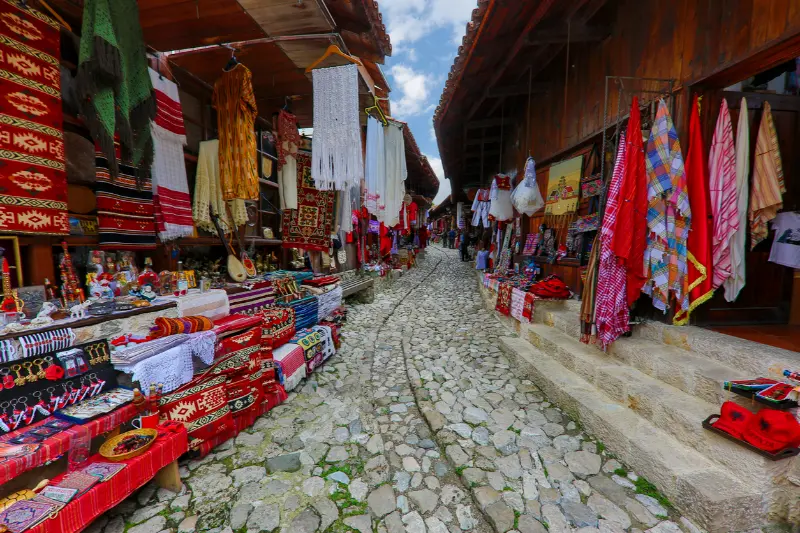
Begin on Krujë’s Old Bazaar. Walk through once without shopping so you understand the approach to the castle. Save purchases for the descent, when you no longer have to carry them through museums and uphill cobbles.
2. Castle entrance and first views
Continue to Krujë Castle. Pause near the entrance and look over the plain. The elevated position is central to the town’s strategic history and also explains why historic Krujë feels physically separate from the lower modern settlements.
3. Skanderbeg Museum
Visit the Skanderbeg Museum if Albanian national history is a priority. Give the narrative time rather than photographing only the building and leaving.
4. Castle lanes and houses
Walk through the inhabited and open sections of the castle complex. Krujë is not simply a museum precinct; the spaces between headline attractions preserve the scale of the old fortified settlement.

5. Ethnographic Museum
Add the Ethnographic Museum if crafts, household organization and traditional domestic life interest you. If you already spent a long time in the Skanderbeg Museum, another interior is optional.
6. Religious and historic elements
Look for the smaller surviving religious and historic structures inside the complex, including Bektashi heritage. Treat sacred places quietly rather than as decorative photo stops.
7. Western viewpoints
Move toward open edges of the castle for wide views across central Albania. On a clear day this is where the geography of the town becomes most memorable.
8. Return through the bazaar
Walk downhill and shop now. Compare several stalls before buying textiles, metalwork or antiques. The Albanian Handicrafts Guide helps explain the craft traditions you are likely to see.
Easier version
Use a taxi to the upper access area and walk mainly inside the castle, then descend through the bazaar. This removes most of the climb.
Short version
For about 90 minutes, walk the bazaar, enter the castle, choose one museum and finish at a viewpoint.
How to extend the walk
If you stay overnight, repeat the bazaar briefly early or late when day-trip traffic is lower. Qafë Shtamë and Lake Bovilla are separate excursions.
Where to stop for food and coffee
Eat after the castle rather than before the climb. Choose a current menu and recent reviews instead of relying on one fixed restaurant list.
Pacing the walk
A good rhythm is forty to sixty minutes of sightseeing followed by a short seated break. This is particularly important in summer and in steep towns. A ten-minute coffee or water stop often improves the final hour more than trying to walk continuously.
If you start later than planned, remove an indoor stop instead of speeding up every street. Museums can be visited another time; the atmosphere of a neighborhood is easy to miss when you are checking the clock every few minutes.
Heat, rain and seasonal adjustments
In July and August, exposed squares and castle approaches are much more comfortable early or late. Spring and autumn usually support a continuous half-day walk. After rain, polished stone and cobbles can become slippery, so reduce speed and avoid unnecessary shortcuts on stairs.
Winter walking is often excellent in year-round cities, but shorter daylight means I prefer to finish the route before dark unless the final section is a well-lit promenade or pedestrian center.
What to carry
- Comfortable shoes with grip.
- Water, especially from late spring through early autumn.
- Sun protection for exposed squares, castles and waterfronts.
- A light layer outside summer or when the route ends after sunset.
- Some Albanian lek for cafés, museums and small purchases.
- An offline map plus your accommodation address.
- A compact bag rather than heavy shopping or luggage.
Navigation strategy
I save only the next two stops rather than every turn. That leaves room to take a pleasant side street without feeling that I have gone off-plan. When a landmark is visible—a castle above you, a cathedral, the sea or a major square—I use the city itself for orientation before checking the phone again.
Avoid blindly following the shortest digital route if it sends you onto a traffic-heavy road or a very steep staircase. A slightly longer pedestrian street is usually the better travel experience.
Common mistakes
- Starting the hardest uphill section at midday in summer.
- Entering every museum simply because it appears on the route.
- Wearing smooth-soled city shoes on polished stone.
- Adding a distant viewpoint and turning a compact walk into a roadside hike.
- Shopping heavily at the beginning and carrying purchases for the rest of the route.
- Ignoring opening or worship conditions at religious buildings.
Photography without slowing the whole walk
Take one wide establishing frame, one detail and one second composition if the light is genuinely good, then keep moving. Repeating the same photo from ten nearby positions can turn a three-hour city walk into a full-day project for everyone traveling with you.
Early morning gives cleaner streets and softer light in historic centers; late afternoon is usually stronger for promenades and viewpoints. Inside museums and religious buildings, follow the local photography rules rather than assuming a phone camera is permitted.
Where to stay for this walk
For a short stay I prefer a walkable base so the route can begin at the hotel and end near dinner. Check current accommodation in Kruje on Booking.com.
Useful related guides
Frequently asked questions
Do I need a professional guide?
No for navigation. A professional guide can add historical depth, but the route is deliberately simple enough to follow independently.
Should I buy museum tickets in advance?
For ordinary city museums, check current official information close to your visit rather than assuming advance booking is required. Time-sensitive rules can change.
Can I do the walk with children?
Usually yes if you reduce museum time and choose the easier version in steep towns. Heat and cobbles often matter more than distance.
What if it rains?
Move an indoor stop earlier, shorten exposed sections and slow down on polished stone. Do not force a castle climb in slippery conditions simply because it was on the plan.
Can I split the route over two days?
Yes. A slower route often works better if you also want museums, shopping and long meals.
Final advice
The best self-guided walk keeps the interesting walking and removes the boring walking. Use a taxi when it eliminates an unpleasant hill or long traffic corridor, then spend the saved energy inside the historic center, on the promenade or at the viewpoint you actually came to see.
How to make the route feel less like a checklist
I leave one twenty- to thirty-minute block completely unassigned. It can become a café, a small side street, a bench, a shop or extra museum time. This unplanned block is often where the city starts to feel personal rather than pre-programmed.
I also decide in advance which stop I am willing to remove. That sounds negative, but it prevents the weakest attraction from controlling the pace of the entire day. If the weather is excellent, I usually protect outdoor streets and viewpoints; if it rains, I protect the best museum instead.
Arrival and departure logistics
Do not carry large luggage through the route. Leave bags at your hotel or a legitimate storage option and begin walking only after check-in logistics are solved. On departure day, finish the route with enough buffer to retrieve luggage without racing through traffic.
If you are moving to another city immediately afterwards, eat before the transfer or carry a simple snack. A delayed bus or road segment feels much less stressful when you are not trying to solve food, tickets and luggage at the same time.
Leave a Reply