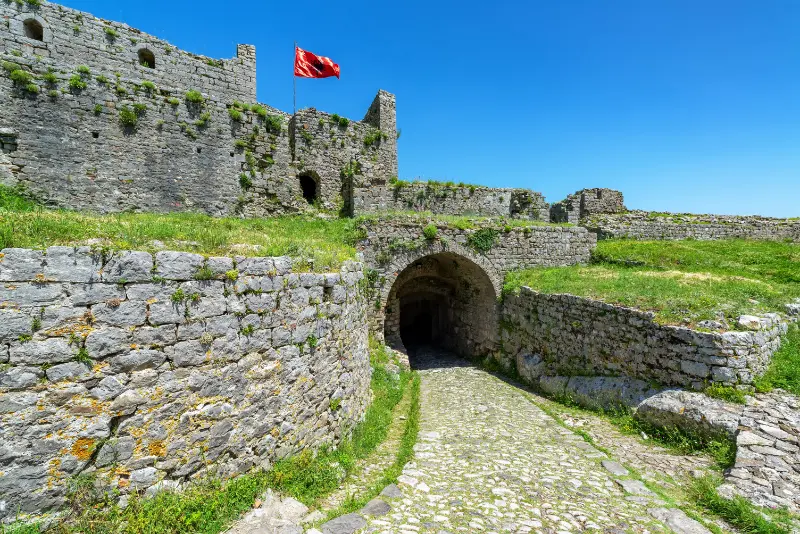
Rozafa Castle is the place where Shkoder’s geography and history become visible at the same time. The fortress rises on a rocky hill at the entrance to the city, above the meeting zone of rivers and within sight of Lake Shkodra. Even if you have already walked the pedestrian center, cycled toward Shiroke or used Shkoder only as a gateway to the Albanian Alps, the castle gives the wider landscape a logic that is difficult to understand from street level.
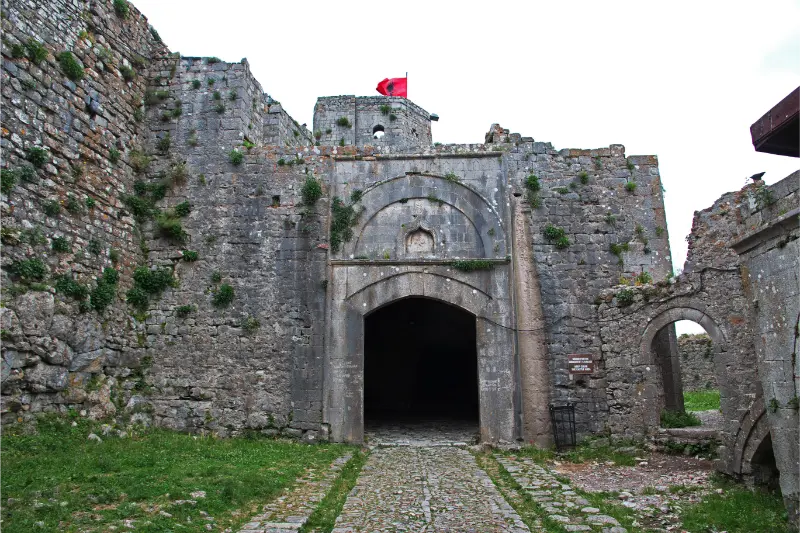
This is not a single-period monument. Illyrian origins sit beneath Roman, Byzantine, medieval, Venetian and Ottoman phases, while the famous legend of Rozafa gives the site a cultural life that is just as important as the masonry. The best visit therefore combines three things: the defensive architecture, the story of the city below and enough time on the viewpoints to understand why this hill controlled movement through northern Albania for centuries.
Albania’s official tourism portal is the main reference used for the core historical and location facts in this guide. I still recommend checking current opening hours, ticket prices, access rules and temporary restrictions close to your travel date, because operational details can change much faster than the monument or collection itself.
Why this place is worth adding to your Albania trip
Rozafa Castle Guide works best when you treat it as part of a larger journey through northern Albania, not as an isolated pin on a map. It adds a layer that broader destination guides can only summarize: a specific building, landscape, collection or historic episode becomes tangible when you stand in the place where it developed.
For me, the strongest visits in Shkoder are not built around the largest possible number of sights. They combine one major attraction with a slower neighborhood walk, food or a nearby landscape. That rhythm leaves enough time to notice details, read interpretation and understand how the site relates to the city instead of moving from photo to photo.
A useful rule in Albania is to separate map distance from real effort. Hilltop monuments, uneven historic streets, summer heat, parking, boat conditions or museum schedules can turn a short distance into a substantial part of the day. Leave a buffer in the itinerary and keep one secondary stop optional.
Historical and cultural context
The official tourism portal places the castle about 130 metres above sea level and describes an Illyrian origin followed by repeated reconstruction in later eras. Much of the form visible today reflects medieval and Venetian development, with Ottoman additions after the conquest. That layering matters because it explains why walls, gates, religious remains and domestic or military spaces do not all belong to one architectural moment.
Albanian heritage is rarely one-layered. Ancient, Byzantine, Ottoman, national, communist and contemporary histories often overlap within the same region. The most accurate way to visit is to ask what the site was originally created for, who adapted it later, what survived and how modern Albania chooses to preserve or interpret it now.
That approach also prevents a common travel mistake: forcing every place into a simple “ancient” or “Ottoman” label. Buildings are reused, collections are reorganized, legends coexist with archaeology and monuments acquire new meanings after political change. The complexity is part of what makes travel in Albania rewarding.
What to see and what to notice
The approach and monumental gates
Do not rush through the entrance. The sequence of walls and gates shows how the fortress used topography as part of its defence. Looking backward as you climb also reveals how quickly the city and river plain drop away beneath the hill.
Take a moment here before moving on. In a site like this, the most memorable detail is often not the headline feature but the relationship between material, landscape and human use. Looking from two or three angles usually reveals more than a quick front-facing photograph.
The panoramic river-and-lake viewpoints
The broadest views explain Rozafa better than any isolated ruin. From different edges of the complex you can pick out Shkoder, Lake Shkodra and the river system around the Buna and Drin. Morning clarity can be excellent, while late afternoon gives warmer light across the plain.

Take a moment here before moving on. In a site like this, the most memorable detail is often not the headline feature but the relationship between material, landscape and human use. Looking from two or three angles usually reveals more than a quick front-facing photograph.
The legend of Rozafa
The story of the woman immured in the walls is one of Albania’s best-known legends and is traditionally linked with sacrifice, family duty and besa, the keeping of one’s word. Treat it as folklore rather than literal archaeology, but do not dismiss it: the legend is central to the way the castle is remembered locally.
Take a moment here before moving on. In a site like this, the most memorable detail is often not the headline feature but the relationship between material, landscape and human use. Looking from two or three angles usually reveals more than a quick front-facing photograph.
Religious and military remains
Inside the walls, ruined religious structures and defensive spaces reveal the changing communities that controlled the fortress. Instead of trying to identify every stone without context, use the museum or interpretive material first, then return to the ruins with a clearer chronological framework.
Take a moment here before moving on. In a site like this, the most memorable detail is often not the headline feature but the relationship between material, landscape and human use. Looking from two or three angles usually reveals more than a quick front-facing photograph.
The castle museum
The museum inside the fortress adds objects, reproductions and historical context to what can otherwise feel like an enormous field of walls. Opening arrangements can change, so verify access on the day, but if it is open I would include it before leaving the complex.
Take a moment here before moving on. In a site like this, the most memorable detail is often not the headline feature but the relationship between material, landscape and human use. Looking from two or three angles usually reveals more than a quick front-facing photograph.
How to plan the visit
Start by checking the official source or local visitor information for current access. Do this even if a recent blog lists exact hours or prices. Albania’s visitor infrastructure is improving quickly, which is positive, but renovation work, seasonal schedules, religious services, weather and local events can all change what is available on a particular day.
If you are staying in Shkoder, place this attraction at the point of the day when its conditions make the most sense. Outdoor sites are usually easier in the morning or later afternoon, while museums can be valuable during midday heat or rain. Do not build the day around rigid ten-minute transfers; give yourself time for coffee, parking, walking and unexpected closures.
Carry some cash even if you normally pay by card. Larger museums and businesses increasingly accept electronic payments, but smaller ticket points, taxis, cafes or local services may still operate more smoothly with Albanian lek. Keep small denominations rather than relying on a large banknote for minor purchases.
Download an offline map before leaving reliable Wi-Fi. For urban museums this is simply convenient; for hilltop monuments, rural trails and boat departure points it can prevent wasted time. Save the official Albanian name as well as the English name because signs and local directions may use a spelling different from your travel app.
Terrain, accessibility and comfort
The site involves uphill access, uneven stone, exposed sections and stairs. Good footwear is more useful than formal city shoes, especially after rain. In summer there is limited shade on some exposed areas, so water, sun protection and a slower pace make a large difference.
Accessibility in Albania varies widely even between attractions in the same city. A modern museum may have lifts and level access while a nearby castle is almost entirely uneven stone. If step-free access, seating, toilets or accessible transport are essential, ask for current information directly rather than relying on a generic “accessible” label in an app.
Heat is another practical accessibility issue. Southern and coastal Albania can be intensely hot in July and August, while exposed castles and stone streets radiate heat. Water, a hat and deliberate breaks can make the difference between a meaningful visit and abandoning the site halfway through.
Best time of day and best season
Spring and autumn are the easiest seasons for a long visit because temperatures are milder. In summer, early morning or later afternoon is more comfortable and usually better for photography. Winter can be atmospheric, but wind and wet stone can make the exposed hill feel colder and more slippery than central Shkoder.
Weather should influence sequence, not just clothing. A cloudy morning may be perfect for museums and streets, leaving a clearer afternoon for viewpoints. Conversely, if mountain visibility or calm sea conditions are essential, move that activity to the best forecast window and let the more flexible cultural stop fill the rest of the day.
Photography and respectful visiting
Photography is most successful when it records context rather than only the obvious landmark. Include surrounding streets, topography, details of stone or wood, and the scale of people moving through the space when photography is permitted. Early and late light usually gives historic surfaces more texture than harsh midday sun.
Respect takes priority over the photograph. Do not climb fragile walls, step into restricted archaeological areas, block worshippers, use flash around sensitive artworks or fly a drone simply because no sign is immediately visible. Protected sites, museums, religious buildings and marine areas can have specific rules, and staff instructions always override a general travel tip.
How to combine it with the rest of Shkoder
Shkoder city guide: Use our Shkoder travel guide for the pedestrian center, museums, food and practical planning.
Marubi Museum: Pair the fortress with the Marubi Museum to connect the city’s ancient history with its extraordinary photographic archive.
Lake Shkodra: After the hill, continue to Shiroke or Zogaj for an evening beside Lake Shkodra.
Where to stay
Staying in or near Shkoder is usually the simplest choice if you want to visit without turning the day into a long transfer. Compare location before room size: a cheaper property far from the historic center can cost more in taxis and time than a slightly more expensive room within walking distance.
Check accommodation in Shkoder on Booking.com. I would filter first by location, recent guest reviews, parking if you are driving, air conditioning in summer and heating in winter, then compare cancellation terms rather than selecting only by headline price.
Common mistakes to avoid
- Relying on old opening hours. Verify the current schedule shortly before visiting, especially after renovations or during public holidays.
- Trying to fit too many major sights into one half-day. A slower visit produces a better understanding and leaves room for transport delays.
- Underestimating heat, stairs or uneven surfaces. Distance alone does not describe the physical effort of a historic Albanian site.
- Treating local legends as literal archaeology. Folklore is culturally important, but separate traditional stories from evidence-based history.
- Ignoring local etiquette. Museums, memorials, religious buildings and protected natural areas require different kinds of respectful behavior.
A practical half-day plan
Begin with a relaxed breakfast or coffee in Shkoder, then reach the site early enough that you are not watching the clock from the moment you arrive. Spend the first part of the visit on orientation: read the main interpretation, identify the landscape or gallery sequence and resist the urge to photograph everything immediately.

Use the middle of the visit for the details that interest you most. If you are traveling as a couple or family, it is perfectly reasonable for different people to spend different amounts of time in a gallery, viewpoint or ruin and meet again at a clear landmark. That is often more enjoyable than forcing everyone through the same checklist.
Afterward, choose one complementary stop rather than three unrelated attractions. A museum pairs well with a historic district, a castle with a city walk, and a coastal nature site with a relaxed meal. The connections in the section above are designed around that principle.
Finish with enough unstructured time for food, a promenade or a cafe. Some of the best travel memories in Albania come from the space between official sights, and a schedule that is full to the minute usually removes exactly that opportunity.
Frequently asked questions
Is Rozafa Castle worth visiting if I only have one day in Shkoder?
Yes. If your day is limited, I would prioritize the castle together with the historic center and one museum. The castle gives the clearest overview of the city’s geography and long history.
How long should I allow?
A rushed visit can be done in about an hour, but roughly 90 minutes to two hours is more realistic if you want the museum, viewpoints and time to read the site rather than simply photograph it.
Can I combine it with Lake Shkodra?
Yes. The castle and the lakeside complement each other well because the viewpoints help you understand the relationship between the city, rivers and lake before you continue toward Shiroke or Zogaj.
Do I need a guide?
Not necessarily, but a knowledgeable guide adds value because the fortress has many historical layers and the surviving structures are easier to understand with chronology and context.
Final thoughts
Rozafa Castle Guide is worth visiting because it gives a precise story within the much larger idea of “travel in Albania.” You are not simply collecting another attraction; you are seeing how geography, belief, engineering, art or political history shaped one particular place.
Plan with current information, allow more time than the map suggests and connect the visit with one nearby experience that adds context. That combination—specific history, realistic pacing and room for observation—is what turns a good Albania itinerary into a memorable one.
Leave a Reply