
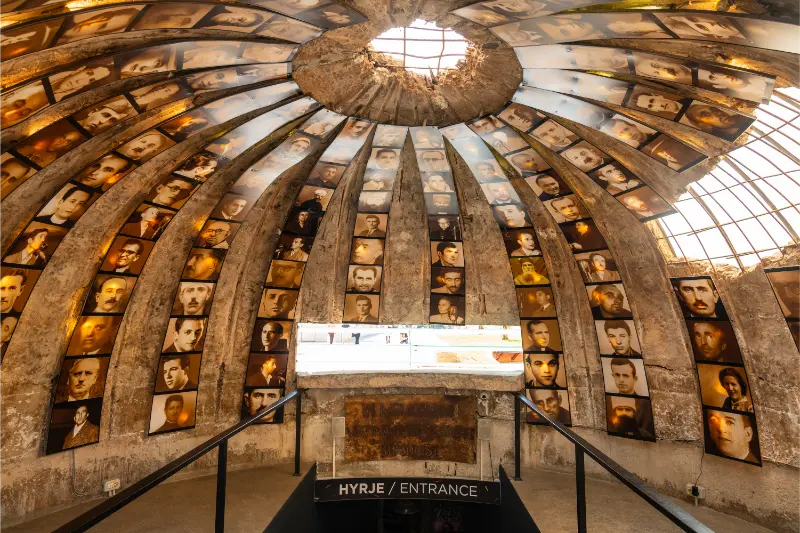
Bunk’Art 1 is not simply a bunker that has been opened to tourists. It is a museum built inside the enormous underground command shelter created for Albania’s communist leadership, now used to explain political, military and social history from the Second World War through the end of the communist period. Long corridors, command rooms and protected spaces make the architecture part of the exhibition. The official tourism portal highlights the museum’s focus on defence systems, surveillance, daily life and the isolation of the era, which is why a visit works best when you give yourself enough time to read rather than treating it as a quick photo stop.
Albania’s official tourism portal is the main official reference used for the core facts in this guide. I still recommend checking current opening arrangements, road access, weather or local restrictions shortly before travelling because those practical details can change.
Why this place deserves time in your Albania itinerary
Tirana can feel youthful, colourful and fast-moving, so Bunk’Art 1 provides important context for how recently Albania emerged from extreme political isolation. The scale of the shelter communicates fear and state priorities in a way that photographs cannot. It is especially valuable before visiting other communist-history sites because it gives you a framework for understanding bunkers, surveillance and the leadership’s obsession with external attack.
The most useful way to approach this destination is to decide what kind of experience you want before you arrive. A traveller interested in history will allocate time differently from a family, photographer or hiker. Albania rewards flexible planning: roads may be slower than expected, small museums can change hours, and the best local meal or conversation often happens when the schedule is not packed minute by minute.
How to get there and plan the access
Bunk’Art 1 lies on the eastern side of Tirana near the Dajti area rather than in the central museum cluster. Public transport, taxi or ride-hailing-style local services are more practical than walking from Skanderbeg Square. If you are also taking the Dajti cable car, the two experiences can fit naturally into the same side of the city. Check the museum’s current official information for opening times and ticket prices because those details can change.

I save the destination name and nearby village in both English and Albanian, keep the map available offline and carry some cash in lek. For rural sites, a current message from a guesthouse, museum or local operator is usually more reliable than a several-year-old driving time. If you are using public transport, confirm the final connection rather than assuming an intercity bus stops at the attraction itself.
What to see and do
Experience the scale of the bunker
The first impression is physical: concrete doors, deep corridors and room after room designed to keep a leadership structure functioning underground. Do not rush to the headline exhibits. The route itself explains how seriously the regime prepared for attack and how architecture can embody political fear.
Follow the historical sequence
Use the museum panels to connect wartime history, the establishment of communist rule, military strategy and later isolation. If you enter with only a vague knowledge of Enver Hoxha’s Albania, the chronological material helps prevent the bunker from becoming a theatrical backdrop detached from the people who lived through the period.
Look at command and leadership spaces
Rooms associated with political and military leadership reveal hierarchy inside the shelter. The contrast between protected command facilities and ordinary citizens’ experience is worth considering. Read labels carefully because replicas, restored rooms and original elements do not always communicate the same kind of evidence.
Pay attention to surveillance and daily life
The strongest museum visits are not only about weapons or fortifications. Displays on propaganda, control and everyday life show how political systems enter schools, workplaces, homes and private thought. This makes a useful bridge to the House of Leaves in central Tirana.
Leave time for the art installations
Bunk’Art combines historical interpretation with artistic installations. Some visitors prefer the archival material; others find the art helps them process the atmosphere. Treat the two as different forms of interpretation rather than expecting every room to function like a conventional historical museum.
A realistic plan for the visit
I would allow around two hours, longer if you read most panels. Go in the morning, then take a break outside before moving to Dajti or returning to central Tirana. Trying to visit Bunk’Art 1, Bunk’Art 2, House of Leaves and several national museums in one day usually leads to information fatigue. Split communist-history sites across two days if this subject is important to you.
I also build in a buffer of at least an hour on road-trip days. That margin covers parking, a slower final road, coffee, roadworks or simply spending longer somewhere that turns out to be better than expected. The mistake I see most often in Albania itineraries is not choosing the wrong place; it is trying to visit too many good places in one day.
Best time to go
Because most of the experience is underground, Bunk’Art 1 is useful in hot summer weather and on rainy days, although indoor conditions can feel cool compared with the street. Bring a light layer even in warm months. Weekdays and earlier hours may feel calmer than peak weekend periods.
Regardless of season, check the specific local forecast rather than relying on a national weather icon. Coastal wind, mountain storms, heat in archaeological sites and winter ice can all change the experience within a relatively small country. Daylight matters too: rural roads and unlit paths are much easier when you finish before dark.
Where to stay
Central Tirana is the most practical base; you can travel out to the museum and still have restaurants and evening life on foot afterward. Compare accommodation in Tirana.
When comparing accommodation, I look beyond the overall score. Check the most recent comments about access, parking, noise, heating or air conditioning, breakfast times and whether the property is actually in the place named in the listing. In rural areas, a beautiful guesthouse ten kilometres away may require far more driving than the distance suggests.
Food and local experience
Plan food before or after rather than assuming the museum itself will be your lunch stop. A café break is useful after a dense historical visit. Back in central Tirana, you can connect the subject of history with contemporary city life by eating in Blloku or around the centre, areas whose current energy strongly contrasts with their role during the communist era.
A few words of Albanian, patience and curiosity go a long way outside the largest resorts. Menus may be shorter, card payment less dependable and service more informal, but that is often where the trip becomes personal. If you have allergies or strict dietary requirements, communicate them clearly and early rather than assuming a dish is prepared the same way everywhere.
Photography without losing the experience
Photography policies can change by exhibition space, so follow museum signs. Even where photographs are allowed, avoid turning sensitive material about imprisonment, surveillance or victims into playful social-media props. Wide corridor shots can show the architecture without photographing other visitors at close range.
I try to take a few deliberate photographs, then put the camera away for part of the visit. Ask before photographing people closely, respect signs in museums and religious buildings, and never cross a barrier or damage vegetation for a cleaner frame. A photograph that includes context usually tells more of Albania than an isolated “perfect” view.
Families, older travellers and accessibility
Older children and teenagers studying twentieth-century history may find the museum valuable, but some content can be emotionally heavy. Parents should preview the subject matter and decide what level of detail is appropriate. The long underground route can also feel enclosed for visitors who dislike confined spaces.
Accessibility varies enormously. Historic stone, village lanes, archaeological ground and natural trails may have steps or rough surfaces even when the distance is short. If step-free access is essential, contact the site or accommodation directly. For older travellers, a private driver can be a worthwhile comfort upgrade because it removes parking stress and allows the day to adapt to energy levels.
Safety and responsible travel
The main practical considerations are enclosed underground spaces, stairs, cool temperatures and the emotional intensity of the subject. Follow the marked route and staff instructions. If you experience claustrophobia, ask about exits or shorter routes before beginning rather than pushing through discomfort.
Responsible travel here is mostly practical common sense: use marked or established routes, do not remove archaeological or natural material, keep noise low near homes and religious sites, and take rubbish away. In protected landscapes, avoid fires and respect any temporary closures. In historic places associated with suffering, responsible travel also means treating memory and testimony with dignity.
How to combine it with a wider Albania trip
Read our communist history in Albania guide, then pair Bunk’Art 1 with Tirana. Visit the House of Leaves on a different half-day if possible; seeing both museums with time to reflect produces a much clearer understanding than collecting them as fast attractions.

Regional clustering is usually more satisfying than zigzagging across the country. I prefer two or three nights in one area with one major day and one lighter day. That leaves room for weather changes and for the spontaneous village, viewpoint or meal that would otherwise be skipped because a rigid itinerary says you must be somewhere else.
Practical checklist before you leave
- Check access: confirm opening status, road condition or trail information close to the date.
- Carry cash: small businesses, parking and rural services may not accept cards.
- Download maps: save the destination and return route for offline use.
- Dress for the place: comfortable shoes, sun protection and a light layer cover most situations.
- Bring water: never assume a spring, café or shop will be open.
- Protect daylight: leave enough time for the return, especially on secondary roads.
- Respect people and heritage: ask before photographing, follow barriers and leave objects where they are.
- Stay flexible: weather, traffic and local arrangements can change the best plan.
Final thoughts
The strongest Albania trips are rarely the ones with the highest number of stops. Give this place enough time to understand why it matters, verify the few details that can change, and connect it to the wider region rather than treating it as an isolated pin. That slower approach is more useful for travellers and more respectful to the communities, landscapes and heritage that make the destination worth visiting.
Leave a Reply