
If you are driving in Albania, parking in Tirana deserves more planning than it usually gets. Parking rules are becoming more structured in the country’s busiest destinations, but the experience still changes sharply from one city to another. Historic centers, beach roads, hotel garages and municipal spaces can all operate differently, especially in July and August.
Tirana is the Albanian city where I would most readily leave the car parked for an entire day. The center is compact enough for walking, taxis and city buses, while driving between Blloku, Skanderbeg Square and the New Bazaar can consume more time than it saves. If the hotel has secure parking, treat that space as part of the room value. This guide focuses on the practical decisions that save time: where to aim first, when a hotel parking space is worth paying for, how to read local restrictions, what changes in summer and when it is smarter to leave the car parked and continue on foot. I checked the municipal information referenced here on September 21, 2026, but signs on the street and instructions from the parking operator always take priority because local rules can change.
Tirana parking at a glance
| Question | Practical answer |
|---|---|
| Best overall strategy | Park legally once, then walk or use a short taxi for the compact sightseeing area whenever possible. |
| Best choice for an overnight stay | A hotel with confirmed on-site or reserved parking, especially in summer. |
| Should I rely on free street parking? | No. Free spaces exist, but availability and legality vary block by block and season by season. |
| Cash or card? | Carry some Albanian lek. Payment systems vary between municipal spaces, private lots and hotel parking. |
| What should I re-check? | Current signs, hours, payment instructions, overnight rules and whether your exact vehicle fits the space. |
Is a car useful in Tirana?
A rental car can be extremely useful for reaching Tirana, continuing to another region and visiting places that are awkward by bus. It is much less useful for moving a few hundred meters between central attractions. A common first-time mistake is to treat the car as the default transport for every meal, viewpoint and museum. In compact Albanian destinations, repeated parking searches can consume more holiday time than walking.

For the wider transport decision, compare this guide with my guide to renting a car in Albania and Getting Around Albania. If your itinerary is mostly Tirana plus easy bus connections, a car may not be essential every day. If you are building a regional road trip, parking becomes part of the hotel and route-planning decision rather than an afterthought.
Where to park in Tirana
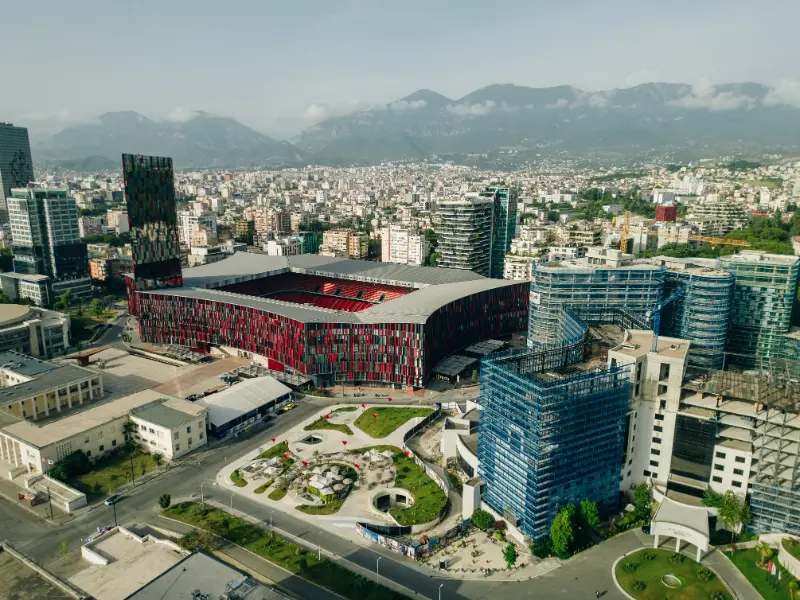
For sightseeing, a garage or legal paid space on the edge of the central core is usually more efficient than circling the blocks immediately around Skanderbeg Square. Blloku and the stadium area become busy in the evening, while streets close to offices fill quickly on weekdays. The Grand Park area also attracts heavy leisure traffic on good-weather afternoons.
The best space is not always the closest space. I prefer a legal parking area that allows a simple exit over a curbside gap that requires reversing into traffic or climbing a difficult street. In Tirana, save the parking pin before you drive into the busiest zone. If your first choice is full, having a second legal option already marked prevents the stressful loop of circling one block repeatedly.
Current municipal parking rules and paid areas
Tirana Municipality currently publishes three street-parking tariff zones: Zone A at 100 ALL per hour, Zone B at 40 ALL per hour and Zone C at 20 ALL per hour. The municipal service also lists SMS payment to 50500 and the Tirana Ime app. For current information, the most useful official reference is the Tirana Municipality paid-parking service.
I do not recommend building a trip around a parking price copied from an old forum or map review. Municipal tariffs, payment methods, seasonal zones and enforcement can change. When you arrive, read the sign at the exact space: it should tell you whether the area is paid, the relevant hours and how payment is handled. If the instructions are unclear, use a managed lot or ask your hotel rather than guessing.
Street parking: how to decide whether a space is legal
Do not read an empty curb as permission to park. Bus stops, driveways, reserved spaces, taxi stands, disabled spaces and signed no-parking areas are enforced independently of whether other cars are stopped nearby. In the center, road design and one-way systems can make it difficult to return to a space after a wrong turn. The safest visual clues are proper bay markings, municipal signs and clearly managed parking areas. Never assume that a line of parked cars proves that the space is legal. Local drivers may be stopping briefly, using resident permissions or simply taking a risk that you do not want with a rental vehicle.
Keep junctions, pedestrian crossings, ramps, fire access and driveways clear. Do not use disabled spaces without the required authorization. If a sign contains Albanian wording you do not understand, translate it before leaving the car. A thirty-second translation is cheaper than a tow, clamp or parking fine.
Hotel parking: what to ask before booking
If you are staying in the center for two or three nights, prioritize a hotel that explicitly confirms on-site or reserved parking. ‘Parking available nearby’ can mean a public garage rather than a private space. Ask whether the space is guaranteed, whether there is a height limit, and whether you can leave and re-enter during the day.
- Is the parking space guaranteed for every night of my reservation?
- Is it on the property, in a private lot, in a garage or simply on the public street?
- Is there an extra daily fee?
- Can I enter and leave at any hour?
- Is there a height, width or vehicle-size limit?
- Will I need to leave the car keys with reception or a parking attendant?
For a road trip, these questions can matter more than being 300 meters closer to the center. You can compare accommodation in Tirana on Booking.com and then confirm the parking arrangement directly with the property before arrival. This is a sponsored link.
Historic center and pedestrian areas
Tirana has areas where walking is part of the experience. Even when a road is technically open to traffic, historic streets can be narrow, crowded or unpleasant for a visitor in an unfamiliar rental car. The practical goal is to stop before the difficult part, not to reach the door of every attraction.
Use the Tirana travel guide to understand which sights cluster together. Once you see that several attractions lie within the same walkable area, parking once becomes the obvious choice. This also reduces the risk of entering a pedestrian zone or getting trapped in a one-way street system.
Arriving with luggage
If you are checking into a hotel in Tirana, do not automatically unload in the middle of a narrow street. Ask the property for the correct arrival procedure before you reach the center. Some hotels prefer that you stop briefly at a specific point, unload, and then move the vehicle to a garage or lot. Others can direct you to an access route that navigation apps do not choose well.
Keep valuables, passports, medication and electronics with you while unloading. Do not leave visible bags in the passenger compartment simply because the stop will be short. The main risk is ordinary opportunistic theft rather than a destination-specific danger, and the easiest prevention is a car that looks empty.
Summer parking and peak-hour strategy
Parking pressure in Tirana is not constant throughout the year. Summer weekends, public holidays and late-afternoon leisure traffic can turn an easy spring parking area into a slow search. If you are visiting a beach, castle, promenade or old town, arriving before the main day-trip wave gives you more choice and a less stressful exit.
On very busy days, I would rather pay for a legal managed space than spend forty minutes searching for a free one. The real cost of free parking is sometimes fuel, time and frustration. If you have a timed ferry, tour, restaurant reservation or flight later in the day, use the option with the most predictable exit.
Night parking and leaving a rental car overnight
For overnight parking, security and legality matter more than saving a small fee. Remove luggage, passports and shopping from view. Close windows fully and check the vehicle manually after locking it. If the hotel offers controlled parking, I usually consider that a meaningful benefit on a road trip.
Read rental terms about keys, damage reporting and towing. If the vehicle is moved or damaged while parked, photograph the position, surroundings and any marks before driving away. For minor issues, contact the rental company according to its instructions rather than arranging repairs independently.
Families, strollers and travelers with limited mobility
The closest legal parking space can be worth more when traveling with a stroller, young children, an older relative or limited mobility. Cobblestones, steep streets and summer heat change the practical walking distance. If step-free access matters, contact the attraction or hotel directly and ask about the route from the parking area, not only whether a parking space exists.
When traveling with children, unload on the pavement side whenever possible and keep them away from moving traffic while luggage is being removed. In a busy beach or old-town car park, agree on a meeting point before everyone disperses. These small habits matter more than complicated parking tricks.
Parking a rental car safely
- Photograph the vehicle at pickup, including wheels and lower bumpers.
- Keep the rental contract and roadside-assistance number accessible offline.
- Use a space with enough clearance rather than squeezing between vehicles.
- Fold mirrors only when appropriate and never leave bags visible.
- Check signs again before leaving the car overnight.
- If crossing a border later, keep vehicle authorization and insurance documents with you rather than hidden in unattended luggage.
When I would leave the car parked in Tirana
Tirana is also the place where a rental car can become unnecessary between arrival and departure. If your Albania road trip starts with two nights in the capital, consider collecting the car only when you leave for Berat, Shkodër or the coast. That can save parking fees, reduce city-driving stress and shorten the rental period.
A good road trip has deliberate no-driving periods. They reduce fatigue, simplify meals and let you enjoy a glass of wine without thinking about the vehicle. If the next destination is not until tomorrow, there is usually no reason to move the car after check-in unless the sight you want is genuinely outside walking or taxi range.
Common parking mistakes to avoid
- Assuming that other parked cars prove a space is legal.
- Booking a central hotel without asking what “parking available” actually means.
- Driving into a historic lane because navigation shows it as a road.
- Leaving luggage visible while sightseeing.
- Expecting peak-August parking conditions to match reviews written in April.
- Ignoring payment instructions because the stay will be “only ten minutes.”
- Planning a zero-margin connection after parking in a crowded center.
A simple parking checklist
- Save your hotel and first-choice parking pins before driving into the center.
- Check current municipal signs and payment instructions on arrival.
- Park fully inside a legal bay and leave access points clear.
- Photograph the parked location if the streets are unfamiliar.
- Remove valuables and travel documents from view.
- Confirm the closing time if using a private garage or lot.
- Before departure, allow extra time to retrieve the vehicle and exit city traffic.
Tours and activities after you park
Once the car is parked, fixed-location sightseeing becomes much easier. I would schedule the first paid activity with enough margin to walk from the parking area rather than choosing a start time that depends on finding a perfect curb space. The widget below is useful for comparing bookable experiences in and around Tirana.
Frequently asked questions
Is parking in Tirana free?
Both free and paid parking can exist in and around Tirana, but the exact rules depend on the street, lot and season. Use the sign at the space as the authority and do not assume that an unmarked-looking curb is free.
Can I pay by card?
Sometimes, but not everywhere. Municipal systems, private lots and hotel garages can use different methods. Carry a small amount of Albanian lek even if you normally pay by card.
Is it safe to leave luggage in the car?
I would not leave visible luggage in any tourist destination. Put bags in the hotel or keep them out of sight before arriving at the parking area, so nobody sees you moving valuables into the trunk.
Should I book a hotel with parking?
If you are visiting Tirana with a rental car in summer, yes, I would give confirmed hotel parking significant weight. It removes one of the least enjoyable parts of arriving in a busy destination.
Can I park in the historic center?
Access varies. Some streets are pedestrian, restricted, narrow or unsuitable for visitor parking. Stop at a legal outer parking area unless your hotel gives you precise access instructions.
What if I cannot understand the parking sign?
Use phone translation, ask a parking attendant or move to a clearly managed lot. Guessing is rarely worth the risk of a fine or tow.
Final planning advice
The easiest way to handle parking in Tirana is to make it part of the itinerary before you arrive. Choose the hotel with the car in mind, save one or two legal parking options, read the current signs and then leave the vehicle alone while you explore the compact center. A car should give you freedom between Albanian destinations, not become a problem you solve every hour.
Travelling with a motorhome or campervan? Read Campervan & Camping in Tirana: Parking, Campsites, Dajti and Road-Trip Planning for overnight strategy, parking, road access, water/waste planning and protected-area camping rules.